Englishen

    The Mental Waves foundations · Brainwaves

    Brainwave Frequencies: Delta, Theta, Alpha, Beta and Gamma

    Your mind has different rhythms. Understanding them opens a more practical question: how can sound help you move towards the calm, concentration or inner exploration you are looking for?

    You finish your day, sit down and finally have a little time to yourself. Yet your mind is still working. A conversation comes back. Tomorrow's tasks begin to line up. Your body has stopped; your attention is still moving.

    Now think of another familiar moment: you become absorbed in a piece of music, an image or a quiet landscape. Your experience changes. There is less effort, a different quality of attention, perhaps a feeling of space.

    These changes in our inner state are at the heart of my work with Mental Waves. I create sound programmes to accompany the movement towards relaxation, sustained concentration, meditation and a deeper connection with yourself. To understand how I approach that work, let us begin with the brain's own rhythms.

    What are brainwave frequencies?

    Brainwaves are patterns in the electrical activity of the brain. Their frequency tells us how quickly a pattern repeats. One hertz, written Hz, means one cycle per second.

    The five best-known families are Delta, Theta, Alpha, Beta and Gamma. We use their names to describe different parts of the brain's electrical spectrum, from very slow rhythms associated with deep sleep to faster activity involved in waking attention and information processing.

    An electroencephalogram, or EEG, records this electrical activity through electrodes placed on the scalp. It gives us a way of studying the rhythms that accompany changes in alertness, sleep and mental activity.

    Your brain is an orchestra: several rhythms are present together, and their balance changes with the moment.

    This is an important point: we are never simply in one wave. Think of the controls on an equaliser: different frequencies are present, while some become more prominent. When we speak about an Alpha or Theta state, we are using a practical shorthand for a much richer activity.

    Brainwave frequency chart: the five main families

    Here is a simple map before we explore the experience behind each name. Frequency boundaries are approximate and vary between references.

    Brainwave familyApproximate rangeCommon EEG contextListening intention in my work
    Delta0.5–4 HzDeep non-REM sleepDeep relaxation, rest and preparation for sleep
    Theta4–8 HzDrowsiness and the transition towards sleepMeditation, imagery and inward exploration
    Alpha8–13 HzRelaxed wakefulness, particularly with the eyes closedLetting go, visualisation and calm presence
    Beta13–30 HzWaking cognitive and sensorimotor activityConcentration, alertness and engagement
    GammaAbove 30 HzFast activity studied in perception, attention and memoryFocused exploration and mentally demanding activity

    The last column describes the direction of the listening experience. A frequency label alone does not tell us what an individual listener's EEG will show.

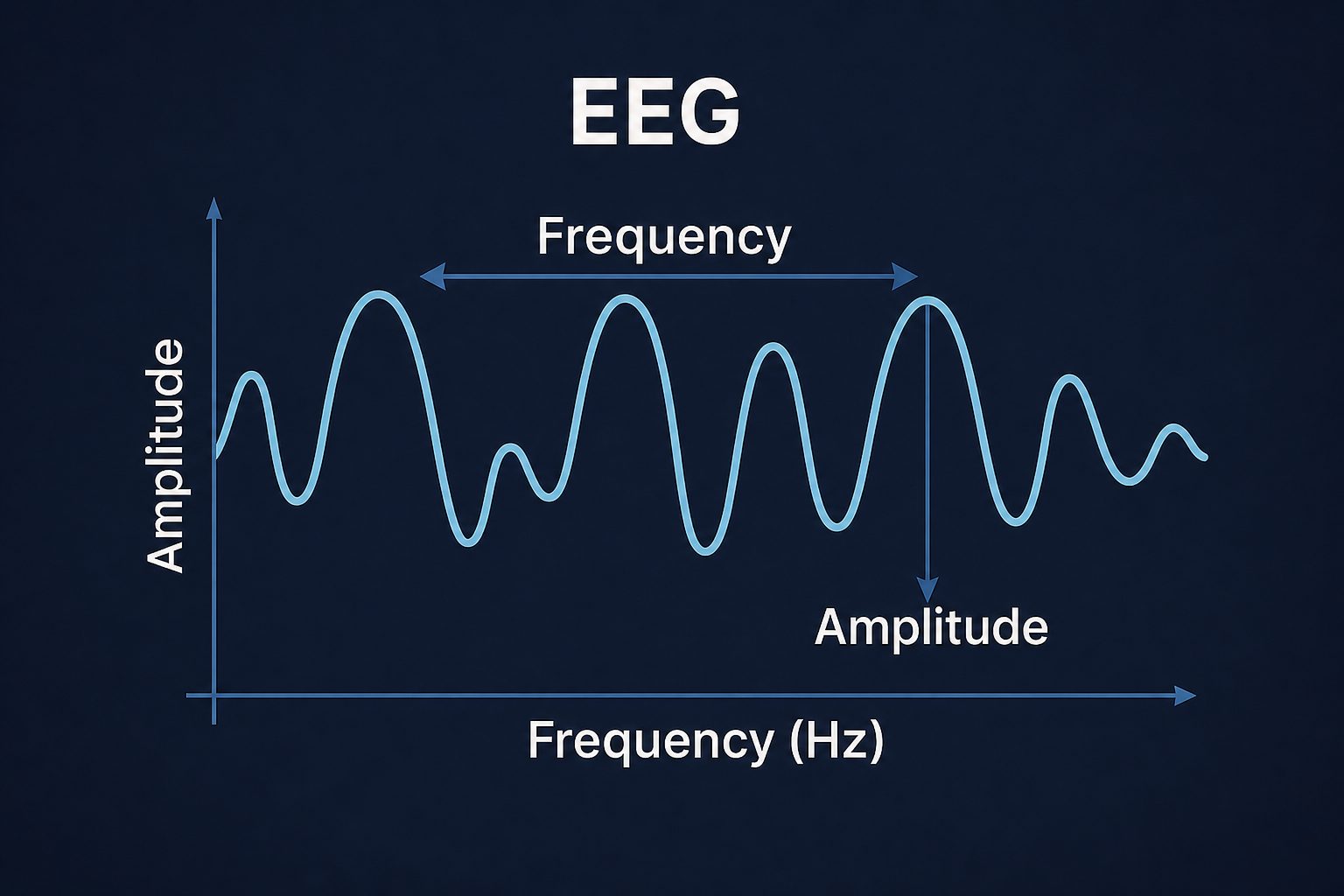
    Illustration of frequency and amplitude in an EEG waveform
    Frequency describes the pace of a rhythm; amplitude describes the size of the recorded signal.

    Pillar pages

    Navigate the Mental Waves foundations

    Follow the full path from sound and resonance to visible vibration, body-brain interaction, brainwave states and the technology behind Mental Waves sessions.

    Delta: make room for deep rest

    Delta belongs to the slow end of this map. Slow-wave activity is a defining feature of deep non-REM sleep, a stage within the body's natural cycle of rest and recovery.

    For listening, the desire is often very simple: to leave behind the pace of the day and give yourself permission to settle. This is why I work with gradual transitions. A person arriving with a busy mind needs a path into a slower experience.

    A Delta-oriented session is designed around that movement towards deep relaxation and rest. Choose a time when you can remain comfortably still, with enough space for the whole listening experience. You can explore the sleep and evening-listening collection for programmes created with this intention.

    Theta: the threshold of the inner world

    You may recognise the moment just before sleep when images begin to appear and ordinary thinking becomes less insistent. You are still aware, yet your relationship with what is happening inside has changed.

    I call this the twilight state. It is central to the way I explain Theta: a passage towards imagery, meditation and a more inward quality of attention.

    In my approach, Theta-oriented sound is designed to make that exploration more accessible, allowing room for imagination, intuitive impressions and what I describe as listening to your inner guide. You bring your own experience to that space.

    For the relationship with meditation, continue with Brainwave Frequencies and Meditation. If your interest is dream awareness, explore our guide to lucid dreaming.

    Alpha: relaxed, awake and receptive

    Alpha is often the most familiar starting point. Imagine sitting comfortably after a demanding day: your eyes close, your shoulders ease and you begin to feel present again.

    Alpha rhythms are commonly prominent during relaxed, eyes-closed wakefulness. In my work, this is a useful direction for letting go, visualisation, creative receptivity and a calmer relationship with your thoughts.

    It is also an inviting place to begin when you find meditation difficult. Rather than making quietness another task to achieve, you give attention a sound environment to follow. You can remain awake and available while the pace becomes gentler.

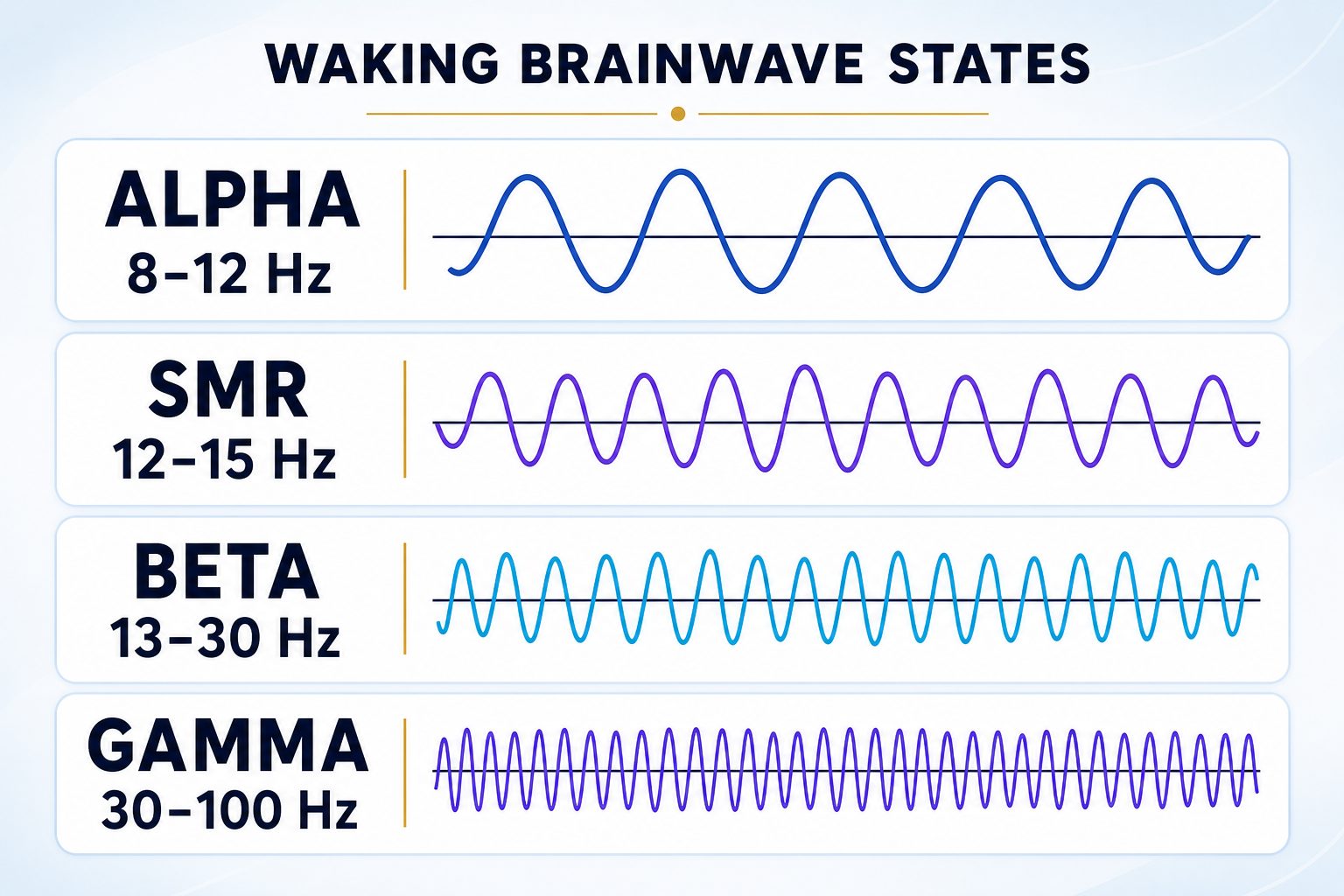
    Illustration comparing Alpha, SMR, Beta and Gamma rhythms
    A changing balance of rhythms accompanies our movement between relaxed attention and active engagement.

    Beta: bring attention into the task

    Listening to an explanation, following a conversation, solving a problem: waking life asks us to direct attention towards the world. Beta activity forms part of that everyday picture.

    The useful question is how to stay engaged without feeling pulled in every direction. In Beta-oriented programmes, my intention is to support concentration, alertness and a more sustained relationship with the task in front of you.

    Choose your listening context accordingly. A composition for focused work and a composition for winding down serve different moments. The name of a wave becomes useful when it helps you make that choice.

    Gamma: explore a more focused quality of attention

    Gamma describes faster electrical activity studied in relation to perception, attention and memory. Researchers examine how these rhythms participate in the coordination of information across neural systems.

    In my sound work, Gamma is associated with a more concentrated, mentally engaged direction: following a complex idea, exploring a subject deeply or giving a demanding activity your full attention.

    Keep the question personal and practical. Is this the kind of sound environment that helps you remain with what you are doing? Does it suit the energy you have today? That relationship matters more than chasing the highest number on the chart.

    How do I work with brainwaves through sound?

    After hearing about these different rhythms, you might ask: how do we move towards the state we want? How can we concentrate for longer, relax more deeply or enter meditation more easily?

    My work uses rhythmic sound stimulation within a composed musical journey to help guide that transition. This approach is commonly discussed as brainwave entrainment. Pulses, modulation, harmonic layers and the development of the piece all contribute to the direction of the session.

    Take a simple binaural example: a tone at 313 Hz reaches one ear and a tone at 323 Hz reaches the other. Their difference is 10 Hz. The audible tones and the beat rate have different roles. Here, the 10 Hz beat rate is the Alpha-range target; it is not the pitch of the music.

    Isochronic sound uses a regular pulse. In my own technology, NeuralTrim, I bring rhythmic and sound-design processes together within a more developed composition. The objective is to help you reach the intended state more easily and stay with the experience for longer.

    The importance of the progression

    This is one of the points I insist on when explaining how I create my audios: the journey matters. For a session directed towards deep rest, I work with ramps — a gradual progression from a waking rhythm towards a slower, more inward experience.

    The opening, the transitions and the ending all have a role. The recording gives you something to follow through time. That is why I pay attention to the whole composition and the quality of the supplied audio, alongside its frequency references.

    You can explore this further in the Mental Waves sound technology guide and our explanation of brainwave synchronization.

    Where should you begin?

    Begin with the moment you are actually living. You may want a calmer mind, time for contemplation, a deeper listening experience or help staying with a piece of work.

    1. Choose one intention. Relaxation, meditation, concentration or preparation for rest.
    2. Choose the programme that fits. Follow its listening instructions and allow time for its progression.
    3. Make yourself comfortable. Begin at a low, comfortable volume. Classical binaural recordings require headphones; other recordings may support speakers. Check the specific programme.
    4. Give the experience your attention. Let the piece unfold, then notice how you feel before returning to the next task.

    Keep sleep and deep-relaxation sessions for a setting where you can rest safely. Stop if the sound becomes uncomfortable.

    Explore the Mental Waves brainwave listening collection and choose the experience that answers the moment. Calm, concentration and inner exploration each deserve their own place.

    Questions about brainwave frequencies

    What are the five main brainwave frequencies?

    The five best-known families are Delta, Theta, Alpha, Beta and Gamma. They cover different parts of the electrical spectrum measured by EEG. This guide gives approximate ranges and explains the listening intentions I associate with them.

    Can Alpha and Theta occur at the same time?

    Yes. Several rhythms coexist. When I talk about moving towards an Alpha or Theta state, I am describing a changing balance and a direction for the listening experience.

    Which brainwave range should I choose for meditation?

    In my approach, Alpha is an accessible direction for relaxed wakefulness and visualisation, while Theta is associated with deeper inward attention and imagery. Start with the programme's intention and your comfort.

    Is a 432 Hz tone an Alpha brainwave?

    No. A reference such as 432 Hz may describe an audible tone or musical tuning. Alpha describes much slower electrical rhythms. A composition can combine a tuning choice with a separate rhythmic design.

    Does listening to a beat prove that my brain is in that state?

    An auditory response and a whole listening experience are different things. EEG interpretation depends on the recording and its context. Research on auditory stimulation also reports varied results. The programme's intention helps you choose a session; your experience remains individual.

    A few reference points

    For EEG background, see The Normal EEG. For research specifically on binaural stimulation, this systematic review of binaural beats and brainwave entrainment discusses the varied experimental findings; it is not a trial of NeuralTrim.

    Mental Waves offers sound experiences for wellbeing, relaxation and personal exploration. It does not replace professional medical care. Experiences vary from one listener to another.

    From explanation to experience

    Explore a brainwave-oriented listening experience

    Choose by context—such as meditation, alert listening or winding down—and approach the session as structured audio rather than a guaranteed neurological result.

    Explore Infinity Waves
    lockpower-switchmagnifycross linkedin facebook pinterest youtube rss twitter instagram facebook-blank rss-blank linkedin-blank pinterest youtube twitter instagram