Englishen

    Foundation guide

    Cymatics: The Science of Sound Made Visible

    Cymatics reveals something both simple and astonishing: sound is not only heard. Under the right conditions, vibration can organize sand, water and matter into visible geometric patterns. This page explores how sound becomes form, from Chladni figures and Hans Jenny’s experiments to water patterns, living structures and the symbolic bridge between science and inner experience.

    Visible vibration

    What is cymatics?

    Cymatics is the study of the shapes and patterns created when sound vibrations move through matter.

    The word comes from the Greek kyma, meaning wave. In practice, cymatic experiments use materials such as sand, powder, water or viscous fluids placed on a vibrating surface. When the sound changes, the pattern changes too. The result is not random decoration: it is a visible trace of vibration.

    This makes cymatics one of the most striking ways to understand sound. It gives the eye access to what the ear normally receives invisibly: frequency, rhythm, resonance and structure.

    A simple experiment can already reveal the principle. Fine sand is placed on a metal plate. When the plate vibrates, the grains move away from the most active zones and gather along calmer lines. A geometric pattern appears. Change the tone, and the entire pattern reorganizes.

    This is why cymatics is so important for the Mental Waves foundation path. After understanding that the body resonates with sound, we now see that vibration can also produce visible form.
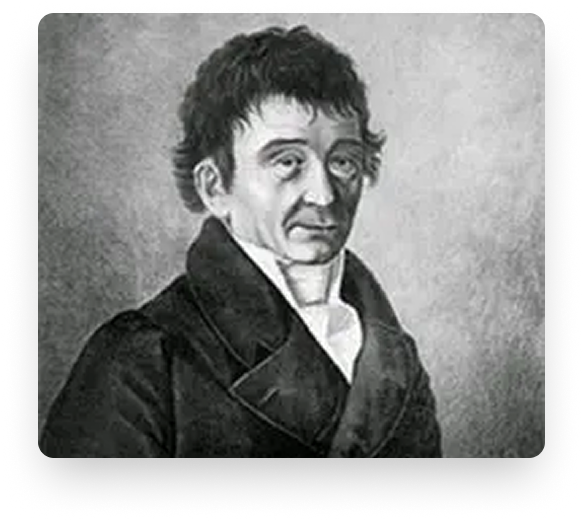
    Chladni figures created by sound vibration
    Chladni figures made sound visible for the first time in a clear, reproducible way.

    How it works

    Sound can organize matter into precise patterns

    The core principle is simple: sound creates movement, and matter responds to that movement. In cymatic experiments, the response becomes visible.

    One frequency, one form

    Change the frequency, and the visible structure changes with it.

    Growing complexity

    Higher frequencies often produce more detailed and intricate structures.

    Repeatable signatures

    Under the same conditions, the same tone can reproduce a similar pattern.

    Water as a medium

    In water, vibration becomes fluid, dynamic and especially revealing.

    Pioneers

    From Chladni figures to modern cymatics

    In the 18th century, the German physicist and musician Ernst Chladni demonstrated that vibration could organize sand into precise geometric figures. By drawing a violin bow across a metal plate covered with sand, he revealed the first clear visual signatures of sound.

    Nearly two centuries later, Swiss physician and researcher Hans Jenny expanded this work with electronic oscillators, powders, liquids and high-speed observation. He named the field cymatics and showed that vibration, form and motion were inseparable.

    Together, their work established a central insight: sound is not only an auditory event. It is a structuring force.

    Chladni figures

    Sand reveals the silent geometry of vibration on a resonating plate.

    Hans Jenny

    Jenny used modern instruments to study the relationship between sound, matter and dynamic form.

    Frequency and amplitude

    The shape depends on the vibration applied, the medium used and the conditions of the experiment.

    Interpreting the patterns

    Cymatics reveals how vibration organizes matter when frequency, medium, intensity and experimental conditions interact.

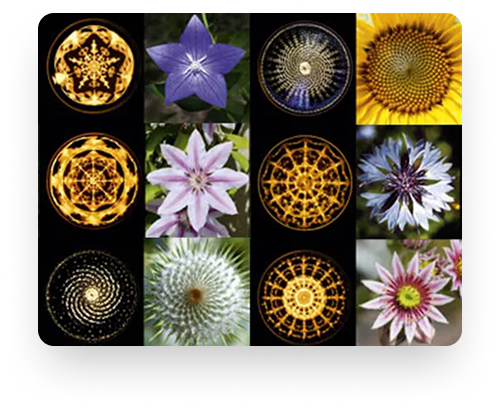
    Comparison between cymatic shapes and natural forms
    Cymatic forms often echo structures found in nature: spirals, petals, cellular forms and radial symmetries.

    Nature and water

    From water patterns to living forms

    Water is one of the most expressive media for making sound visible. A frequency can create ripples, circles, hexagons, spirals or mandala-like structures on its surface.

    This matters because the body is largely fluid. Cymatics offers a vivid visual language for considering how living matter responds to vibration. Sound is not detached from biology; it enters a field of membranes, fluids, tissues and rhythms.

    The similarity between some cymatic patterns and natural forms also invites reflection. Flowers, shells, honeycombs, cellular structures and neural networks all reveal patterns of organization. Cymatics suggests that vibration may be one of the deep languages through which form emerges.

    This is why cymatics sits at the crossroads of physics, biology, art and philosophy: it shows an order that is not imposed from outside, but that appears from within the movement itself.

    Modern visualization

    CymaScope: when technology reveals the invisible

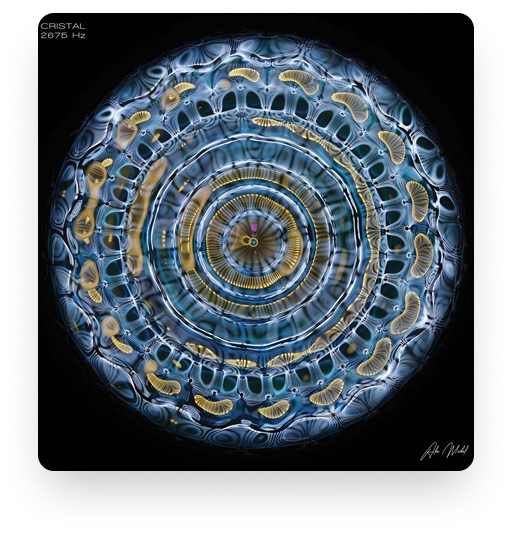
    Modern instruments such as the CymaScope allow researchers and artists to visualize sound patterns in water with much greater precision.

    The principle is simple in appearance: a sound wave is transmitted into a sensitive liquid medium, and the movement of the surface is captured as a visual form. Each sound has its own geometric signature, almost like a visual fingerprint.

    These images make the invisible more tangible. Listening becomes seeing. A tone, a voice, a vowel or a musical note can be observed as movement, pressure and geometry. This does not replace hearing; it expands our understanding of what sound is doing.

    You can learn more about the instrument at CymaScope.com.

    Sound, language and meaning

    Ancient languages and sacred vibratory forms

    Some of the most intriguing claims around cymatics concern spoken vowels and ancient sacred languages. Researchers have explored whether certain vocal sounds could create stable patterns in sand or water, sometimes reminiscent of symbolic forms.

    This idea resonates with many spiritual traditions, especially mantra practices, sacred chanting and ritual sound. Across cultures, sound has often been viewed not merely as communication, but as a creative force capable of shaping attention, emotion and inner state.

    The responsible position is to stay nuanced: cymatics can show that vocal sound produces visible patterns, while symbolic interpretations must remain careful. Still, the question is powerful: what if language is not only meaning, but also vibration?

    Voice as vibration

    A spoken vowel is not just a symbol. It is also a physical wave moving through air and matter.

    Sacred pattern

    Traditional chanting often treats sound as a way to order attention, space and inner state.

    Emotional language

    The voice carries meaning, but also intensity, resonance, rhythm and emotional tone.

    Discernment

    The visual power of cymatics should inspire curiosity without turning every image into a fixed doctrine.

    Cymatic art

    When vibration becomes artwork

    Beyond the laboratory, cymatics has inspired photographers, video artists and visual creators around the world.

    The images produced by vibration have a unique aesthetic: geometry born from movement, order appearing inside instability, beauty emerging from a process rather than from a fixed drawing.

    Filming water under the influence of frequencies offers a direct way to witness this: the sound does not merely accompany the image. It writes the image. The pattern is not decoration added afterward; it is the trace of vibration itself.

    This artistic dimension is important because it makes the science more accessible. Cymatics is not only measured; it is seen, felt, contemplated and experienced.

    Cymatic visual artwork
    Cymatic art captures the moment when vibration becomes a visible image.

    Consciousness and resonance

    Cymatics changes how we think about listening

    Cymatics does not only change how we think about sound. It changes how we think about ourselves as listeners.

    Brain rhythms

    Sound can influence attention and state by interacting with rhythm, repetition and expectation.

    Focused presence

    Visible sound patterns invite a more precise, embodied and attentive way of listening.

    Emotional tone

    What we hear can change the internal atmosphere in which emotion and thought unfold.

    Intentional listening

    Mental Waves uses structured sound to support relaxation, focus, presence and inner exploration.

    Cymatics invites us to notice a fundamental principle: vibration can organize form.

    That one shift changes the way we listen, observe, create and understand the living world.

    Mental Waves method

    Why cymatics matters for sound-based sessions

    Mental Waves uses cymatics as a vivid reminder that sound is active: it moves through matter, creates patterns, affects perception and participates in the quality of inner experience.

    A session is therefore not just a playlist. It is a structured sonic environment built through frequency layers, spatial movement, rhythm, silence and intention. The goal is to create conditions for relaxation, presence, focus or inner exploration.

    Cymatics makes the underlying principle visible: sound is movement, and movement can organize.

    Designed listening

    Each layer is selected to support a coherent listening environment.

    Frequency layers

    Sound design can combine texture, rhythm and frequency to guide attention.

    Embodied response

    The listener receives sound through the body, nervous system, memory and imagination.

    Experience-led design

    Each session brings frequency layers, spatial movement, rhythm, silence and intention into one coherent listening experience.

    Scientific orientation

    What cymatics reveals about organized vibration

    Cymatics provides a clear visual demonstration of sound acting through matter.

    It clearly demonstrates that vibration can organize certain materials under specific physical conditions. It shows patterns, nodes, standing waves and structural responses to frequency.

    Plates of sand and bowls of water reveal physical responses to frequency with remarkable clarity. Living systems add further layers of perception, memory, biology and individual experience.

    Cymatics reveals the organizing potential of sound, while listening practice explores how sound can shape state, attention and embodied experience.

    Useful resources

    Continue with related Mental Waves guides

    These internal resources connect this page to the wider Mental Waves foundation path.

    Previous pillar

    Sound and the Resonance of Life

    Understand why sound can be felt through the body before becoming a mental interpretation.

    Open page →
    Body and brain

    How Sound Acts on the Body and Brain

    Explore the physiological and neurological dimensions of immersive listening.

    Open page →
    Brain states

    Brainwaves Explained

    Discover the brainwave states that shape sleep, focus, relaxation and inner exploration.

    Open guide →
    Technology

    Mental Waves Sound Technology

    See how sound design, frequency layers and listening protocols are built.

    Open page →

    Frequently asked questions

    Cymatics and visible sound

    What is cymatics?

    Cymatics is the study of visible patterns created by sound vibration in materials such as sand, water, powder or fluid. It shows that vibration can organize matter into geometric structures.

    Who were the pioneers of cymatics?

    Ernst Chladni demonstrated visible sound patterns on vibrating plates in the 18th century. Hans Jenny later expanded this field in the 20th century with modern tools and coined the term cymatics.

    What kind of shapes can sound produce?

    Sound can produce circles, waves, stars, mandala-like structures, spirals and more complex geometric patterns depending on frequency, intensity, medium and experimental conditions.

    What does cymatics demonstrate about frequency?

    Cymatics demonstrates that changes in frequency can reorganize visible patterns in matter under controlled conditions. It gives sound a concrete visual form and reveals the relationship between vibration, medium and geometry.

    Why is water important in cymatics?

    Water responds dynamically to sound. Because the body is largely fluid, water-based cymatic imagery offers a vivid way to explore how sensitive living media can be to vibration.

    How does this relate to Mental Waves sessions?

    Cymatics visually reminds us that sound is movement. Mental Waves sessions transform that principle into structured sound environments for relaxation, focus, presence and inner exploration.

    Visible vibration Sound patterns made observable through matter.
    Scientific perspective Observation and wonder work together.
    Internal path Part of the Mental Waves foundation sequence.
    Listening practice Move from theory to direct experience.

    Begin with sound

    Experience vibration instead of only reading about it

    Cymatics shows that sound can organize matter. Mental Waves sessions invite you to experience sound as a structured field for relaxation, focus, presence and inner exploration.

    Explore Mental Waves sessions
    lockpower-switchmagnifycross linkedin facebook pinterest youtube rss twitter instagram facebook-blank rss-blank linkedin-blank pinterest youtube twitter instagram