en
enVotre panier est vide.



Everyone carries a certain vibration, and within this perspective it is seen as something that runs through the whole person, shaping both their aura and, to some extent, the experiences that gather around them. That vibration is not fixed. It shifts with mood, lifestyle and the general quality of our inner life. Short-term fluctuations are part of being human, but when that level remains low for too long, the effects can become harder to ignore. The lower the vibration, the more it can weigh on mood, energy, motivation and even overall wellbeing; the higher it is, the easier it often feels to move through life with strength, optimism and a steadier sense of health.
In short: lower your vibration
Lower vibration is best understood as a symbolic way to describe patterns that drain attention, confidence, openness and emotional steadiness.
Use this article as a practical map: keep what helps attention become steadier, question anything that sounds absolute, and connect the idea back to repeatable daily practice.
That is why it matters to pay attention to what quietly drains us. A drop in vibration does not always come from one dramatic event; more often, it builds through habits of mind, emotional patterns and ways of relating to ourselves, other people and the past. The influences below are presented in that spirit: not as reasons for blame, but as reminders of the subtle attitudes and attachments that can gradually pull our inner balance down if we leave them unchecked.
When Self-Victimisation Drains Your Energy
How everyday setbacks can turn into a victim mindset
Daily life brings its share of frustrations, disappointments and small wounds. It is only human to complain now and then. The real difficulty begins when these experiences slowly settle into a victim mentality, where life starts to feel as though it is always happening to you and never through your own inner state or choices. In that frame of mind, everything around you can seem like proof that you are losing control, and each new problem feels like one more catastrophe added to the last.
If this pattern is not recognised early, it can become a spiral. You may feel surrounded by repeated setbacks without really understanding where the cycle began. The original cause becomes harder to identify, because the feeling of powerlessness starts colouring everything. In the perspective of this article, what happens around us is not separate from what we carry within. That is why self-victimisation can weigh so heavily on your vibration: it keeps you locked in a loop of discouragement, helplessness and emotional exhaustion.
- feeling that everything is slipping out of your hands
- seeing each setback as part of a larger pattern of misfortune
- struggling to trace the real source of your distress
What to look at instead of feeding the loop
The first step is not to deny your pain, but to observe your life with honesty. Look carefully at your environment, your habits, your relationships and the situations that repeatedly leave you depleted. Ask yourself what, in your current life, genuinely does not contribute to your happiness or inner balance. These are not details to brush aside. They often point towards the places where something in you feels hurt, neglected or unresolved.
Seen this way, the elements that affect your soul are also the places that call for healing. Rather than staying trapped in the story that life is unfair, you begin to notice what needs attention, repair or release. That shift matters. It moves you away from passive suffering and towards a more conscious relationship with yourself. And that, in turn, is what helps protect your energy instead of letting it be steadily drained.
When Inherited Beliefs Start Limiting Your Potential
The ideas we absorb are not always neutral
Our beliefs, principles and reflexes do not appear out of nowhere. They are shaped over time by religion, family upbringing and the education we receive at school. These frameworks can offer guidance, stability and meaning, but they are not flawless. Some of the values and dogmas we inherit can quietly become restrictive, especially when they teach us to stay small, fear change or doubt what we are capable of.
That is often how a limiting paradigm works: it feels so familiar that we mistake it for truth. We stop questioning it, even when it narrows our choices or keeps us from imagining a bigger life for ourselves. In that sense, certain beliefs do more than influence our thinking; they can lower our energy by making us feel boxed in, hesitant or disconnected from our own potential.
- religious teachings
- parental values
- school-based rules and expectations
Questioning old mental frameworks can raise your energy
Recognising this does not mean rejecting everything you were taught. It means learning to notice which principles still support you and which ones now hold you back. If a belief may reduce the risk of you from dreaming bigger, trying again or trusting that your life can expand beyond what you were told was possible, it may be time to loosen its grip.
Hope and perseverance matter here because they help break the sense of limitation created by rigid paradigms. When you keep going, even while questioning old conditioning, you begin to make room for a more open and life-giving way of thinking. Little by little, that shift can help you reconnect with your abilities and move closer to your full potential.
When Uncertainty Pushes You to Grip Too Tightly
Why the unknown so easily turns into worry
The future is, by nature, unclear. So when you have plans, hopes or a clear vision for what comes next, it is only natural for worries to appear alongside them. In this perspective, repeated uncertainty often reveals a deeper lack of self-trust. And when trust in yourself is fragile, trusting other people can become difficult too.
That inner insecurity can quietly shape your behaviour. You may become excessively organised, needing everything to happen exactly as expected. You go back over the same details again and again, sometimes dozens or even hundreds of times, hoping that enough preparation will protect you from what cannot be predicted. Yet this constant mental checking rarely brings peace; more often, it lowers your energy and keeps you trapped in tension.
- Worry about the future
- Loss of confidence in yourself
- A growing need to control every detail
Letting go of total control
The original idea here is not that your life is directionless, but that a deeper part of you is already at work beneath conscious effort. Your subconscious influences your actions, your habits and even the way events seem to unfold around you. In that sense, not everything has to be managed by force or planned to perfection for life to keep moving in the right direction.
Releasing the need to control everything does not mean giving up. It means trusting the process a little more, instead of trying to dominate every outcome. When you loosen that grip, your subconscious can guide you more naturally through the situations that help heal your fears and gradually free you from them. Sometimes what raises your energy is not having every answer, but allowing life to unfold without fighting every unknown.
When Fear of Change Keeps You Stuck
Why new situations can feel so unsettling
Change is one of the things people struggle with most. Even when a shift is necessary, the loss of familiar habits and routines can leave us feeling disoriented. It is often hard to let go of what once gave structure to our lives: an old home, long-standing friendships, a school, a university, or simply a version of life we had grown used to. That resistance is understandable, but it can also lower our energy when we cling too tightly to what is already ending.

Part of the difficulty lies in accepting a truth most of us would rather avoid: nothing belongs to us for ever, and permanence is not something human life can offer. One of the hardest lessons is learning to love without trying to possess, and to care deeply without demanding that everything remain unchanged. When we begin to accept that all things have an end, change becomes less of a threat and more of a natural movement of life.
- an old house
- old friends
- school or university
Letting go without closing yourself to life
If we stay attached to the past for too long, we can miss the opportunities that are quietly opening in front of us. Holding on may feel safer, yet it often keeps us facing backwards when life is asking us to move forwards. No one can see the future clearly, and no one can fully predict the consequences of every choice. That uncertainty is real, but it is also part of what makes growth possible.
For that reason, it helps to aim for a way of living with fewer attachments and fewer rigid expectations. This does not mean becoming cold, indifferent or detached from everything. It means loosening the need to control outcomes, and allowing life to unfold without insisting that it match the past. The less we demand that everything stay the same, the more available we become to what is new, healing and unexpectedly good.
How Judgement Lowers Your Energy
What your judgements often reveal
Faced with a situation or another person, it is easy to slip into judgement without even noticing. We also do it to ourselves. Yet these reactions do not appear out of nowhere: they usually come from a very specific inner filter, shaped by our experiences, fears and beliefs. In that sense, judgement says as much about our own perception of reality as it does about the person or event in front of us.
That is why judgement tends to expose us. The way we interpret others, and the way we speak to ourselves, often reveals what is unresolved within us. A harsh opinion, an immediate criticism or a rigid conclusion can sometimes be less about truth and more about what we are carrying inside.
- Judging others can reflect our own inner tensions
- Judging ourselves too severely can reveal self-rejection
Stepping back from harsh self-criticism
One of the clearest examples is the way some people are relentlessly hard on themselves. When every mistake becomes proof of inadequacy, it often points to a deeper form of self-rejection. This kind of inner severity drains emotional energy and keeps you stuck in a posture of constant correction, rather than growth.
Learning to loosen your grip on judgement matters because no one embodies perfection. Neither you nor anyone else will get everything right all the time. Creating a little distance from these automatic verdicts does not mean abandoning discernment; it means replacing reflex criticism with a more honest, balanced and humane view. That shift can lighten the mind considerably and help restore a steadier inner state.
When Regret Keeps You Tied to the Past
Why missed chances can quietly drain your energy
Regret often appears after something was left undone, badly handled, or simply did not turn out as we hoped. A missed opportunity, a poor decision, a moment we wish we had lived differently: all of these can keep pulling the mind backwards. The problem is not only emotional pain. Regret also consumes time and energy, because it keeps us revisiting what cannot be changed instead of helping us live more fully in the present.
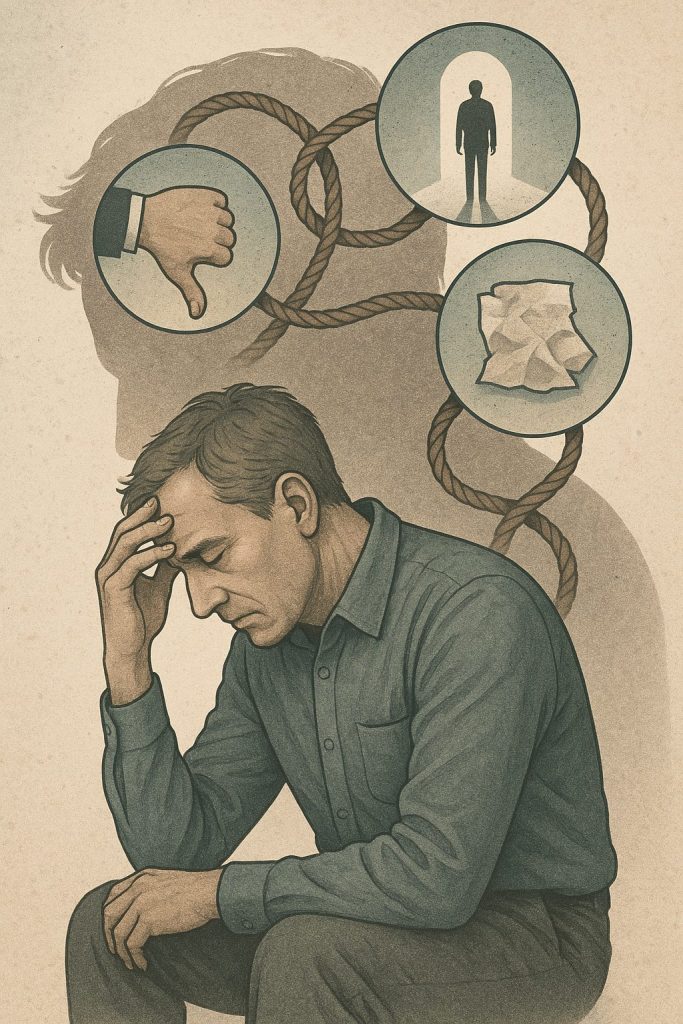
There is also a more personal sting to it. Many of us like to believe we are fundamentally good, capable people, so when our actions fail to reflect that image, we experience the gap as a personal failure. We do not just think, “I made a mistake”; we start feeling, “I failed at being who I thought I was.” That is often why old memories can feel so heavy.
- missed opportunities
- poor decisions
- actions we wish we had handled differently
Accepting mistakes as part of becoming who you are
Yet bad decisions and disappointments are not signs that your life has gone wrong beyond repair. They are part of being human. In truth, many of the choices you now regret have also shaped the person you are today. They have taught you something about your limits, your values, your reactions and your needs. That does not make every mistake desirable, but it does mean it was not meaningless.
Related offer
Sacred frequency 432 Hz
432Hz : COSMIC COHERENCE Enter into perfect resonance with the universe... COHERENCE - UNITY - ENERGY - BLISS
View productYou are not meant to be perfect, and neither is anyone else. Like every human being, you are formed partly through error, trial and failure. Loosening your grip on the past does not mean pretending nothing happened. It means recognising that your mistakes helped forge you, and that growth rarely comes from getting everything right the first time.
When Blame Keeps You Stuck in the Same Pain
Not everything is your fault, but your part still matters
Everyone runs into difficulties, and very often we are not the direct cause of the upheavals that disturb an otherwise peaceful life. Even so, it helps to recognise that whenever something affects you deeply, your own participation is involved in some way — through your reactions, your choices, your boundaries, or what you continue to tolerate. That is not the same as saying you are to blame for everything. It means that your inner position still matters, and that is precisely where your power to heal begins.
Seen in that light, the people you meet are not only obstacles or sources of frustration; they can also be teachers in your life. Each experience carries a lesson in which you play a part, and each stage reveals something about who you are. Sometimes it shows a wound that still needs attention. Sometimes it exposes a pattern you have outgrown. Either way, what happens around you can become a mirror rather than a sentence.
- Your reactions show what still affects you
- Your boundaries reveal what you are ready to protect
- Your repeated patterns often point to what needs healing
Healing begins when you stop handing your power away
Blaming other people for your problems may bring a brief sense of relief, but it rarely brings peace. More often, it delays healing because it keeps your attention fixed outside yourself. The longer you avoid looking inward, the easier it is to slip into a victim role, where life feels as though it is only happening to you and never with your involvement. That mindset can quietly drain your energy and make the same emotional wounds return again and again.
Taking responsibility in a deeper sense means asking a more useful question: what is this situation showing me about myself? When you do that, you stop avoiding yourself and start understanding yourself. That shift does not erase what others have done, nor does it excuse harmful behaviour. It simply allows you to recover your footing, learn the lesson within the experience, and move forward with more clarity instead of remaining trapped in resentment.
When the Need to Feel Superior Starts Draining Your Energy
Always needing to be right often comes from insecurity
Feeling superior to everyone else rarely comes from real inner strength. More often, it grows out of a lack of self-confidence and a deeper sense of insecurity. When that insecurity is left unchecked, the need to be right all the time can start to feel like protection. Correcting others, dominating conversations or insisting on your own judgement may create a brief sense of safety, as though being right proves your value.
But that kind of reassurance comes at a cost. If you need to stand above others in order to feel secure, then someone else must always be placed below you. The ego may enjoy that position for a moment, yet it keeps you trapped in tension. In that mindset, being right feels comforting, while being wrong can trigger fear, discomfort and self-doubt. What looks like confidence from the outside is often just a fragile way of defending yourself.
- Wanting to control the conversation
- Feeling threatened when challenged
- Equating disagreement with personal attack
Inner peace begins when you let go of superiority
The path towards inner peace involves loosening this constant need to win, dominate or have the final word. In most discussions, proving that you are right is far less important than staying open, calm and honest. Letting go of superiority does not mean becoming passive or pretending you have no opinions. It means no longer tying your sense of safety to the idea that you must always know better than everyone else.
You are not omniscient, and neither is anyone else. Every person you meet can teach you something, even if that lesson comes through disagreement. The moment you accept that, conversations become lighter and your energy becomes less defensive. Instead of protecting your ego at all costs, you make room for humility, learning and a more stable form of confidence—one that does not depend on putting other people in the wrong.
When Constant Anxiety Pulls You Away from Inner Peace
Fear can quietly shape far more than you realise
Fear is one of the greatest obstacles to inner peace and happiness. It does not always arrive in dramatic form. Sometimes it appears as the worry that a happy moment will not last, the dread that something tragic may happen, or the anxiety of losing someone or something important. The causes are many, and that is precisely why constant anxiety can be so draining: it finds its way into both the big moments and the ordinary ones.
What makes this even more difficult is that fear does not only affect how you feel; it can also begin to guide how you live. Many everyday actions are driven by fear without us fully noticing it. We avoid, postpone, overthink or cling too tightly, believing we are protecting ourselves, when in reality we are moving further away from the calm and openness that support genuine wellbeing.
- fear of losing a good situation
- fear that tragedy may strike
- fear of loss, change or uncertainty
Recognising hidden fear is part of the healing process
Some fears are easy to identify, but others remain hidden beneath habits, reactions and decisions that seem perfectly normal on the surface. That is why constant anxiety can be so persistent: it often works in the background. When fear becomes a regular inner state, it pulls you away from the path of happiness little by little, narrowing your perspective and making life feel heavier than it needs to be.
Facing fear is rarely simple, and the original point still stands: it is a difficult process, but a necessary one. The first step is often to notice where fear is speaking in your life, rather than letting it direct everything unnoticed. Once it is recognised, it becomes easier to loosen its hold and move back towards a steadier, more peaceful way of being.
When Attachment to Possessions Starts Weighing You Down
Why material things rarely satisfy for long
Material possessions exist on a purely physical level. They can certainly bring comfort, pleasure and a sense of ease, but that satisfaction is often short-lived. With time, many of the things we buy either lose their appeal or become a burden in their own way: they wear out, clutter our space, demand upkeep or simply stop meaning as much as they once did. That is why learning not to cling too tightly to material things matters if you want to protect your inner balance.
This does not mean rejecting comfort or pretending that practical needs do not matter. It means recognising that possessions are limited in what they can truly give. When too much emotional weight is placed on what we own, our wellbeing becomes tied to things that are temporary by nature. That attachment can quietly lower our energy, because what is fleeting can never offer lasting inner stability.
- Possessions can be useful and enjoyable
- But their effect is often temporary
- Over-attachment can turn comfort into dependence
Choose memories and lived experience over accumulation
Recent studies suggest that life experiences tend to bring more happiness, and far more lasting memories, than material goods. That idea is worth sitting with. If you are about to buy something you will probably get rid of in a few years, it may be wiser to ask yourself whether that same money, time or attention could create a meaningful experience instead. A shared moment, a trip, a personal milestone or even a simple but memorable day often leaves a deeper mark than another object added to the home.
In the end, the goal is not to deny yourself a comfortable life, but to remember that enjoying life is more nourishing than merely owning things. Comfort has its place, of course. Yet what tends to stay with us most is not what we purchased, but what we lived, felt and remembered. Detaching a little from material accumulation can therefore help you make room for something richer: presence, gratitude and experiences that genuinely stay with you.
When Guilt Becomes a Prison Instead of a Lesson
Why constant guilt drains you so deeply
Just after fear, guilt is one of the emotions most capable of draining the life out of you. It can lock you inside your own torment and keep you circling around the same thoughts, the same memories and the same self-accusations. Of course, there are moments when you are responsible for what you did, and the consequences may not have been good. That part should not be denied. But your life does not end there. The world has not stopped turning, and neither has your chance to grow beyond what happened.
Related offer
Sacred frequency 963 Hz
963Hz : INNER LIGHT Reveal the power of your perfect nature... STRENGTH - ELEVATION - FULL AWARENESS
View productGuilt becomes destructive when it no longer helps you recognise a mistake, but instead turns into a permanent identity. At that point, it stops being a moral signal and starts becoming a form of inner punishment. You remain trapped in what went wrong rather than moving towards what can still be repaired. As long as you are alive, you can apologise, make amends, change your behaviour or choose a better path. That is what gives guilt its proper place: not as a cage, but as a passing reminder that can lead to responsibility and healing.
- acknowledge what happened honestly
- repair what can still be repaired
- refuse to turn one mistake into your whole identity
Accepting your humanity without surrendering to shame
There is also no need to bend yourself endlessly to someone else’s standards, whoever that person may be, including the harsh ideal you may hold of yourself. Many people suffer not only because they made a mistake, but because they cannot bear the fact that they are imperfect. Yet being human means carrying contradictions. We hold both light and darkness, both strength and weakness, both what some traditions would call yin and yang. We are capable of goodness, and we are also capable of error. That tension is not proof that you are broken; it is part of being human.
When you accept this more honestly, guilt loses some of its power to consume you. You can still take responsibility without condemning your whole being. You can recognise harm without deciding that you are nothing but harm. And that shift matters if you want to raise your energy and return to a more balanced inner state. If you would like support in that direction, you may find these resources helpful: Raise your vibratory rate and Sacred frequency 432 Hz.
The Mental Waves Vibration Hygiene Framework
The Mental Waves frame approaches vibration as a lived quality of attention. You do not need to judge yourself for feeling low; the useful move is to notice what contracts your energy and choose one small behaviour that restores space.
- Notice contraction: identify where fear, regret or blame has tightened your attention.
- Name the pattern: call it a habit of mind, not your identity.
- Use a frequency cue: let sound mark a shift from reaction to presence.
- Choose one cleaner action: apology, rest, movement, decluttering, forgiveness or a clearer boundary.
If you want a fuller sacred-frequency path, continue with the 11 Sacred Frequencies Pack + Ebook.
The Mental Waves Energy Hygiene Framework
The Mental Waves frame is to use vibration language as a reflective map, not as a rigid judgement. A low state is information: something in attention, emotion, routine or environment may need care.
Instead of fighting yourself, choose one draining pattern and one restorative counter-practice. Small shifts in sleep, breath, sound, boundaries and self-talk often matter more than dramatic declarations.
For a gentle sound-based reset, receive the free 128 Hz sacred frequency session and use it as a quiet support for energy awareness.
Editorial note from Mental Waves
This article uses vibration as symbolic self-development language. It is not a diagnosis, a moral ranking of people or a substitute for mental-health support when distress is persistent.
Conclusion
What runs through all of these patterns is not simply “negative thinking”, but a gradual loss of inner space. Self-victimisation, rigid beliefs, fear, blame, regret, superiority or guilt each pull attention away from presence and into contraction. Lower energy often has less to do with one dramatic event than with habits of mind and emotion that quietly harden over time. Seen that way, raising your vibration is not about becoming perfect, endlessly positive or detached from real life. It is about noticing where your energy is being tied up, and meeting those places with more honesty, responsibility and softness.
That is also where the article’s deeper balance matters. Some of these tendencies come from pain, insecurity or old conditioning, so they do not call for harsh self-correction. They call for awareness, discernment and a willingness to loosen what no longer serves you: the need to control everything, the urge to judge, the attachment to what has already gone, or the belief that your worth depends on being right, blameless or beyond human contradiction. When you stop feeding those inner tensions, you do not become someone else; you return to a steadier version of yourself. And that shift can change more than it first appears.
Frequently Asked Questions About Lowering Your Vibration
What does it mean to lower your vibration?
In this article, lowering your vibration means moving into a contracted inner state: more fear, guilt, regret, judgement or heaviness, and less clarity, openness and presence.
Does feeling low mean I have failed spiritually?
No. Low energy states are part of human life. The point is not to judge yourself, but to notice the pattern and choose a cleaner response when you can.
Why can victimhood lower your vibration?
Victimhood can keep attention fixed on powerlessness. Even when pain is real, staying only in blame may make it harder to reclaim agency and choose the next helpful step.
How does fear of change affect energy?
Fear of change often narrows attention and makes uncertainty feel dangerous. That contraction can reduce flexibility, curiosity and trust in your ability to adapt.
Why are regret and guilt described as heavy?
Regret and guilt keep the mind tied to past action. They can become useful when they lead to repair, but draining when they turn into repeated self-punishment.
Can sacred frequencies raise your vibration?
Sacred frequencies can be used as a ritual cue for presence, reflection and emotional settling. They should be understood as supportive listening practices, not automatic fixes.
What is vibration hygiene?
Vibration hygiene means noticing what repeatedly pulls your energy down and creating small practices that help you return to clarity, kindness and steadier attention.
What is one fast way to shift a low state?
Pause, exhale slowly, name the pattern in one sentence and choose one clean action. A short sound ritual can help mark that shift if it keeps you grounded.
What is the main takeaway?
The main takeaway is that your energy is shaped by attention and behaviour. Instead of forcing positivity, notice what contracts you and choose one response that restores space.