en
enVotre panier est vide.



We live in a culture that often feels swept along by emotion, yet many of us still respond to our own inner life in the same old way: by trying to push it down. That reflex is understandable, but it comes at a cost. Emotional distress does not arise simply because we feel deeply; more often, it grows from our difficulty in recognising what is happening and responding to it with any real steadiness. The problem is not emotion itself, but our troubled relationship with it.
When feelings are repeatedly dismissed, denied or forced underground, they rarely disappear. More often, they return in more confusing forms: irritability that seems to come from nowhere, a body that remains tense long after the moment has passed, or a quiet sense of disconnection from oneself. Many people know this pattern intimately. They are not overwhelmed because they are too emotional, but because they have never really been taught how to stay in contact with what they feel without either collapsing into it or shutting it out.
That matters because emotions are not intruders to be driven out. They are part of our oldest survival equipment, present since the dawn of humanity. Drawing on the work of Yves-Alexandre Thalmann, they can be understood as responses to an internal trigger, such as a thought, or an external event, rooted largely in the brain and expressed through the body. Joy, fear, anger and sadness — sometimes joined by surprise and disgust — shape our social lives, help us communicate and prepare us to act. In that sense, an emotion is less an enemy than an alarm bell: a normal, deeply human signal that mobilises energy, alters the body and readies us for flight, defence or engagement.
In short: how do you make peace with emotions?
Making peace with emotions starts by treating them as signals, not enemies. You cannot always choose the first wave of fear, anger, sadness or joy, but you can learn to recognise it, feel it in the body and choose a response that is calmer than the reaction.
- Name the emotion before trying to change it.
- Notice the body: breath, jaw, chest, belly, hands and posture often speak first.
- Separate signal from story: the feeling is real, but your first interpretation may be incomplete.
- Use one reset cue so the nervous system has a path back to steadier attention.
For a simple transition ritual, start with the free Mental Reset Session, then explore the guide to sound rituals for a crowded mind.
To remember this changes the tone of the whole conversation. Instead of asking how to get rid of emotion, we begin to ask what it is trying to show us, what need it may be pointing towards, and what kind of response would honour both the feeling and reality. That shift is subtle, but it is often the beginning of a more grounded inner life.
Making Peace with Emotions to Live More Fully in the Present
Why emotions are not the enemy
One of our biggest mistakes is to treat emotions as if they were intruders to be silenced or pushed away. In reality, they follow a logic that is deeply rooted in human nature. Far from being signs of weakness, they are part of the way we survive, adapt and relate to one another. As Yves-Alexandre Thalmann writes in Le décodeur des émotions, an emotion is a response to an internal trigger, such as a thought, or to an external event. Joy, fear, anger and sadness — sometimes joined by surprise and disgust — are not marginal experiences.
They are at the heart of social life: they make us feel alive, help us evolve, allow us to communicate and remain essential to our balance.
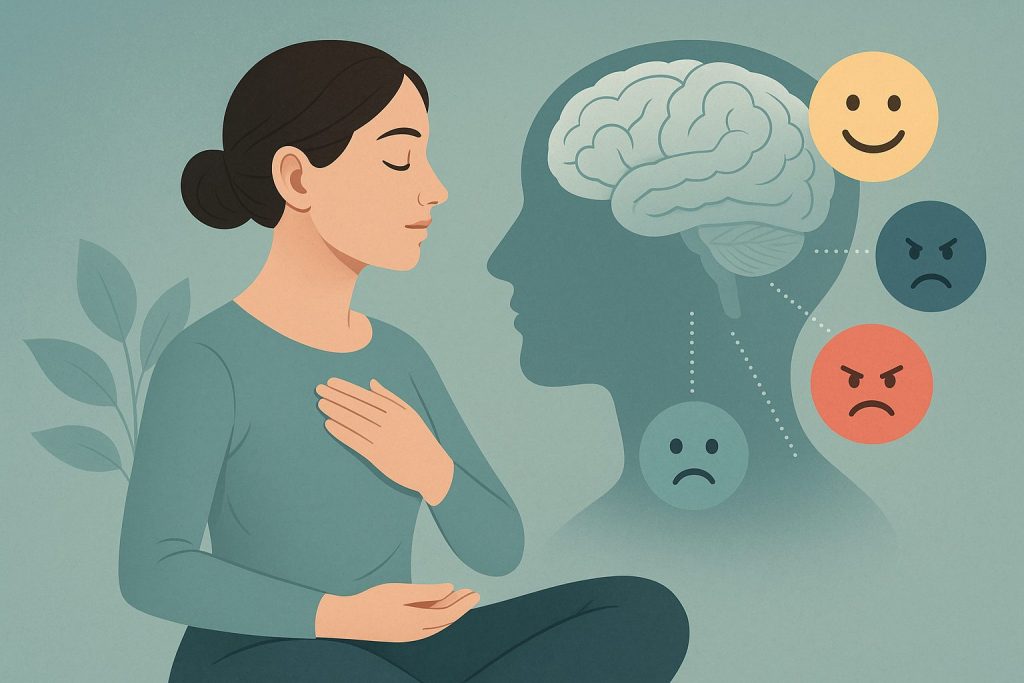
Seen in that light, an emotion is not a problem in itself but a signal. It works rather like an alarm bell, mobilising energy so that we can respond, whether by withdrawing, protecting ourselves or taking action. This is why emotions have accompanied human beings since the dawn of time. They are reactional by nature, and they prepare us for what comes next. If we keep fighting them as though they were enemies, we end up exhausting ourselves. If, on the other hand, we begin by recognising their function, we already take a first step towards a calmer and fuller experience of the present moment.
There is also something quietly humbling in this. An emotion does not ask our permission before it arrives. It appears, often quickly, and reveals that we are affected by life. That is not a flaw in our design; it is part of what makes us responsive, relational and alive. A person who never felt fear would not be freer, only less protected. A person who never felt sadness would not be stronger, only cut off from loss, tenderness and attachment.
Even anger, which is so often mistrusted, can contain useful information. It may point to a boundary that has been crossed, a value that has been ignored, or a long-standing frustration that has not yet found words. This does not mean every emotion is automatically right in its interpretation, but it does mean every emotion deserves to be heard before it is judged. The signal may be imperfect, but ignoring it altogether usually leaves us further from ourselves, not closer.
- They arise in response to a trigger, internal or external.
- They support survival, adaptation and communication.
- They are better understood as signals than as faults.
Learning to work with what we feel
For many people, the inner mechanics of emotion still feel obscure. Yet it is possible to live with far more intelligence and peace by learning to explore our emotions rather than merely endure them. That shift matters. To live more quietly within ourselves, we need to change our attitude towards these inner movements, because they are indispensable to the body’s proper functioning. The aim is not to be rid of them, but to stop being at their mercy. In other words, it is wiser to use our emotions than to suffer them passively.
This also means accepting a simple but demanding truth: emotions are born within us, not in the outside world itself. Events, words or memories may trigger them, but the emotional experience takes shape in us. Once we understand that, we can begin to approach our feelings with more curiosity and less fear. Exploring them, naming them and gradually taming them does not distance us from the present moment; it brings us back to it. Rehabilitating emotions in this way is not indulgence. It is a more lucid, more grounded way of living.
In practice, this often begins with very ordinary questions. What am I actually feeling just now? Where do I notice it in my body? What thought, memory or situation has stirred it? What is this feeling asking for: protection, expression, rest, clarity, distance, comfort, repair? Such questions do not make emotion vanish, but they prevent it from remaining a vague force that governs us from the shadows.
There is a meaningful difference between being flooded by a feeling and accompanying it. When we accompany it, we do not dramatise it, but neither do we abandon ourselves in the face of it. We stay close enough to listen, while steady enough not to be swallowed whole. That is often how emotional maturity grows: not through hardness, but through a more faithful presence to what is already there.
Living fully in the present is impossible if large parts of our inner life remain exiled. The present moment is not only made of what surrounds us; it is also made of what moves within us. To reconcile ourselves with emotion is therefore not a side issue. It is one of the conditions for inhabiting our own life more completely.
How Emotions Show Up in the Body and Behaviour
An emotion is felt before it is explained
As Yves-Alexandre Thalmann reminds us, emotions are reactions to events or thoughts that trigger changes inside the body as well as visible behaviour. A joyful person may leap with delight; someone gripped by fear may run away without a second thought. Many of these responses do not pass through the brain’s usual decision-making centres, because they are rooted in reflexes that are already inscribed within us. Being frozen with fear, clenching our fists in anger or shouting when tension rises are not always carefully chosen acts; they are often immediate reactions, shaped either by instinct or by conditioning.
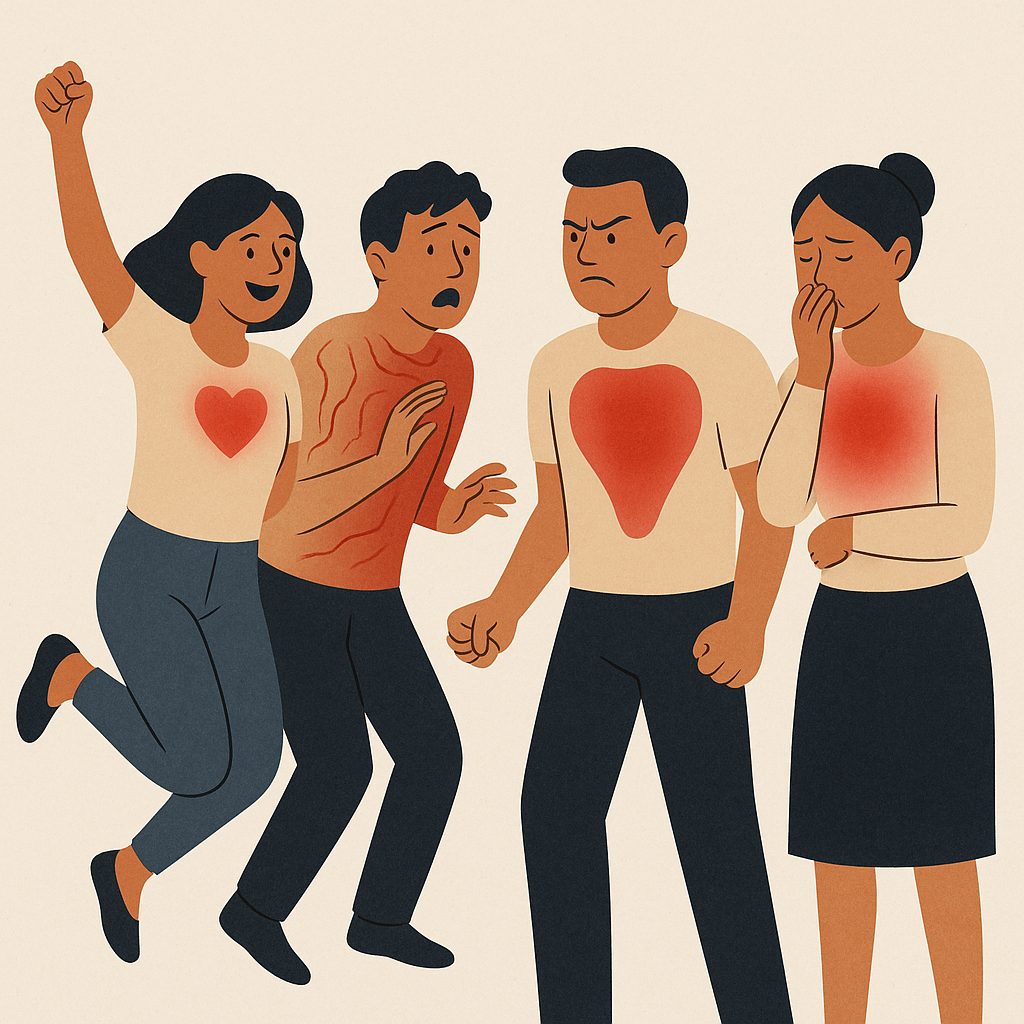
That is why emotions can feel so powerful and, at times, so difficult to contain. They may lead to disinhibition, withdrawal, fear, anger, disgust or surprise, and they often appear before we have had time to make sense of what is happening. An emotion is not just an idea in the mind; it is something lived through the whole organism. It takes hold quickly, moves through us, and leaves traces in both our posture and our actions.
Most people recognise this from experience. Before the mind has formed a coherent sentence, the body has already spoken: the stomach tightens, the jaw hardens, the shoulders lift, the eyes fill, the voice changes. We often explain our emotions after the fact, but we usually feel them first. This is one reason emotional life can seem so unruly. It does not wait politely for analysis.
Conditioning also plays a larger part than we sometimes admit. Some people learned early that fear should be hidden, that sadness was inconvenient, or that anger was the only acceptable way to show hurt. Over time, these lessons become embodied habits. We do not merely think them; we enact them. Part of emotional reconciliation, then, is noticing not only what we feel, but the habitual form our feeling takes when it enters behaviour.
Related offer
Meditation - Relaxation set
All the Mental Waves® know-how in a single pack for quick and easy access to meditation and...
View product- reflex reactions, such as freezing or clenching up
- conditioned responses, such as shouting when anger builds
- visible shifts in behaviour, from withdrawal to sudden action
Why the body is so deeply involved
One of the central features of emotion, as Thalmann puts it, is that it is “lived in the body and upsets the body”. Feeling is not purely a psychological process, which is precisely why controlling it is so hard. When an emotion rises, the body begins to prepare for action. Heart rate can increase sharply, breathing may become faster, blood pressure and body temperature can rise, blood flow can shift, and peripheral temperature may drop. Appetite can fall, gastrointestinal transit may slow, blood coagulation can accelerate, and the face itself may display what words have not yet said: fear, sadness or anger.
Seen in this light, these physical changes are not signs of weakness or failure. They are the body’s way of mobilising itself in response to what it perceives. Emotional experience can also disturb sensory, motor and cognitive functioning, which helps explain why we do not always think clearly in the heat of the moment. The body is not a secondary player in emotion; it is one of its main stages. And the more clearly we recognise that, the easier it becomes to understand why emotions cannot simply be switched off by willpower alone.
This bodily dimension deserves respect. Many people become frustrated with themselves for not being able to think their way out of panic, grief or rage quickly enough. Yet when the nervous system has already shifted into a state of alert, the body is no longer waiting for a philosophical argument. It is preparing for survival. In those moments, gentler and more concrete forms of regulation are often more effective than self-criticism: slowing the breath, feeling the feet on the ground, stepping away from overstimulation, or simply allowing a few minutes before speaking.
It is also worth remembering that the body keeps score in quieter ways. Unprocessed emotion may not always erupt dramatically; sometimes it settles into chronic fatigue, shallow breathing, muscular tension or a persistent sense of inner pressure. Listening to the body, then, is not a secondary wellness gesture. It is often one of the most honest ways of noticing what the mind has been trying to outrun.
- faster heartbeat and breathing
- changes in blood pressure, temperature and blood flow
- reduced appetite and slower digestion
- facial expressions that reveal the emotion at work
What We Can Really Control When Emotions Take Hold
You cannot switch off an emotion, but you can work with it
Can we truly master our emotions? Only to a limited extent — but that does not mean we are powerless. Most of the physical signs that accompany an emotion are not under voluntary control. As Yves-Alexandre Thalmann reminds us, they are largely driven by the autonomic nervous system, which regulates the body’s vital functions. In other words, when fear tightens the chest, anger brings heat to the face or sadness drains our energy, these reactions do not simply obey willpower. At best, we may contain them, disguise them or soften them for a moment, but making an emotion disappear altogether is unrealistic.
What remains within our reach, however, is crucial: the way we respond once the emotion is there. Thalmann makes the distinction clearly: we do not choose to blush with anger, but we can choose whether or not to insult the driver who has just cut us up. That is where real freedom begins. The more aware we become of what is happening inside us, the less likely we are to be carried away by reflex. We may not command the first surge, but we can learn not to let it dictate every word, gesture or decision.
This distinction between feeling and acting is one of the most liberating we can make. Many people fear that if they allow themselves to acknowledge an emotion, they will automatically be ruled by it. In reality, the opposite is often true. What is denied tends to act indirectly; what is recognised can be held with more discernment. To say, “I am feeling intense anger,” is not the same as giving anger permission to do whatever it likes. It is simply refusing confusion.
There is often a small but decisive interval between the emotional wave and the behaviour that follows. At first, that interval may feel almost non-existent. With practice, it widens. In that widening, choice becomes possible: not perfect choice, not saintly composure, but enough space to refrain, to delay, to speak more truthfully, or to leave the room before harm is done. Emotional work is rarely about becoming unshakeable. More often, it is about becoming less automatic.
- We cannot fully control the body’s automatic emotional reactions.
- We can influence how we behave once those reactions appear.
- Awareness creates the space needed to choose a better response.
Breath, perspective and practice: the path back to balance
One of the most reliable ways to regain some steadiness is through the breath. Because voluntary breathing can slow the respiratory rhythm, it helps activate the parasympathetic nervous system — the system associated with release, recovery and a return to equilibrium. As tension eases, other functions begin to settle too, including heart rate and body temperature. This is why practices centred on breath and attention can be so helpful: yoga, Qigong, tai chi chuan, meditation, certain martial arts, Jacobson’s progressive relaxation, sophrology and ACT — Acceptance and Commitment Therapy, which encourages us to accept the emotion rather than wage war against it.
The same can be true of music, time in nature, Nordic walking, archery and any physical activity approached with the genuine intention of learning to live more intelligently with what we feel.
There is, of course, no miracle method. The deeper work is to learn to relax, to put things back into proportion, to step outside our immediate self-focus, to recover a sense of what truly matters and to loosen the grip of cognitive distortions. It is also to make peace with anger, with vulnerability and with the whole range of our inner life. Epictetus expressed this with striking clarity: “It is not things themselves that disturb men, but the opinions they form about them.” Faced with a painful mental image, he advises us to say: “You are only an appearance and not at all what you seem to be.
Then examine it well, test it thoroughly...” In that spirit, learning to decode our emotions begins with rehabilitating them, because they do have something to tell us — if we are willing to listen.
Breathing practices help not because they erase emotion, but because they give the body another message alongside the alarm: you are safe enough, for this moment, to slow down. That is sometimes all we need in order to avoid being swept away. A few deliberate breaths, taken seriously, can interrupt escalation and restore just enough inner order for thought to return.
Regular practice matters more than intensity. A person who spends ten minutes each day cultivating attention, movement, stillness or breath often develops more emotional steadiness than someone who reaches for a technique only in moments of crisis. The nervous system learns through repetition. So does the mind. What we practise in calm moments becomes more available when life becomes difficult.
Perspective is equally important. Not every emotion requires immediate expression, and not every thought generated by emotion deserves belief. Sometimes maturity lies in speaking; sometimes it lies in waiting. Sometimes it means setting a firm boundary; sometimes it means recognising that fatigue, old wounds or projection are colouring the present. To reconcile ourselves with emotion is not to surrender judgement. It is to bring judgement back into relationship with feeling, instead of letting the two tear each other apart.
- Breathwork can help calm the body’s stress response.
- Regular practices support emotional steadiness over time.
- No technique replaces the need for reflection, perspective and acceptance.
The Mental Waves Emotion-to-Presence Framework
The Mental Waves frame is not to control every emotion, but to create enough space between the feeling and the next action. That space is where presence returns.
- Pause: give the emotion a few seconds before naming it.
- Locate: ask where the feeling appears in the body.
- Listen: identify the need, boundary or memory the emotion may be pointing toward.
- Reset: use breath, sound or a short walk to reduce intensity.
- Respond: choose one action that respects both the emotion and reality.
If the emotional charge is linked to performance, public speaking or an important event, continue with How to Relax Before an Important Event. If breath is the easiest doorway, read Everything You Need to Know About Cardiac Coherence.
Editorial note from Mental Waves
This article is educational. Strong emotional distress, panic, trauma symptoms or persistent low mood deserve qualified support. Sound, breathing and self-observation can help create space, but they do not replace care when care is needed.
Conclusion
To live more fully in the present is not to become untouched by fear, anger or sadness. It is to stop treating them as intruders and begin recognising them for what they are: signals, movements of the body and mind, and sometimes necessary forms of inner intelligence. Emotions are not the opposite of balance; more often, balance begins when we stop fighting their existence and start listening with a little more honesty.
That does not mean romanticising every feeling, nor pretending we can command our inner life by sheer will. Much of an emotional surge happens before choice enters the room. Yet there is still a meaningful freedom in how we respond: in the breath we return to, the pause we create, the perspective we recover, and the habits that help us come back to ourselves. In that sense, reconciliation with our emotions is less about control than about relationship — and it is often there that the fullness of the moment quietly becomes possible.
Perhaps that is the deepest invitation here: not to become someone who no longer feels, but someone who can remain present while feeling. Someone who no longer confuses sensitivity with fragility, or emotional intensity with failure. The more honestly we welcome what moves through us, the less we need to fear it. And from that reconciliation, a different quality of presence emerges — less defended, less divided, and far more alive.
{
"@context": "https://schema.org",
"@type": "FAQPage",
"mainEntity": [
{
"@type": "Question",
"name": "What does making peace with emotions mean?",
"acceptedAnswer": {
"@type": "Answer",
"text": "It means learning to recognise emotions without suppressing them or letting them run every decision. The goal is to hear the signal, calm the body and choose a steadier response."
}
},
{
"@type": "Question",
"name": "Are emotions good or bad?",
"acceptedAnswer": {
"@type": "Answer",
"text": "Emotions are not good or bad in themselves. They are signals. Some are uncomfortable, but they can still reveal a need, boundary, fear, value or attachment that deserves attention."
}
},
{
"@type": "Question",
"name": "Why do emotions feel physical?",
"acceptedAnswer": {
"@type": "Answer",
"text": "Emotions involve the nervous system and the body. Breath, heart rate, muscle tension, temperature and posture may shift before the mind has fully explained what is happening."
}
},
{
"@type": "Question",
"name": "Can you control your emotions?",
"acceptedAnswer": {
"@type": "Answer",
"text": "You cannot always control the first emotional wave. You can influence what happens next by pausing, naming the emotion, regulating the body and choosing a response."
}
},
{
"@type": "Question",
"name": "How can breathing help during strong emotion?",
"acceptedAnswer": {
"@type": "Answer",
"text": "Slower, steadier breathing gives the body a signal of safety. It may not remove the feeling, but it can lower intensity enough for clearer thinking to return."
}
},
{
"@type": "Question",
"name": "Why use sound for emotional reset?",
"acceptedAnswer": {
"@type": "Answer",
"text": "A simple sound cue can mark a transition. It gives attention something stable to return to when emotion is loud, scattered or hard to organise."
}
},
{
"@type": "Question",
"name": "Should I analyse every emotion?",
"acceptedAnswer": {
"@type": "Answer",
"text": "No. Some emotions simply need to be felt and allowed to pass. Analysis is useful only when it leads to clarity rather than more rumination."
}
},
{
"@type": "Question",
"name": "What if emotions feel overwhelming?",
"acceptedAnswer": {
"@type": "Answer",
"text": "Start with safety and support. Use grounding, breath and simple contact with someone trustworthy. If the distress is intense, persistent or linked to trauma, professional help matters."
}
},
{
"@type": "Question",
"name": "What is the main takeaway?",
"acceptedAnswer": {
"@type": "Answer",
"text": "The main takeaway is that emotions become easier to live with when they are recognised as signals. You do not need to obey every reaction, but you do need to listen carefully."
}
}
]
}
Frequently Asked Questions About Making Peace with Emotions
What does making peace with emotions mean?
It means learning to recognise emotions without suppressing them or letting them run every decision. The goal is to hear the signal, calm the body and choose a steadier response.
Are emotions good or bad?
Emotions are not good or bad in themselves. They are signals. Some are uncomfortable, but they can still reveal a need, boundary, fear, value or attachment that deserves attention.
Why do emotions feel physical?
Emotions involve the nervous system and the body. Breath, heart rate, muscle tension, temperature and posture may shift before the mind has fully explained what is happening.
Can you control your emotions?
You cannot always control the first emotional wave. You can influence what happens next by pausing, naming the emotion, regulating the body and choosing a response.
How can breathing help during strong emotion?
Slower, steadier breathing gives the body a signal of safety. It may not remove the feeling, but it can lower intensity enough for clearer thinking to return.
Why use sound for emotional reset?
A simple sound cue can mark a transition. It gives attention something stable to return to when emotion is loud, scattered or hard to organise.
Should I analyse every emotion?
No. Some emotions simply need to be felt and allowed to pass. Analysis is useful only when it leads to clarity rather than more rumination.
What if emotions feel overwhelming?
Start with safety and support. Use grounding, breath and simple contact with someone trustworthy. If the distress is intense, persistent or linked to trauma, professional help matters.
What is the main takeaway?
The main takeaway is that emotions become easier to live with when they are recognised as signals. You do not need to obey every reaction, but you do need to listen carefully.