en
enVotre panier est vide.



Some life events do more than unsettle us in the moment. They may also be associated with faster ageing in the brain, especially when stress becomes a repeated part of daily life rather than a brief response to danger. Bereavement, divorce, serious illness, financial strain or ongoing conflict can all leave a mark that is not only emotional, but potentially neurological as well.
That is the question explored by researchers at the University of California San Diego School of Medicine, who examined brain ageing in men aged 57 to 66 using MRI scans and repeated reports of stressful experiences over time. Their findings, published in Neurobiology of Aging, suggest that negative events experienced in midlife were linked to an older-looking brain later on, with interpersonal losses and tensions appearing especially significant. More broadly, the study adds weight to a careful but important idea: chronic stress does not affect mood alone — it may also contribute to changes in the body, the immune system and the brain’s long-term health.
In short: can stressful events accelerate brain ageing?
Some research suggests that stressful life events may be associated with signs of faster brain ageing, especially when stress is repeated, intense or poorly recovered from. This does not prove that every difficult event directly ages the brain, but it does show why recovery, sleep, emotional support and nervous-system regulation matter.
- The research points to association, not simple destiny.
- Relationship strain, bereavement and major losses may be especially demanding.
- Chronic stress can affect sleep, inflammation, hormones and cognitive load.
- Recovery practices matter because the body needs signals that the danger has passed.
This article focuses on the research angle. For the practical stress-management angle, read Stressful Life Events and Brain Ageing.
This does not mean that every difficult period inevitably harms the brain in a lasting way. The more plausible interpretation is subtler: when emotionally demanding events accumulate, and when recovery is incomplete, the brain and body may remain in a prolonged state of adaptation. Over time, that burden may be reflected in biological markers associated with ageing.
How Stressful Life Events Can Age the Brain Faster
What the research observed in older men
Stressful life events do not only affect mood in the moment; they may also be associated with a brain that appears to age more quickly over time. To explore this, researchers at the University of California San Diego School of Medicine, working in psychiatry and the genetics of ageing, analysed data from 359 men aged 57 to 66. Their findings, published in Neurobiology of Aging, suggest that everyday negative experiences can be linked to earlier brain ageing, especially when they occur during midlife.
The men were asked twice, five years apart, to list the events that had most affected them during the previous two years. The researchers then used MRI scans to assess the brain’s neurological and anatomical state, including cortical volume and thickness, and from these measurements estimated each participant’s “brain age”. They found that experiencing negative events in one’s forties or fifties was associated with a brain that looked older than expected. On average, each negative event was linked to an increase of around 0.37 years in brain age — in other words, roughly a third of a year older than the person’s actual age.
That kind of result is striking because it translates lived experience into a measurable anatomical pattern. MRI-based estimates of brain age are not a diagnosis, and they do not tell us everything about cognition, memory or future decline. Even so, they offer a useful way of examining whether the brain appears biologically older or younger than would normally be expected for a given chronological age.
It is also worth noting that the study focused on associations rather than proof of direct causation. Stressful events may interact with many other factors, including sleep quality, cardiovascular health, social support, depression, alcohol use and long-term lifestyle habits. The value of the research lies in showing that these experiences are not trivial from a neurological perspective, even if the exact pathways remain under investigation.
Which events seemed most strongly linked to brain ageing
Not all stressors appeared to carry the same weight. In this study, interpersonal experiences were the ones most strongly associated with faster brain ageing. These included conflict, the death of a loved one or a friend, romantic break-ups and divorce. The researchers also pointed to other difficult experiences, such as financial hardship, serious illness and miscarriage. What these events have in common is not simply that they are unpleasant, but that they can deeply disrupt emotional balance, attention and the body’s stress regulation over time.
The study also highlights a broader link between stress and the ageing of brain-related molecules. Chronic stress may damage the body’s cells and weaken the immune system, which helps explain why its effects are not limited to mental strain alone. It can affect the body more widely, and the brain is part of that picture. That said, these findings should be read with appropriate caution: the research was carried out only in men, and the authors hoped to repeat it in women in order to confirm whether the same pattern holds more broadly.
Interpersonal stress may be especially potent because it often combines several burdens at once. It can involve grief, uncertainty, rumination, social isolation, disrupted sleep and a repeated sense of threat to one’s emotional security. In cognitive terms, such experiences may repeatedly capture attention and reduce the mind’s ability to return to a calmer baseline.
That may help explain why relationship conflict and bereavement often feel so mentally consuming. They are not merely events that happen and pass; they can alter daily routines, internal dialogue and physiological arousal for weeks or months. When that pattern persists, the body’s regulatory systems may have fewer opportunities to recover fully.
- Conflict and strained relationships
- Bereavement, separation and divorce
- Financial difficulties and serious illness
- Miscarriage and other emotionally destabilising events
What Stress Really Is and Why So Many Everyday Situations Trigger It
Stress is a normal protective response, not just a reaction to physical danger
Stress is often described as an automatic response by the body. In its original form, it is a protective mechanism: an unconscious reaction that appears when we perceive danger and need to adapt quickly. Today, however, stress is not limited to immediate physical threats. It is just as often linked to emotionally destabilising experiences, uncertainty, pressure and the feeling of losing control. In other words, the brain and body may react strongly not only to real danger, but also to situations that are mentally and emotionally demanding.
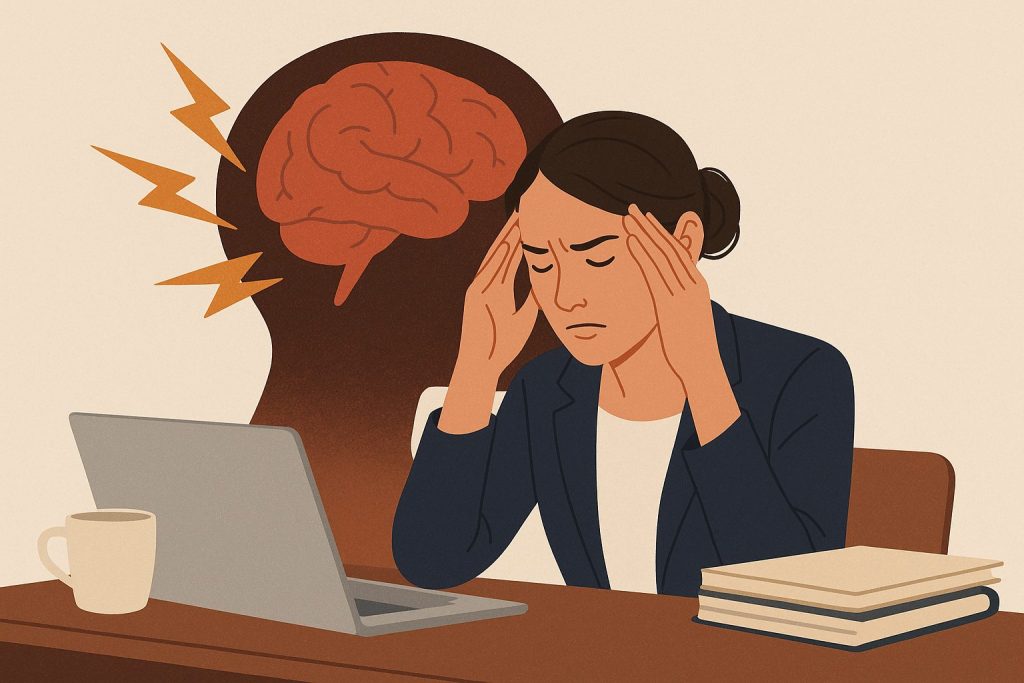
This helps explain why stress can arise in very ordinary settings. Family life, social life, responsibilities, obligations and the simple fact of having to function constantly in a demanding environment can all become sources of tension. The body releases stress hormones whether the situation is objectively serious or simply experienced as overwhelming. When emotional regulation is strained for too long, that state of alert may stop being occasional and begin to shape everyday mental and physical functioning.
From a biological point of view, the stress response involves coordinated activity between the brain, the autonomic nervous system and hormonal pathways such as the hypothalamic-pituitary-adrenal axis. This system is useful when it helps us respond to challenge. The difficulty begins when activation becomes too frequent, too intense or insufficiently resolved.
That distinction matters because stress is not inherently harmful. A short-lived rise in alertness can sharpen attention, mobilise energy and support rapid decision-making. Problems are more likely to emerge when the nervous system remains biased towards vigilance, making rest, recovery and emotional regulation harder to sustain.
- perceived threat or insecurity
- emotional upheaval
- social and family pressures
- accumulated responsibilities
Mental stress can spread through the whole body when it becomes constant
One of the key points in this section is that mental stress does not stay in the mind. Fear is one of its main drivers: fear for oneself, fear for someone else, fear of loss after a death or even a separation. Difficult professional or social relationships can also be deeply stressful, as can failure, frustration and the many constraints of daily life. Physical pain, overwork and lack of sleep add another layer. Taken together, these experiences create a continuous background of tension that the body may struggle to regulate.
It is this persistence that appears most harmful. When stress becomes chronic, it may weaken immunity, affect general health and contribute to faster ageing in the body as well as the brain. The original text also points to broader health consequences associated with prolonged stress, including physical dysregulation, reduced resilience and a decline in overall longevity. The important distinction, then, is not that all stress is harmful by nature, but that repeated, unresolved stress can gradually wear down the organism far beyond the initial emotional trigger.
In practical terms, chronic stress can influence sleep, appetite, concentration, motivation and the ability to recover after effort. It may also narrow attention, making the mind more likely to focus on threat, conflict or anticipated problems. This can create a feedback loop in which the person feels mentally overloaded while the body remains physiologically activated.
Over time, that pattern may affect how people think, feel and function day to day. They may become more irritable, less patient, more mentally fatigued or less able to regulate emotional responses. These are not signs of weakness; they are often signs that the system has been under pressure for too long.
Related offer
Anti-depression, anti-depression
Help for nervous, seasonal or depressive breakdowns. A revolutionary new 100% solution that is non-chemical, effective and has no...
View product- fear and anticipation of loss
- strained work or social relationships
- frustration, failure and daily constraints
- pain, overwork and insufficient sleep
Why Ongoing Stress Can Wear Down Both Brain and Body
How chronic stress affects the body over time
When stress becomes persistent, its effects are not limited to mood or mental fatigue. It can disrupt the body more broadly, and is associated with problems such as weight gain, reduced skin elasticity and a general decline in physical resilience. Some research also links long-term stress with more serious health conditions, including stroke and certain cancers. In this sense, stress is not simply an uncomfortable feeling: it can contribute to a wider process of premature ageing that affects both the brain and the rest of the body.
Studies on stress suggest that it may weaken immune defences and promote inflammatory processes in the body. Researchers have also described epigenetic changes associated with chronic stress, which may help explain why its effects can become so widespread. The link with ageing appears at several levels: Johnson et al. in 2010 reported findings suggesting that stress can accelerate brain ageing, while other work points to cellular ageing through the shortening of DNA telomeres. Over time, the skin, arteries and supporting tissues may lose elasticity, and even the liver may be affected if blood circulation to the organ is reduced, potentially contributing to earlier wear and tear.
These mechanisms should be understood carefully. Stress does not act in isolation, and it does not determine health outcomes with certainty. Rather, it may increase vulnerability by altering inflammatory balance, metabolic regulation and recovery processes that normally help maintain tissue integrity over time.
The brain is especially relevant here because it both interprets stress and is shaped by it. Regions involved in memory, emotional regulation and executive control may be sensitive to prolonged physiological strain. This does not mean that stress inevitably causes irreversible damage, but it does support the idea that repeated overload can influence the conditions under which the brain ages.
- Immune defences may become less effective
- Inflammation can become more persistent
- Cellular ageing may be reinforced through telomere shortening
Why recognising stress early matters
The original protective role of stress is not the problem in itself. In a genuinely dangerous situation, this automatic response helps the body mobilise its defences. The difficulty begins when mental stress becomes constant, because repeated emotional pressure may be more damaging than a short-lived response to immediate danger. That is why chronic stress is often presented as more harmful than the brief stress triggered by an acute threat: the body is not designed to remain in a prolonged state of internal alert.
It is therefore important to notice the signs early and try to relieve stress before it settles in. Feeling oppressed, unusually irritable or easily overwhelmed can be warning signals. So can a reduced ability to cope with everyday demands, or becoming more prone to colds and flu after a difficult period. Stress cannot be removed from life altogether, but it can often be identified and managed. The key point is to avoid letting it become chronic, because it is this ongoing strain that is most strongly associated with accelerated ageing in both the brain and the body.
Early recognition matters because chronic stress often becomes normalised. People may assume that constant tension, poor sleep, irritability or mental fatigue are simply part of adult life. Yet these signs can indicate that the nervous system is spending too much time in a state of mobilisation and too little time in genuine recovery.
Supportive routines may help reduce that burden: regular sleep, physical activity, social connection, psychological support when needed, and deliberate periods of mental decompression. None of these measures eliminates adversity, but they may improve regulation and resilience, which is often the more realistic goal. Protecting brain health is not only about avoiding major crises; it is also about reducing the cumulative load of everyday strain.
- Feeling tense, oppressed or unusually irritable
- Lower resistance to pressure, illness or fatigue
- Difficulty recovering after emotionally demanding periods
The Mental Waves Research-to-Recovery Framework
The Mental Waves frame is to read this kind of study carefully: neither dismissing the signal nor turning it into fear. A research finding becomes useful when it helps you protect recovery rather than panic about the past.
- Separate evidence from certainty: an association is not a personal sentence.
- Look for load: repeated stress matters more than one isolated hard day.
- Protect recovery: sleep, rhythm, support and decompression are part of resilience.
- Use a reset cue: help the body register that the stressful moment is over.
The free Mental Reset Session can act as a short decompression cue. For biological rhythm context, read Circadian Rhythms and the K-complex.
Why This Article Should Stay Distinct From the Similar Stress Article
This page should be treated as the research explainer. Its job is to clarify what the brain-ageing finding suggests, where its limits are and why the result should be interpreted cautiously. It should not become a broad self-help page or repeat every stress-management technique.
For brain ageing and stressful events, that distinction matters because readers need both careful interpretation and a separate practical route for daily regulation.
The companion article can carry more of the practical advice: how stress builds, how to notice it earlier and how to reduce daily load. Keeping the two pages distinct helps search engines and readers understand the difference between evidence summary and applied stress guidance.

Related offer
Mental and Physical Recovery
This session uses waves with extremely precise frequencies that target healing and recovery. Guidance...
View productHow to Read Brain-Ageing Research Without Fear
Brain-ageing research can sound alarming because the subject touches memory, identity and the fear of decline. But a useful reading starts with proportion. A study can show that a stressful history is associated with a measurable signal without meaning that every stressful event leaves permanent damage. Human biology is responsive, and recovery conditions still matter.
It is also important to remember that brain age is an estimate, not a complete portrait of a person. It can point toward patterns in tissue, structure or function, but it does not capture resilience, meaning, social support, learning, creativity or the daily practices that help someone recover. A single metric should not be confused with the whole life of the brain.
The most grounded response is to ask what the finding can help you protect. If stress load matters, then rhythm, sleep, emotional expression and decompression deserve attention. The lesson is not to fear the past; it is to make the present more recoverable.
That recovery can be humble. It may begin with ending the day at a more regular time, reducing late-night stimulation, taking a walk after difficult news or speaking with someone before rumination hardens into isolation. These choices do not erase stressful events, but they help the body receive a different message: the event happened, and now repair is possible.
Editorial note from Mental Waves
This article is educational and does not diagnose brain ageing, stress disorders or cognitive decline. If memory, mood, sleep or functioning changes persist, qualified medical or psychological support is appropriate.
Conclusion
What emerges here is not the idea that every difficult experience leaves the brain permanently damaged, but something more measured and more important: when stress becomes frequent, emotionally heavy and prolonged, it may be associated with faster brain ageing. The study discussed points in that direction, particularly in older men, while also reminding us to stay cautious about the limits of the evidence and the need for broader research.
That nuance matters, because stress is not simply an enemy to eliminate. It is a normal biological response that can protect us in moments of threat. The problem begins when that state of alert stops being occasional and becomes a background condition, shaping attention, mood, immunity and physical resilience over time. In that sense, learning to recognise chronic stress early is less about chasing perfect calm than about protecting the brain and body from unnecessary wear.
Seen in this light, stressful life events are not only psychological episodes; they may also become biological experiences when their effects are prolonged. The more seriously we take recovery, regulation and support, the more likely we are to reduce the long-term burden that stress can place on the brain.
A pressured life may feel ordinary; its effects are not always so ordinary.
Frequently Asked Questions About Brain Ageing and Stressful Events
Can stressful events age the brain?
Some studies suggest an association between stressful life events and signs of faster brain ageing, but this does not prove a simple direct cause for every person.
What kind of events may matter most?
Major losses, relationship strain, bereavement and repeated emotional stress may be especially demanding because they create sustained load.
Does one event determine brain age?
No. Brain health is shaped by many factors, including sleep, movement, genetics, support, inflammation, mood and recovery.
Why is recovery important?
Recovery gives the nervous system repeated signals that the threat has passed. Without recovery, stress can remain biologically active.
Does this research prove causation?
No. It suggests a relationship that deserves attention, but association is not the same as proof of direct cause.
How does sleep fit in?
Sleep supports memory, emotional processing and repair. Stress that disrupts sleep may add another layer of strain.
Can a reset practice help?
A reset practice may help lower stress intensity and mark a transition into recovery. It is supportive, not clinical care.
How is this different from the companion stress article?
This article explains the research signal. The companion page focuses more on practical ways to recognize and reduce stress load.
What is the main takeaway?
Stressful events may be linked with brain ageing signals, but the useful response is careful interpretation and stronger recovery habits.