en
enVotre panier est vide.



As brighter weather returns and the days begin to stretch out again, seasonal affective disorder may gradually ease for the 1.3% to 4.6% of Europeans affected by it, a condition in which women account for roughly 70% to 80% of cases. Yet the picture is more nuanced than a simple “winter low”. One report notes that among people living with major depression or bipolar disorder with depressive episodes, 10% to 15% may experience a seasonal worsening. The farther a population lives from the equator, the more limited natural daylight tends to be, and the more frequently SAD appears to rise alongside it.
This link with light is not merely symbolic. In winter, natural light may average around 2,000 lux, compared with close to 100,000 lux on a bright summer day, and that difference matters for mood, internal biological rhythms and day-to-day mental regulation. Light acts as a major timing signal for the brain: it helps synchronise sleep-wake cycles, influences alertness and may shape how stable attention and emotional regulation feel across the day. In some countries near the poles, the lack of daylight has even been associated with higher suicide rates.
It is also worth remembering that SAD is recognised medically only under specific conditions, and that it does not affect everyone in the same way: in rarer cases, seasonal depressive symptoms may also emerge in summer, as was noted during the 2003 heatwave.
In short: what may help seasonal affective disorder?
Seasonal affective disorder may be supported by regular daylight exposure, carefully used light therapy, movement, stable routines and clinical guidance when symptoms are strong. The goal is not to force positivity, but to help the body and mood regain rhythm.
- Natural daylight remains the central daily signal.
- Light therapy can be useful when used with sensible precautions.
- Movement, sleep timing and social contact can reinforce the effect.
- Persistent low mood deserves professional support.
For more context on biological timing, read Circadian Rhythms and the Body Clock. For a short daily cue, try the free Mental Reset Session.
Why light matters most in easing seasonal depression
Why seasonal depression rises and falls with daylight
As brighter weather returns and the days lengthen, seasonal affective disorder, or SAD, often begins to ease. In Europe, it is thought to affect roughly 1.3% to 4.6% of people, with women representing around 70% to 80% of cases. One report also notes that among people living with major depression or bipolar disorder involving depressive episodes, 10% to 15% experience a clear seasonal worsening of symptoms. The pattern is not random: the further a population lives from the equator, the less natural sunlight it receives, and the more common SAD tends to become. In countries close to the poles, this lack of daylight has even been associated with higher suicide rates.
The contrast in light exposure is striking, with winter days averaging around 2,000 lux compared with about 100,000 lux on a bright summer day.
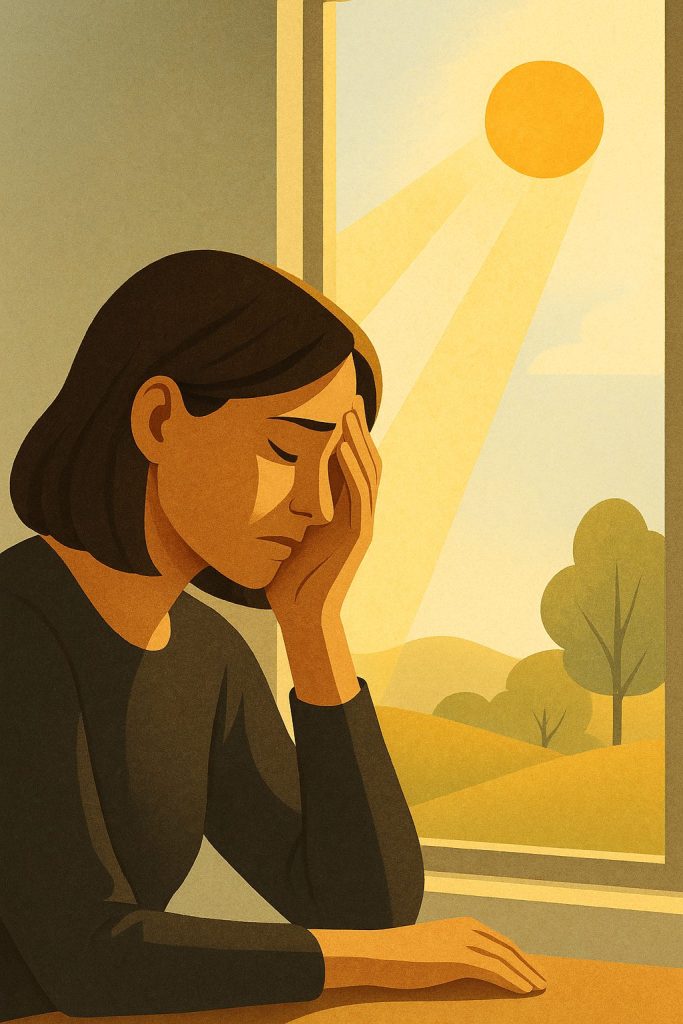
Although SAD is usually associated with autumn and winter, it can also affect some people in summer under specific conditions, as seen during the 2003 heatwave. Since 1984, when Dr Norman E. Rosenthal, psychiatrist and researcher at the National Institute of Mental Health, helped identify the role of light in mood and the body’s internal clock, research has continued to explore practical ways of reducing symptoms linked to low light exposure. Even when symptoms begin to lift naturally in spring, it remains wise to consult a GP for a personalised diagnosis rather than assuming every seasonal dip in mood is the same condition.
That distinction matters because seasonal depression is not simply tiredness or dislike of winter. It is generally associated with a recurrent pattern in which mood, energy, motivation, sleep and appetite shift in a recognisable seasonal rhythm. For some people, the most noticeable change is emotional heaviness; for others, it is cognitive slowing, reduced concentration, increased sleepiness or a sense that ordinary tasks require disproportionate effort. A careful diagnosis helps separate SAD from burnout, thyroid problems, non-seasonal depression, bipolar spectrum conditions or the cumulative effects of chronic stress.
- Winter daylight: around 2,000 lux on average
- Bright summer day: around 100,000 lux
- Estimated prevalence in Europe: 1.3% to 4.6%
Making better use of natural light and light therapy
The first step is often to make the most of natural daylight. A sunny summer day may provide between 50,000 and 130,000 lux, whereas indoor light is far weaker: roughly 100 to 500 lux in a home, and around 400 to 1,000 lux even in a well-lit office. That gap helps explain why simply staying indoors near a window is not always enough. Practical adjustments can still help: light-coloured walls, mirrors positioned to reflect daylight, and windows left unobstructed rather than covered by dark curtains. For anyone planning a home, orientation towards the sun also matters. Even so, the spectrum of sunlight remains fundamentally different from that of artificial lighting.
For many people, timing is almost as important as intensity. Exposure to outdoor light early in the day may help anchor circadian rhythms more effectively than light received late in the afternoon, when the body is already moving towards evening physiology. In practical terms, a morning walk, breakfast near a bright window or arranging work tasks close to daylight can support a more stable sense of wakefulness. These measures are modest, but they may reduce the mismatch between the brain’s internal clock and the social demands of winter schedules.
For people who need additional support at home, light therapy is often considered. Specialists generally advise adults to begin gradually in the morning, with sessions of 10 to 15 minutes, then increase to around 30 to 45 minutes a day using a 10,000-lux lamp that emits no ultraviolet rays. For younger people, sessions are usually shorter, at around 15 to 20 minutes. Studies have supported the value of this approach, as white light entering the eye sends chemical signals to brain regions involved in biological rhythms and hormone regulation. That said, it is not something to improvise alone.
Side effects and contraindications can occur, including headaches, agitation, eye pain or other ocular problems, sedative effects, and possible issues for people receiving treatment for glaucoma. An ophthalmologist and/or GP should therefore be consulted before starting treatment. Caution is also needed with portable blue-light lamps marketed as a new generation of devices: despite the claims, the evidence does not support them over full-spectrum white light.
As Dr Hani Iskandar, Medical Director at the Douglas Institute, states: “The body of research indicates that the best therapeutic effect is obtained with the full spectrum of a 10,000-lux white light.” By contrast, artificial dawn simulation using an alarm clock that gradually brightens the room about half an hour before waking has shown encouraging results, including in a meta-analysis of five clinical trials.
It is also worth noting that response to light therapy is not always immediate. Some people report a perceptible improvement within days, while others need several weeks of regular use before mood, alertness or sleep timing begin to shift. Consistency tends to matter more than occasional long sessions. If symptoms worsen, become unusually activating, or are accompanied by marked irritability or reduced need for sleep, medical review is especially important, as these patterns may require a more nuanced assessment.
- Choose a 10,000-lux white light lamp without UV
- Use it in the morning and increase exposure gradually
- Seek medical advice first if you have eye conditions or relevant treatment
From dawn simulators to therapy: the main treatment options
Daily habits that can strengthen the effect of light
Another option, distinct from standard light therapy, is the dawn simulator. This alarm-based device is programmed the night before and gradually brightens the bedroom around half an hour before waking, in line with your family or work schedule. Unlike portable blue-light lamps, whose claims remain poorly supported, this artificial simulation of sunrise has shown encouraging results, with its effectiveness reported as early as 2005 and supported by a meta-analysis covering five clinical trials. For some people, this gentler transition into the day may help the brain and body move more smoothly into wakefulness.

This may be particularly relevant for those who struggle most at the point of waking: heavy sleep inertia, difficulty initiating the day, and a pronounced sense of mental fog are common complaints in winter depression. A gradual increase in light before the alarm sounds may support a less abrupt shift from sleep to alertness. It does not replace treatment where symptoms are severe, but it may improve the subjective quality of mornings, which is often where seasonal depression is felt most sharply.
Related offer
Mental and Physical Recovery
This session uses waves with extremely precise frequencies that target healing and recovery. Guidance...
View productPhysical exercise also has an important place in the management of seasonal affective disorder. As with other forms of depression, movement can support mood regulation, but when it is done outdoors it may offer a double benefit by combining activity with exposure to daylight. Several Finnish studies suggest that even in winter, a brisk daily walk paired with natural light can be beneficial, ideally for around one hour a day. Diet is sometimes discussed too: researchers currently suppose that a high intake of fish and seafood, rich in omega-3 fatty acids, may help protect against seasonal depression.
Observations in Iceland, where SAD appears to be less common, have led to the hypothesis that both dietary habits and certain genetic factors may contribute to this lower vulnerability.
Exercise may help through several pathways at once: it can improve sleep quality, support stress regulation, reduce psychomotor slowing and restore a sense of agency that depression often erodes. Importantly, the goal is not athletic performance. Regularity is usually more useful than intensity, especially when energy is low. A sustainable routine such as walking, cycling, swimming or gentle strength work may be easier to maintain across the darker months than ambitious plans that quickly become exhausting.
Dietary observations should also be interpreted carefully. Omega-3 intake is of scientific interest, but food is not a stand-alone remedy for a depressive disorder. Still, stable meals, adequate protein, sufficient micronutrients and reduced reliance on highly processed comfort eating may help limit some of the energy fluctuations and lethargy that accompany winter low mood. In practice, nutritional support is best seen as one part of a broader regulatory framework rather than a substitute for treatment.
- Dawn simulators may help by reproducing a gradual sunrise before waking.
- Outdoor exercise combines movement with the regulating effect of daylight.
- Fish and seafood are being studied for a possible protective role linked to omega-3 intake.
When additional treatment may be needed
For people who remain largely unaffected by light therapy, or whose symptoms are not sufficiently relieved, antidepressants can sometimes be useful. In some cases, combining medication with light therapy appears to produce better results than either approach alone. Psychotherapy may also help, especially when it focuses on negative thought patterns, behaviour and the emotional habits that can deepen winter low mood. This kind of work does not replace medical assessment, but for some people it forms an effective part of treatment.
Psychological support can be particularly valuable when seasonal depression has begun to shape expectations and behaviour over time. People may start withdrawing socially, reducing activity, anticipating failure or interpreting winter fatigue as a personal weakness rather than a recurring condition. Therapy may help identify these patterns and loosen the cycle in which low mood narrows attention, narrows attention reduces engagement, and reduced engagement further deepens low mood. In that sense, treatment is not only about symptom reduction but also about restoring flexibility in how the person thinks, plans and responds.
Research is continuing into other possible options. Some studies suggest that supplements containing 5-HTP, also known as oxitriptan, may be of interest for people who are not well suited to light therapy. Because 5-HTP is an immediate precursor of serotonin, these findings have reinforced the idea that low serotonin levels in the brain may be involved in triggering SAD. Melatonin supplements may also ease symptoms in some cases, although caution remains essential because their long-term effects are still not fully understood, despite melatonin’s central role in regulating chronobiological rhythms and its mainly nocturnal production.
St John’s wort (Hypericum perforatum) is sometimes mentioned as well, but at present there is no solid evaluation confirming its value specifically for seasonal depression, even if the plant is recognised in more general depressive states. With the return of brighter days, sensible exposure to sunlight can also support vitamin D production, which is essential for bone health, but excessive ultraviolet exposure remains harmful to both skin and eyes. As Seneca wrote, “When the sun is eclipsed, one sees its greatness”; seasonal affective disorder is a powerful reminder of just how deeply human mental balance can depend on light.
Here too, caution is essential. Supplements that appear “natural” may still interact with medication, alter sleep timing or produce unwanted effects in vulnerable individuals. Melatonin, for example, is not simply a sleeping pill but a signal involved in circadian timing, so dose and timing can matter greatly. St John’s wort is also well known for interacting with a range of prescribed medicines. For that reason, any attempt to use supplements in the context of depression should ideally be discussed with a clinician rather than approached as a harmless self-experiment.
- Antidepressants may help when light therapy is ineffective or insufficient.
- Psychotherapy can work on attitudes and behaviours linked to depressive episodes.
- 5-HTP, melatonin and St John’s wort remain areas of interest, but evidence is still uneven.
A Simple Daily Rhythm for Darker Months
For many people, the hardest part of seasonal affective disorder is not knowing where to begin. A useful plan can stay simple: give the body clearer light in the morning, steadier movement during the day and less stimulation before sleep.
Morning is usually the anchor. Opening curtains early, stepping outside for a short walk or sitting near natural light can all help the body receive a stronger wake signal. If a light therapy lamp is used, it should be used according to safe instructions rather than improvised.
Related offer
Mental Dynamism and Good Mood
The action of our audio recording affects the limbic system, where our emotional keyboard is located. The...
View product- Start the day with daylight before screens when possible.
- Move gently even when motivation is low.
- Keep evening light softer and sleep timing more regular.
- Tell someone trusted when mood is dropping.
This kind of rhythm does not solve everything by itself, but it can reduce the feeling of drifting through the season without control. Small repeated cues often matter more than a dramatic one-day effort.
The Mental Waves Light and Rhythm Framework
The Mental Waves frame is to treat seasonal mood as a rhythm question before treating it as a willpower problem. Light, sleep, movement and mental reset cues all give the nervous system information about when to wake, act, recover and rest.
- Light: seek safe morning daylight whenever possible.
- Rhythm: keep wake time, meals and evening routines steady.
- Movement: use gentle activity to signal energy and circulation.
- Support: ask for help when mood, sleep or motivation deteriorate.
If stress is part of the seasonal pattern, continue with How to Free Yourself from Stress. If sleep timing is the concern, read Natural Sleep Aids.
Editorial note from Mental Waves
This article is educational. Seasonal affective disorder can be serious, and light therapy may require medical advice for some people, especially when eye conditions, bipolar disorder, medication or severe depressive symptoms are involved.
Conclusion
Seasonal affective disorder is not simply a case of “winter blues”, nor does it yield to a single remedy. What emerges instead is a more careful picture: light remains the central lever, because it is closely tied to biological rhythms, mood regulation and the brain’s internal sense of timing, yet its use still calls for judgement. Natural daylight, properly supervised light therapy and dawn simulation may all help, but they do not cancel the need for an individual assessment, especially where symptoms are marked, persistent or intertwined with another depressive condition.
That is why the most sensible response is often a combined one: more daylight where possible, regular movement outdoors, and, when needed, psychological or medical support adapted to the person rather than the season alone. The article also keeps an important scientific balance in view: some approaches appear promising, while others remain uncertain or insufficiently supported. In that sense, managing SAD is less about chasing a miracle solution than about restoring conditions in which the mind and body can regulate themselves more steadily. Sometimes, a little more light is not a metaphor at all.
Perhaps the most useful conclusion is therefore a practical one. If low mood, oversleeping, slowed thinking, loss of motivation or recurrent winter withdrawal return year after year, it is worth taking the pattern seriously rather than normalising it. Seasonal depression may be linked to the environment, but it is experienced in the texture of everyday consciousness: in attention that feels blunted, in mornings that feel disproportionately heavy, and in a reduced capacity to engage with life. Recognising that pattern early may help people seek support before the season fully closes in.
Frequently Asked Questions About Seasonal Affective Disorder
What is seasonal affective disorder?
Seasonal affective disorder is a recurring mood pattern linked to seasonal changes, often with lower mood, fatigue, sleep changes and reduced motivation.
Why does light matter so much?
Light helps regulate the body clock and mood-related rhythms, which is why reduced daylight can affect energy and emotional balance.
Can it happen in summer?
Yes. Winter patterns are more common, but some people experience seasonal mood difficulty during brighter or hotter months too.
How is light therapy usually used?
It is often used in the morning with a suitable lamp, but timing, distance and duration should follow safe guidance.
Are there precautions with light therapy?
Yes. People with eye conditions, bipolar disorder, medication sensitivity or severe symptoms should seek professional advice first.
What daily habits may help?
Morning daylight, stable sleep timing, outdoor movement, social contact and reduced evening overstimulation may support a steadier rhythm.
Is ordinary indoor light enough?
Usually not. Outdoor daylight is much stronger than typical indoor lighting, even on grey days.
When should someone seek help?
If low mood, sleep disruption, hopelessness or loss of function persists, professional support is important.
What is the main takeaway?
Seasonal affective disorder is best approached through light, rhythm, daily support and appropriate care rather than self-blame.