en
enVotre panier est vide.


Music can affect us far more deeply than we often realise. Within that wider relationship between sound, perception and inner state, the so-called sacred frequencies — or sacred solfeggio — refer to a precise scale built around nine tones: 174, 285, 396, 417, 528, 639, 741, 852 and 963 Hz. These frequencies are often sought for their potential to support a sense of rebalancing across the emotional, physical and mental dimensions of experience, and are associated with themes such as change, intuition and the easing of fear.
This idea does not sit outside a longer history of reflection on sound. Observers and researchers have, in different ways, explored how frequencies, melodies and harmonies may influence the body, attention and emotional regulation. In that context, sacred frequencies are presented not simply as abstract tones, but as part of a tradition that links listening with inner transformation — a tradition shaped both by the history of the original solfeggio scale and by more recent attempts to understand how sound may act on consciousness, mood and the felt coherence of the self.
How Sound Frequencies Shape the Body, Mind and Sacred Scale
Why sound can affect more than mood
Music can have a surprisingly deep effect on human experience. In the tradition of the sacred frequencies, also known as the sacred solfeggio, this takes the form of a precise scale built around nine tones: 174, 285, 396, 417, 528, 639, 741, 852 and 963 Hz. These frequencies are often sought for their potential to support inner balance, encourage change, sharpen intuition and help loosen the grip of fear. While such claims should be approached with care, the broader idea that sound can influence the body and mind is not new.
In short: what are sacred frequencies used for?
Sacred frequencies are used as listening supports for relaxation, meditation, emotional reflection and symbolic inner work. Traditions associate different tones with different meanings, but the safest approach is to treat them as sound rituals rather than simple biological interventions.
- 174 Hz is often linked with comfort and grounding.
- 396 Hz is associated with fear, guilt and release symbolism.
- 528 Hz is often presented as a frequency of repair or harmony.
- 963 Hz is linked with unity, spiritual openness and subtle awareness.
For historical and symbolic context, read Sound, Frequency and Vibration. For a free listening cue, receive the Sacred Frequency Session.
Marie-Louise Aucher highlighted the direct effect of sound and frequency on the physical body, and many listeners recognise that melodies, harmonies, instruments and tonal structures can also shape emotional state, attention and mental regulation.
Sound does more than fill the ears: it can evoke images, organise perception and sometimes help release emotions that feel held in the body. Even Lenin is said to have acknowledged music’s disarming power when he remarked, “I cannot listen to music too often; it makes me want to say silly things and stroke people’s heads.” In a different register, the work of Tomatis, the Hypérion method and other sound-based approaches suggests that certain filtered frequencies used in therapeutic listening may help some people regain a sense of stability.
Within that wider landscape, sacred frequencies are presented as tones that may support not only emotional wellbeing, but also the physical, mental and spiritual dimensions of experience.
- They are associated with emotional release and inner regulation.
- They are often used in sound therapy and meditative listening.
- They are traditionally described as acting on body, mind and consciousness together.
From Saint John’s hymn to the sacred scale
The origin of the sacred frequencies is traditionally linked to the hymn of Saint John the Baptist. In that hymn, the first six lines correspond to the first six successive notes of the sacred scale, with the opening syllable of each line sung one degree higher than the one before it. The Benedictine monk Guido d’Arezzo (991–1050) was the first to develop this original form of solfège as a practical aid for singers. It was organised around six ascending notes: Ut, Re, Mi, Fa, Sol and La. Over time, Ut was replaced by Do, derived from Dominus, because it was easier to sing.
Research also indicates that the seventh note, Si, was only named in the sixteenth century, from the contraction of the S of Sancte and the J of Johannes.
According to this tradition, these tonal developments changed the way people sang and understood the scale. The older frequencies then faded from view before later being brought back into discussion through the work of Dr Joseph Puleo. He claimed to have rediscovered a pattern of six codes in the Book of Numbers, chapter 7, verses 12 to 83, using an ancient method of reducing verse numbers to whole digits associated with Pythagoras. From this, he concluded that the first six electromagnetic sound frequencies corresponded to the six lost notes of the sacred scale.
Whether one sees this as symbolic, historical or vibrational, it remains central to the modern story of sacred frequencies and to the meanings now attached to them.
- Guido d’Arezzo structured the original six-note solfège.
- Ut later became Do, and Si appeared in the sixteenth century.
- Dr Joseph Puleo linked the lost notes to a numerical reading of the Book of Numbers.
The Higher Sacred Frequencies and the Story of 528 Hz
From relationship balance to a sense of unity
In this tradition, the higher sacred frequencies are associated with progressively subtler forms of regulation. 639 Hz is often sought for harmony in relationships: it is said to support connection in family, friendship and professional life, while encouraging a more communicative, understanding and tolerant state of mind. Some descriptions also link it to better communication between cells and their environment. 741 Hz, meanwhile, is presented as a frequency for intuition, self-expression and problem-solving. It is traditionally described as helping to clear what is burdensome or toxic, so that life feels simpler, steadier and more aligned.
852 Hz is usually connected with intuition, spiritual order and unconditional love. In the language of the sacred scale, it may help a person see beyond illusion and feel more attuned to the dimension of spirit. 963 Hz extends this movement even further: it is associated with unity, light and a sense of connection with universal energy. Whether one interprets these claims symbolically, spiritually or through the lens of inner experience, these higher tones are commonly used to support a feeling of coherence, expanded awareness and a return to what many describe as one’s truest nature.
- 639 Hz: harmony in relationships and communication
- 741 Hz: intuition, self-expression and inner clearing
- 852 Hz and 963 Hz: spiritual order, insight and unity
Why 528 Hz became so iconic
Among all these tones, 528 Hz has acquired a special status. According to legend, this so-called “frequency of love” was once sung repeatedly to open the heart and invite peace. It is described as a vibration that may restore confidence, serenity and a sense of inner potential. Many accounts also associate it with imagination, intuition and self-realisation, while its reputed ability to “repair DNA” is what gave rise to the well-known label “miracle frequency”. In some narratives, its resonance is linked to the sound of acoustic instruments such as the accordion, cello, kora, voice, kalimba and Tibetan bowls, and it is imagined as being revealed within deeply relaxing music that can be listened to again and again.
The modern appeal of sacred frequencies has also been supported by a broader scientific and para-scientific history around vibration, information and living systems. Georges Lakhovsky described cells as biological oscillators; Emile Pinel explored the mathematical mechanisms governing cellular life; and Dr Fritz-Albert Popp’s work on biophotons suggested that cells exchange information through light. Étienne Guillé proposed that biology rests on a matter-vibration relationship, with DNA acting in some respects like an antenna, while Peter Gariaev argued that DNA may also store, process and interpret information rather like a biological computer.
Other references often cited in this field include Luc Montagnier’s return to Benveniste’s work on the “memory of water”, Masaru Emoto’s photographs of frozen water crystals, cymatics, which studies the forms created by sound vibrations in matter, and epigenetics, which shows that behaviour, environment and wellbeing can influence gene expression. Taken together, these ideas do not prove every claim made about sacred frequencies, but they do help explain why sound therapy is often explored as a way to influence inner state, attention, relaxation and the felt relationship between body and mind.
- 528 Hz: linked in legend with love, peace and confidence
- “Miracle frequency”: a nickname tied to claims about DNA repair
- Scientific backdrop: oscillators, biophotons, cymatics and epigenetics
How to Use Sacred Frequencies Without Overclaiming
The appeal of sacred frequencies comes from more than numbers. A frequency becomes meaningful when it is placed inside a ritual: a quiet space, a listening intention, a relaxed body and a moment of attention that is not being pulled in ten directions at once.
That does not mean every traditional claim should be treated as scientific proof. The better approach is to respect the symbolic language while noticing what the listening experience actually changes for you.
- Choose one frequency rather than jumping from tone to tone.
- Set a simple intention before listening.
- Listen at a comfortable volume.
- Observe mood, breath and body tension afterward.
The Mental Waves Sacred Frequency Listening Framework
The Mental Waves frame is to make sacred frequency practice precise, gentle and repeatable. The frequency is not a magic command. It is a sound environment that may help attention reorganise.
- Prepare: make the space calmer before the session starts.
- Listen: allow the sound to be received without forcing an effect.
- Name: connect the frequency with one clear emotional theme.
- Integrate: bring one grounded action back into the day.
For the 432 Hz debate, read 432 Hz Tuning. For visual sound patterns, continue with Cymatics.
Editorial note from Mental Waves
This article explains sacred frequencies as symbolic and experiential sound practices. It does not claim that a frequency can diagnose, treat or cure a medical condition.
Conclusion
Sacred frequencies sit at an unusual crossroads: part musical tradition, part symbolic system, part modern search for inner regulation. What gives them their lasting appeal is not simply the promise of a specific number in hertz, but the broader experience that sound can alter attention, emotional tone and the felt sense of the body. In that light, the language around these frequencies may be interpreted with care: some claims belong to spiritual practice or personal testimony, while others resonate more plausibly with what we know about perception, relaxation and the way rhythmic sound can influence mental state.
That balance matters. The history of the sacred scale, the special status often given to 528 Hz, and the attempts to connect vibration with biology all point to the same human intuition: that sound is not neutral, and that certain tonal environments may help us feel more centred, open or calm. Used thoughtfully, these frequencies are perhaps best approached not as promised remedies, but as tools for listening — to the body, to emotion and to the quality of our own awareness. Sometimes, that shift in listening is already significant.
Scientific sources and references
To explore the subject further, the work of Tomatis, the Hypérion method and many others suggests that certain frequencies we hear during sound therapies, once filtered, may help to stabilise a person once again.
Sacred frequencies are among them, and are said to benefit our emotions as much as the physical body, the spirit and the mind.
The origin of sacred frequencies

Sacred frequencies were discovered through the hymn of Saint John the Baptist, a hymn whose first six lines correspond to the first six notes in succession of the sacred frequencies. In it, the first syllable of each line is sung on a note one degree higher than the first syllable of the line before it.
The Benedictine monk Guido d’Arezzo (991–1050) was the first to develop the original solfeggio. It was intended to help singers sing more easily and took the form of six ascending notes: Ut-Re-Mi-Fa-Sol-La. Later, it was found that the syllable UT was difficult to sing because it did not end with a vowel, so it was naturally replaced by DO from Dominus.
Research also shows that the seventh note, SI, was not given that name until the 16th century. Its name comes from the contraction of the S in Sancte and the J in Johannes. The appearance of these frequencies significantly changed the way people sang the notes. Having fallen into obscurity, the ancient frequencies reappeared thanks to the work of Dr Joseph Puleo.
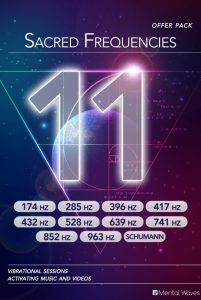
Related offer
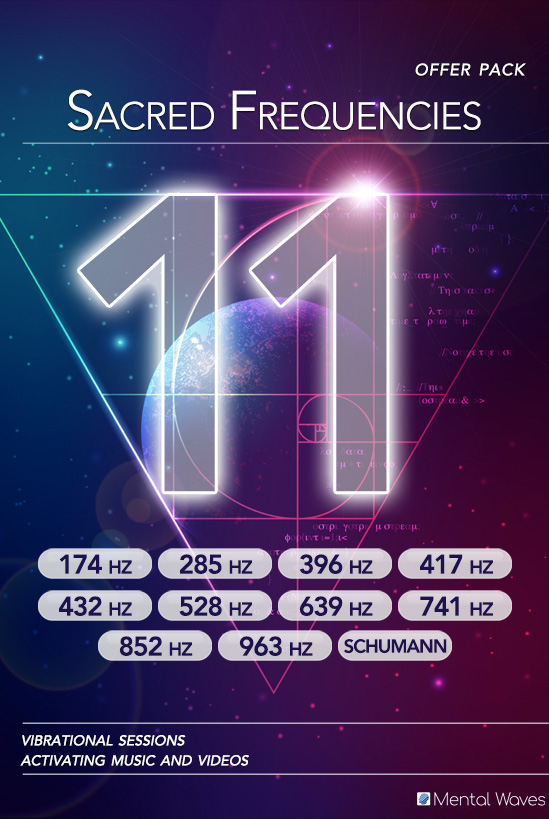
11 Sacred Frequencies + Climax Bundle
Sacred Frequencies Pack including 10 videos and 11x 20-minute tracks of activating music.
View productHe rediscovered the pattern of the six codes in the Book of Numbers, chapter 7, verses 12 to 83. He deciphered these notes using the ancient method of reducing verse numbers to whole numbers developed by Pythagoras. In this way, he found that the first six electromagnetic sound frequencies corresponded to the six lost notes of the sacred frequency scale.
Sacred frequencies and their benefits
Each of the sacred frequencies mentioned in the introduction is said to have its own benefits:
The 174 Hz frequency
It is regarded as the foundation of the frequencies and acts as a natural anaesthetic. This tuning frequency is said to bring a feeling of safety, serenity and love to the organs of the human body. It encourages them to keep improving and helps to relieve physical pain.
The 285 Hz frequency
The 285 Hz tuning frequency is said to be capable of regenerating tissues to the point of restoring their original form. It acts on the etheric body and the chakras by sending them a message that would restructure damaged organs in the body. Ultimately, it is said to restore health and vitality to our organism.
The UT-396 Hz frequency
People struggling with guilt and fear may free themselves from them through the UT-396 Hz frequency. It is linked to the first chakra and to the colour red, and may help dissolve feelings of guilt.
That feeling, combined with fear, represents one of the main obstacles to self-realisation and may reduce the risk of us from fulfilling our goals. They stop us from expressing who we truly are deep down. With the 396 Hz frequency, it is said that we can release the hidden blockages within us and the negative beliefs lodged in our subconscious.
The RE – 417 Hz frequency
This is presented as the ideal frequency for a desire for change. It resonates with difficult and traumatic experiences by connecting with them and transforming them. To do this, it allows the body to come into contact with a source of endless energy capable of changing the emotional patterns that harm us.
The MI-528 Hz frequency
A miraculous frequency said to be capable of transforming us and repairing our DNA. It is therefore called the “frequency of miracles”. By repairing DNA, it is said to increase the amount of vital energy in the body, make the mind clearer and raise consciousness.
The 528 Hz frequency may also lead us to absolute inner peace. It is said to make us more imaginative, more intuitive and to stimulate intention. For the mathematician Vic Showell, “the 528 frequency, music of Light, is the key to spiritual freedom”. It is also said to be closely linked to the Golden Ratio and to Pi.
The FA – 639 Hz frequency
It helps to reconnect and rebalance relationships while unifying and connecting neurons. This frequency is said to make relationships more harmonious. It may resolve relational difficulties at different levels: family, friendship, professional life and more. This tuning frequency may also stimulate communication between cells and their environment. It is said to make a person more communicative, understanding, tolerant and full of love.
The SOL – 741 Hz frequency
To awaken and activate intuition, encourage self-expression and resolve various problems, the Sol 741 Hz tuning frequency is recommended. It eliminates toxins from our cells and helps us move towards a healthier, simpler existence.
It cleanses the cell through different electromagnetic radiations and resolves all kinds of problems. This tuning frequency leads to a pure and stable life by encouraging self-expression.
The LA – 852 Hz frequency
A frequency that awakens intuition, restores spiritual order and gives power to unconditional Love. It may help us see through the illusions of life and communicate with Spirit. It contributes to the restoration of spiritual order and allows a higher level of cellular transformation.
The SI – 963 Hz frequency
It allows mastery of and connection with universal energy and grants a feeling of unity. This tuning frequency, linked to Light, concerns both the infinitely small and the infinitely vast, and reconnects the being with Oneness. It also allows a reconnection with universal energy and spiritual energies, and enables us to express our true nature through Unity.
The story of the 528 Hz frequency
According to legend, the 528 Hz tuning frequency, also called the frequency of Love, was sung constantly to open hearts and receive peace. It consists of a vibration capable of restoring confidence, serenity and the infinite potential of the listener.
Some claimed that this frequency could release certain negative emotions and encourage intuition, imagination and self-realisation. To these qualities is added its ability to restore DNA, a faculty that earned it the nickname “miracle frequency”.
According to the story, the 528 Hz tuning frequency would radiate and vibrate through the gentle sounds of acoustic instruments such as the accordion, cello, kora, singing voice, kalimba, Tibetan bowls, and so on.
This magical frequency would one day be “revealed and presented at the heart of relaxing music, music specially suited to allow it to be heard tirelessly. The listener could feel its presence in different sound environments.”
Related offer
Sacred frequency 963 Hz
963Hz : INNER LIGHT Reveal the power of your perfect nature... STRENGTH - ELEVATION - FULL AWARENESS
View productA closer look at the scientific developments leading to the use of frequencies
 Over the course of a century, scientific developments have highlighted different paradigms:
The work of Georges Lakhosky (1869–1942)
This scientist and engineer was the first to suggest that cells and their nuclei are “biological oscillators” through which data are transmitted by the emission of electromagnetic waves.
Emile Pinel (1906–1985)
This mathematician studied the biological mechanisms governing the life of cells by using mathematical analysis.
The work of Dr Fritz-Albert Popp
Dr Fritz-Albert Popp, founder of The International Institute of Biophysics in Neuss, measured photons emanating from various organisms using modern instruments of exceptional sensitivity and precision.
His work, carried out in the 1980s with a scientific team from the University of Marburg in Germany, suggests that photons carry and then transmit information to other cells in the body. These biophotons allow the exchange of information between cells and create biochemical reactions.
The hypothesis of Etienne Guillé
This biologist states that biology rests on a combination of matter and vibration. Matter would be the support, while vibration carries the information. In addition, in 1983 he stated that the functioning of certain parts of DNA resembles that of receptors and transmitters of electromagnetic vibrations. In this sense, DNA is regarded as an antenna that emits and transmits data to the other cells of the body.
The findings of Dr Peter Gariaev
Peter Gariaev, Director of the Wave Genetics Institute in Moscow, argues that DNA does not merely receive and emit information. It is a storage site that processes, interprets, deciphers, modifies and records the data it receives, and reacts accordingly. It is said to have the same functions as a biological computer.
The recording of information by water
Dr Luc Montagnier, who discovered the AIDS virus, revisited Benvéniste’s work in a report entitled “We Rediscovered the Memory of Water”. It was produced with the help of Dr Masaru Emoto, who proposed a process for photographing frozen water crystals. This Japanese doctor claimed to show that water receives information and reacts accordingly.
Cymatics
Here we enter the world of frequencies and vibrations. Cymatics studies the images created in different materials by the vibrations of sounds and frequencies.
Epigenetics
 This branch of biology studies the modulation of the expression of our genes based on our various behaviours. It invites us to think differently from the way we do today. According to epigenetics, it is possible to modulate the expression of our genes depending on how we behave each day. In this sense, doing sport or physical exercise, eating, interacting socially, feeling pleasure in living, the environment, and our state of wellbeing all have an impact on the expression of our genes.
Taken together, all this information suggests that sacred frequencies may alter our inner state, and even our outer state, during sound therapy.
Frequently Asked Questions About Sacred Frequencies
What are sacred frequencies?
Sacred frequencies are tones associated with symbolic, spiritual or wellbeing meanings, especially in solfeggio traditions.
Are sacred frequencies scientifically proven?
Some sound effects are studied scientifically, but many sacred frequency meanings are traditional, symbolic or experiential rather than proven medical facts.
Why is 528 Hz so famous?
528 Hz is often linked with repair, harmony and transformation in sacred frequency culture, although claims should stay measured.
What is 396 Hz associated with?
396 Hz is often associated with release from fear, guilt or limiting emotional patterns.
What is 963 Hz associated with?
963 Hz is commonly linked with unity, spiritual awareness and a sense of expanded consciousness.
How should someone listen to sacred frequencies?
Choose a comfortable volume, settle the body, set a simple intention and notice the response without forcing results.
Can sacred frequencies replace care?
No. They may support wellbeing or meditation, but they do not replace medical or psychological care.
What is solfeggio?
Solfeggio refers to a musical naming tradition that has also become linked with sacred frequency interpretations.
What is the main takeaway?
Sacred frequencies are best used as intentional listening supports, with wonder, structure and grounded expectations.