en
enVotre panier est vide.


If Jnana, Bhakti and Karma Yoga set out the great spiritual foundations of the tradition, the many paths that lead towards them — Raja Yoga, Hatha Yoga, Kriya Yoga or Kundalini Yoga — inevitably place more emphasis on preparatory disciplines. That shift can sometimes make Yoga look like a collection of methods, when in fact those methods were never meant to stand alone. In the Indian understanding, technique is a support, not the destination; something that prepares the body, steadies the mind and sustains practice, rather than replacing the spiritual aim itself.
In short: paths of yoga
The paths of yoga are different ways of organising attention, action and inner discipline around a calmer relationship with life.
Use this article as a practical map: keep what helps attention become steadier, question anything that sounds absolute, and connect the idea back to repeatable daily practice.
A simple comparison helps. There are, of course, people who devote their whole lives to cars — racers, collectors, enthusiasts of every kind — but most people simply learn to drive so they can get to work or go away on holiday. The car is a means, not an end. Much the same is true of Yoga. A few practitioners give themselves to it completely, exploring its furthest demands, but most seekers approach the basic postures and disciplines in order to cultivate the physical health, psychological balance, energetic stamina and mental concentration that make meditation possible.
From one school to another, the number of techniques and the place given to them may vary enormously; what matters is not mistaking the path for the goal.
Yoga techniques are means, not the destination
Why the practical paths of Yoga focus so much on technique
If the great spiritual paths of Yoga — Jnana, Bhakti and Karma — establish its essential inner foundations, the many routes that lead towards them, such as Raja Yoga, Hatha Yoga, Kriya Yoga and Kundalini Yoga, naturally give more space to preparatory methods. These methods can sometimes seem to dilute the spiritual core, yet they remain part of the Yogi’s Sadhana, or practice, for a very simple reason: they help prepare the body, the energy and the mind for meditation.
A useful comparison is that of the motor car. There are racing drivers, collectors of vintage cars and enthusiasts devoted to performance for its own sake. But most people simply learn to drive so they can get to work or go away on holiday. For them, the car is a means, not an end. In much the same way, a few people in India devote their whole lives to Yoga, exploring every aspect of it or pushing it to extremes. Most spiritual aspirants, however, are content to learn the basic postures and techniques that support physical health, psychological balance, energetic stamina and mental steadiness — all of which are needed for the meditative state to become possible.
Here too, the techniques of Yoga are tools rather than the goal itself, even if their number and importance vary greatly from one method to another.
- Some paths emphasise posture.
- Others work more directly through the mind.
- All use technique as preparation rather than fulfilment.
From posture and breath to the movement of energy
Even though the techniques differ from one school to another, many are shared across several forms of Yoga. The best known is the bodily posture, or Asana, though its place is far from identical everywhere. In Zazen, posture is everything. In the Raja Yoga of the Brahmakumaris, it has no real place at all. Hatha Yoga, by contrast, gives posture a central importance without reducing the whole discipline to that alone. Broadly speaking, postures are intended to steady the mind while helping energy circulate more freely. Breathwork, or Pranayama, is just as important. Here, “breath” does not refer only to air moving through the lungs, but to the whole play of vital currents within the body.
Traditional teaching distinguishes several of these currents — prana, apana, samana, udana and vyana — each associated with particular bodily centres and functions. Through breathing techniques, the Yogi seeks to regulate them and gradually awaken the latent spiritual energy known as Kundalini.
Other methods serve the same aim of directing and refining the life force. Mudras use symbolic hand gestures; Bandhas rely on muscular locks, including contractions of the sphincters. Some more austere practices are still used at times: cleansing the stomach, intestines, sinuses, tongue, ears, teeth or genital passages; stimulating the body’s eliminative organs such as the kidneys, lungs and skin; and purifying the energetic centres, the chakras, along with the channels known as nadis. Taken together, these practices are all meant to purify and stimulate the energies. Yet even here, their deeper purpose remains the same: not technique for its own sake, but the gradual preparation of the whole being for inner stillness.
- Asana: posture and stability
- Pranayama: breath and vital currents
- Mudras and Bandhas: directing energy
- Cleansing practices: purification of body and subtle channels
From bodily discipline to inner steadiness
Why the work does not stop at the body
All these preparatory methods are, in essence, intended to purify and stimulate the energies. Yet Yoga does not truly end with bodily practice. Beyond postures, breathwork and energetic techniques, its heart lies in two more directly psychological and spiritual stages: concentration and meditation. As long as a person remains strongly identified with the body, it is natural for Yoga to begin there, using physical practice to quieten the mind. But for someone whose life is centred more in thought than in sensation, the work may begin more directly with the mind itself.
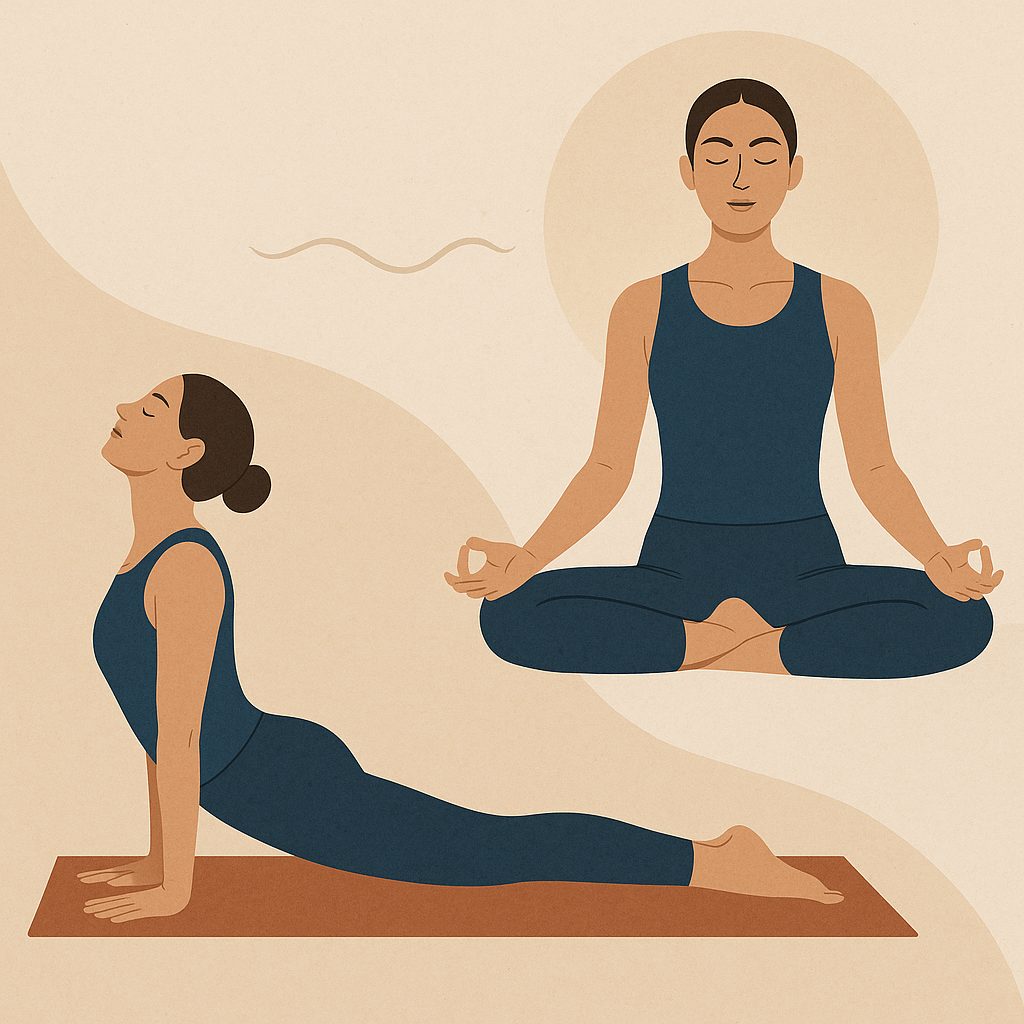
That is where concentration, or Dhâranâ, becomes essential. Its aim is to bring about the inner calm without which no real spiritual work can take root. In that sense, the physical techniques are not dismissed; they simply serve a larger purpose. They prepare the ground so that attention can become steadier, less scattered and more available for what follows.
Dhâranâ: gathering the mind around a single point
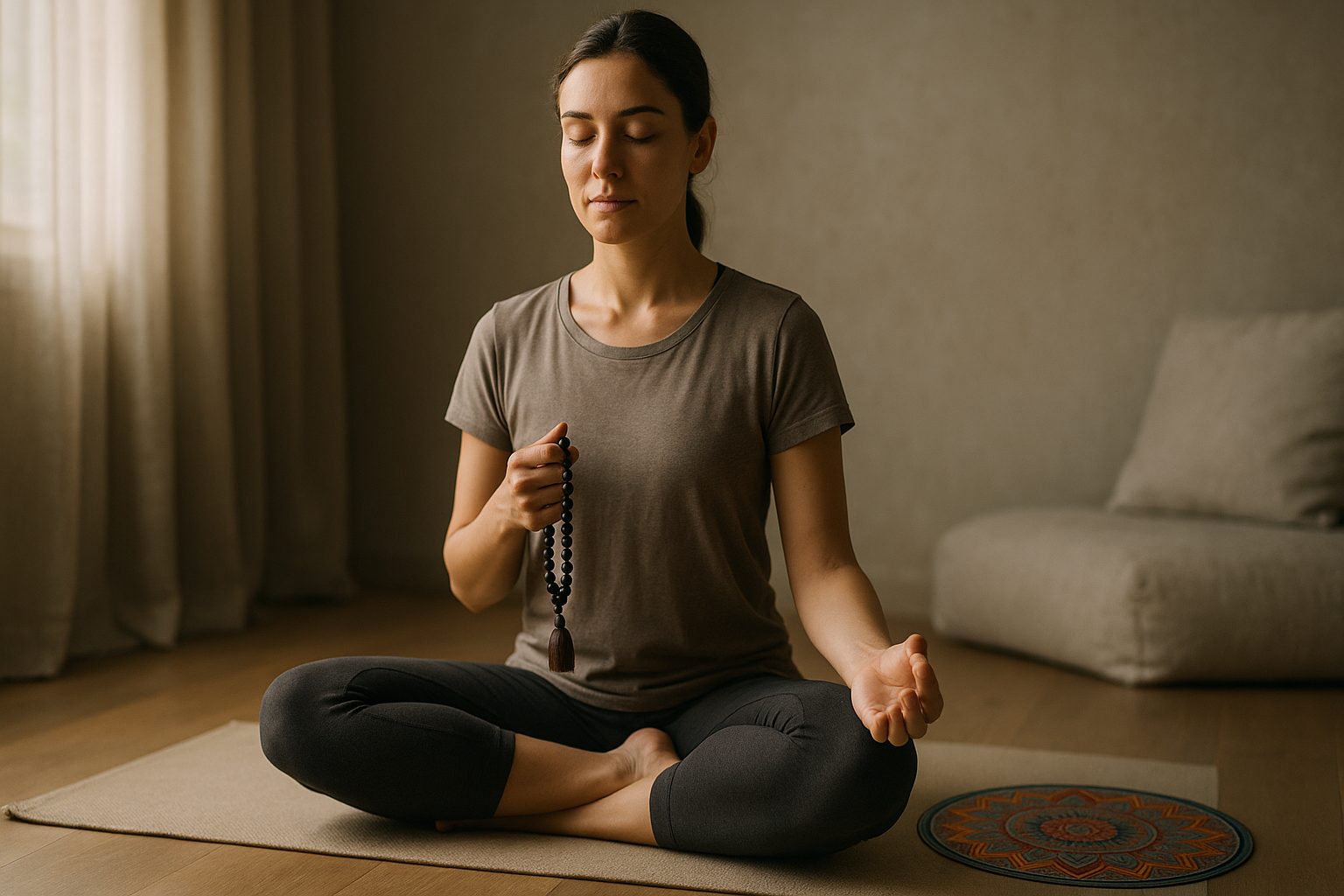
Dhâranâ is closely linked to Pratyahara, the withdrawal of the senses, which trains attention to turn inward rather than being constantly pulled outward. From there, concentration consists in fixing the mind on a chosen object. That object may be external — a figurine, a statue, a flower, the ticking of a clock, the sound of water — or it may be located in the body, such as the third eye, the tip of the nose, the heart chakra or the spine. It may even be something inward and subtle: an emotion, a sensation, a thought, an energy.
This practice helps counter mental dispersion, but its role is deeper than simple calm. Spiritually speaking, it teaches the mind to set aside every thought except one: the one deliberately held in view. In doing so, it greatly clarifies the inner field. At its furthest point, concentration allows one to oppose a kind of sacred obsession to worldly obsessions — to replace old habits that keep illusion in place with a single, steady inclination towards Freedom.
- external objects such as a flower, a statue or the sound of water
- points in the body such as the third eye, the heart centre or the spine
- inner objects such as a sensation, a thought or an emotion
From Focused Practice to True Meditation
Mantras and mandalas as supports for concentration
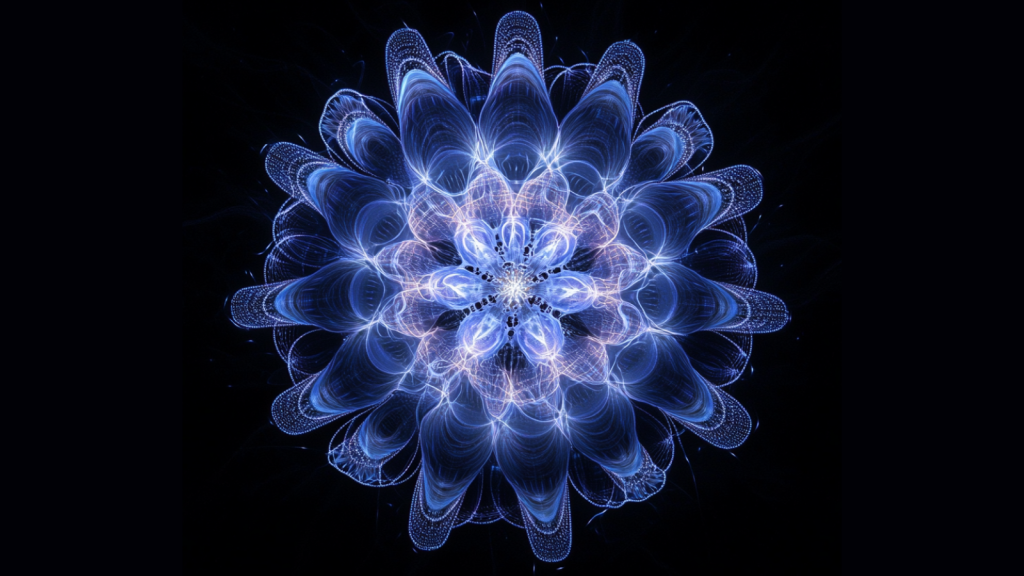
To help the aspirant move towards these aims, two major complementary supports have traditionally been used: mantras and mandalas. Mantras involve the repeated use of words or syllables such as “OM”, formulas generally said to have been established by great Yogis in deep meditation. Mandalas, by contrast, are graphic representations of the evolution of consciousness, tracing a movement from the state of the ego towards that of the Absolute, and serving as a visual point of concentration for the practitioner.
Related offer
OM Meditation
This music is based on the particular frequency of the sacred chant OM. Listening to this program, the term...
View productThese methods belong to the work of Dhâranâ, or concentration. At this stage, there is still an observing self: the subject fixes attention on an outer or inner object, and this act of focusing strengthens, steadies and above all calms a mind that is usually restless, overstimulated and endlessly distracted. In that sense, concentration is already a powerful discipline. It gathers scattered mental energy and gives the practitioner a first real taste of inner stability.
- Mantras: repeated words or syllables such as “OM”
- Mandalas: visual symbols used to support concentration
Dhyâna, where the observer falls away
Beyond Dhâranâ lies Dhyâna, meditation in the fuller spiritual sense. The Sanskrit term is the one that became “Zen” in Japan. The difference is decisive: in concentration, an “I” remains, attending to something; in Dhyâna, there is no longer either an observing subject or an observed object. At first, this may mean being open to everything at once, to what is happening outside and inside, without selecting one phenomenon over another: simply receiving what presents itself, attentive to attention itself, as though one were the observer of the observer.
Then a further recognition becomes possible: that true attention is none other than awakening, Samadhi. Yet such absolute attention cannot be produced by technique alone. It belongs to a state of Grace, if by Grace we mean the natural and spontaneous functioning of Consciousness once it has been cleared of ego. All the preparatory exercises of Yoga can lead a person to the threshold, but they cannot manufacture that final shift. They can only help to wear away the ego to a certain extent, making room for what no exercise can command.
When Practice Helps — and When It Gets in the Way
No technique can manufacture awakening
As Ramana Maharshi taught: “How is the Self realised? By getting rid of the ego. How is the ego to be got rid of? By realising the Self.” The paradox is central. All the preliminary exercises, and indeed all the paths of Yoga, can only take us so far. They may help to wear down the ego, soften its grip and prepare the ground, but they do not in themselves produce awakening. At most, they create conditions in which something deeper may become possible — and even then, only if the ego is willing, so to speak, to be eroded.
This is why yogic methods should never be mistaken for the goal. Used in a self-centred way, merely to strengthen the psycho-physical self, they can become obstacles rather than supports. A practice meant to free us may end up reinforcing the very structure it was supposed to loosen. Seen in that light, Yoga is perhaps best approached not as a system for achieving spiritual results on demand, but as an art of living: a disciplined, lucid way of inhabiting body, mind and consciousness without turning practice into another possession of the ego.
Why ethics and self-knowledge come before method
That art of living rests on a framework of laws intended to accompany the Yogi on the path: Yama, the moral disciplines, and Niyama, the principles of purification. These concern truthfulness, honesty, sexuality, greed, purity, non-violence, contentment, austerity and study. Ideally, it is only once these principles have been genuinely woven into daily life that the techniques of Yoga should be applied — not as spiritual decoration, but as practical means of preserving the health and vitality of body and mind, without which the intensity required for meditation is far harder to sustain.
There is also a necessary caution here. Beyond health and balance, these techniques can unblock sensitive points, awaken new capacities and, above all, help us shed what our inner development has made obsolete and burdensome. But that also means they must be chosen with care. A method that tries to develop what we no longer need, or to destroy what has not yet truly formed, wastes time and may even do harm. The choice of a Yoga must therefore answer to strictly individual needs, which is why a minimum of self-knowledge is indispensable: we need enough honesty to distinguish between our real deficiencies and the insights we have already integrated.
- Yama: moral disciplines such as truthfulness, honesty and non-violence
- Niyama: principles of purification, contentment, austerity and study
- Technique should follow lived integration, not replace it
Choosing the Right Yoga for Where You Really Are
A method only helps when it matches a real need
It follows that if we use techniques designed to develop capacities we no longer need, and may even have already outgrown, or if we try to destroy tendencies that are not yet truly present in us, we risk wasting time and doing ourselves harm. A practice is not wise simply because it is traditional, demanding or impressive. Its value depends on whether it answers something real in us, at the right moment, and in the right measure.
That is why the choice of one’s Yoga must remain strictly individual. What steadies one person may burden another; what opens one practitioner may confuse someone else. The point is not to adopt the most celebrated path, but the one that genuinely corresponds to one’s present condition, one’s temperament and one’s actual stage of inner development.
- some practices strengthen what is still lacking
- others help loosen what has become unnecessary
- the mistake is to confuse one need with the other
Self-knowledge comes before technique
For that reason, even a modest degree of self-knowledge is indispensable. One must be able, at least in part, to distinguish between genuine deficiencies and insights already integrated. Without that discernment, it becomes all too easy to choose methods for the wrong reasons: to chase powers instead of clarity, to force a purification that has not yet become meaningful, or to cling to exercises that once helped but no longer serve.
Seen in this light, Yoga asks for honesty before ambition. It is less a matter of accumulating techniques than of recognising what is needed now, and what is not. That sober lucidity is part of the path itself. It protects practice from becoming mechanical, and gives each method its proper place: not as an end in itself, but as a support adjusted to the practitioner’s real necessities.
Related offer
Meditation - Relaxation set
All the Mental Waves® know-how in a single pack for quick and easy access to meditation and...
View productThe Mental Waves Yoga Integration Framework
The Mental Waves frame is to treat yoga as integration. The path is not only posture or philosophy; it is the repeated act of bringing body, breath, attention and conduct into the same direction.
A useful practice can stay simple. Choose one path, one posture, one breath cue or one attitude, then repeat it consistently enough for daily life to absorb it.
Before practice, the free Mental Reset session can help create a quieter transition from scattered attention into deliberate presence.
Editorial note from Mental Waves
This article respects traditional yoga categories while keeping the practical focus clear: yoga is a lived discipline, not a collection of labels.
Conclusion
The real thread running through these different paths is simple, though not simplistic: Yoga is not reducible to its techniques. Posture, breath, concentration, purification and energetic work all have their place, sometimes an essential one, but they remain preparatory unless they serve something deeper than performance, comfort or self-image. The body may need discipline, the mind may need steadiness, and the whole being may need a more ethical, lucid way of living; yet none of that can, by itself, force awakening into being.
That is why the article holds two truths together without confusing them. Practice matters, because without a certain balance, vitality and inwardness, meditation easily remains an idea. But practice also has limits, and can even become another refinement of the ego when it is pursued as an end in itself. Seen in that light, the choice of a yoga is never a matter of fashion or prestige, but of honesty: what is needed here, now, for this particular person, on this particular stretch of the path.
Perhaps that is the most demanding lesson of all: Yoga asks less to be accumulated than to be lived.
Frequently asked questions about the paths of Yoga
What is the main difference between the great paths of Yoga and the practical methods such as Hatha or Raja Yoga?
The great paths such as Jnana, Bhakti and Karma set out Yoga’s spiritual foundations, while methods like Raja Yoga, Hatha Yoga, Kriya Yoga and Kundalini Yoga place more emphasis on preparation. They work through techniques that steady the body, energy and mind, but those techniques are meant to support meditation rather than replace the spiritual aim.
Why are yogic techniques described as a means rather than an end?
They are presented as supports for practice, not as the final goal. Postures, breathwork and other disciplines help build physical health, psychological balance, energetic stamina and mental concentration, all of which make meditation more accessible. Problems begin when technique is treated as an achievement in itself rather than as preparation for inner stillness.
Do all forms of Yoga give the same importance to postures?
No, the place of posture varies greatly from one school to another. In Zazen, posture is central, whereas in the Raja Yoga of the Brahmakumaris it is absent. Hatha Yoga gives it major importance, but does not reduce the whole discipline to bodily form. In general, postures are used to stabilise the mind and help energy circulate more freely.
What does Pranayama mean here, beyond simple breathing exercises?
Pranayama refers to the regulation of vital currents, not just air moving in and out of the lungs. These currents include prana, apana, samana, udana and vyana, each linked to different functions and centres in the body. Through breathing techniques, the practitioner seeks to guide these energies and gradually awaken the latent spiritual force known as Kundalini.
What are Mudras, Bandhas and cleansing practices meant to do?
They are used to direct, purify and stimulate the life force. Mudras are symbolic hand gestures, while Bandhas are muscular locks. Cleansing practices may involve the stomach, intestines, sinuses, tongue, ears, teeth, skin, kidneys, lungs, chakras and nadis. Their purpose is not bodily display, but preparing the whole being for deeper inner work.
How is concentration, or Dhâranâ, different from meditation, or Dhyâna?
Dhâranâ still involves an observer focusing on an object, whether that object is external, bodily or inward. It gathers the mind, reduces distraction and clarifies thought. Dhyâna goes further: the division between observer and observed falls away. Instead of fixing attention on one thing, there is an open awareness in which true meditation begins.
What role do Pratyahara, mantras and mandalas play in practice?
Pratyahara trains attention to turn inward rather than being constantly drawn to external stimuli. Mantras and mandalas then support concentration. A mantra uses repeated sounds or syllables such as OM, while a mandala offers a visual form for focused attention. Both belong to the work of Dhâranâ, helping the mind become steadier and less scattered.
Can yogic practice by itself produce awakening or Samadhi?
No technique is presented as capable of manufacturing awakening. Practice can calm the mind, refine attention and help erode the ego, but Samadhi is described as a state of Grace, the natural functioning of Consciousness once ego has fallen away. Exercises may prepare the ground, yet they do not directly cause the final shift.
Why are Yama and Niyama considered important before advanced techniques?
They provide the ethical and practical foundation that keeps Yoga from becoming self-centred. Yama and Niyama include truthfulness, honesty, non-violence, purity, contentment, austerity and study. When these are integrated into daily life, techniques can support health, vitality and meditation more soundly, instead of becoming another way for the ego to strengthen itself.