en
enVotre panier est vide.


There are many forms of meditation and relaxation practice, and researchers have long tried to classify them in a way that reflects how they are actually practised. In 2008, Antoine Lutz proposed a clear distinction between two broad families: concentration-based meditation, in which attention is directed towards a chosen object or support, and mindfulness meditation, in which the practitioner remains attentive to present-moment experience and sensation. This distinction matters because meditation is not a single, uniform practice, even when different methods are grouped together under the same name.
In short: meditation techniques classification
Meditation techniques can be classified by the kind of attention they train, from focused concentration to open awareness and transcendence.
Use this article as a practical map: keep what helps attention become steadier, question anything that sounds absolute, and connect the idea back to repeatable daily practice.
Later, Jonathan Shear and Fred Travis suggested adding a third category: automatic self-transcending, associated in their work with transcendental meditation. Their proposal drew on differences observed in EEG recordings across meditation styles, with the idea that each practice may be associated with a distinct pattern of brain activity and a different mental state. Rather than treating all meditation techniques as interchangeable, this approach places emphasis on their specific mechanisms, aims and observable effects.
This point is especially important in scientific discussion. When studies speak broadly about “meditation” without distinguishing the method used, they may combine practices that rely on very different attentional strategies. A technique based on sustained focus, for instance, does not engage the mind in quite the same way as a practice based on open monitoring or effortless repetition. That difference may influence not only subjective experience, but also the physiological markers researchers record.
How meditation techniques are classified and why the differences matter
From two broad families to a third distinct category
There are many methods of meditation and relaxation, and several researchers have tried to classify them in a way that reflects how they are actually practised. In 2008, Antoine Lutz proposed a simple distinction between two main families. The first is focused attention meditation, in which the practitioner deliberately fixes attention on a defined object or support, such as the sound of Tibetan singing bowls. The second is mindfulness meditation, in which attention is directed towards present-moment experience itself: sensations, perceptions and what is being lived here and now, as in contemplative practice.
Later, Jonathan Shear and Fred Travis suggested adding a third category: automatic self-transcending, often associated with Transcendental Meditation. Their proposal was based on observed differences in EEG recordings across meditation styles. In other words, these practices do not simply feel different subjectively; they may also be associated with distinct patterns of brain activity. This point is important, because it suggests that meditation should not be treated as one single, uniform method, but as a group of practices with different modes of attention and different underlying mechanisms.
Seen more closely, these three categories also describe three different relationships to mental effort. Focused attention usually involves active redirection when the mind wanders. Mindfulness tends to involve monitoring experience without immediately narrowing it to one object. Automatic self-transcending, in the model proposed by Travis and Shear, is presented as involving less deliberate control and a quieter shift in awareness. These distinctions may seem subtle, but they are central if we want to understand why practices can produce different cognitive and physiological outcomes.
- Focused attention: attention is held on a chosen object.
- Mindfulness: attention remains open to present experience.
- Automatic self-transcending: the practice is associated with a quieter, less effortful mental state.
EEG patterns suggest that each practice engages the brain differently
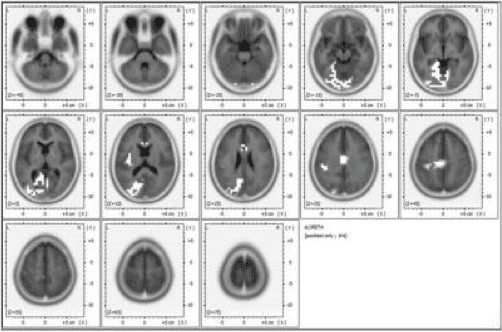
According to the studies cited, each meditation practice generates a specific EEG profile. In the case of Transcendental Meditation, EEG recordings suggest a state described as “restful alertness” or “wakeful rest”. This state is associated with a marked increase in Alpha waves and a reduction in Beta frequency in the frontal cortex. Researchers also observed greater Alpha coherence between the two hemispheres, which may indicate that, during this form of meditation, the brain is functioning in a more integrated way rather than as a set of loosely coordinated regions.
Fred Travis summarised the point clearly: “The differences between meditation techniques are explicit and they must be respected.” The broader classification proposed by Travis and Shear links different traditions to different dominant EEG tendencies. Class 1, focused attention, includes practices from Tibetan Buddhism, Chinese Buddhism such as Qi gong, and Zen Buddhism, and is associated with stronger Beta and Gamma activity. Class 2, mindfulness, includes mindfulness-based Buddhist practices, Zazen, Chinese Buddhist practices such as Qi gong, and Vedic practices such as Sahaja Yoga, and is associated with greater Theta activity. Class 3, automatic self-transcending, includes practices such as Qi gong and Vedic meditation, especially Transcendental Meditation, and is associated with stronger Alpha activity.
Even within this framework, the aims of meditation can still differ. That is why these findings support a cautious conclusion also expressed by Jonathan Shear: as with medicines, the effects of meditation vary according to the method chosen, and studying all techniques as though they were equivalent can lead to misleading conclusions about their real clinical effects and mechanisms.
It is worth adding a note of caution here. EEG patterns are useful indicators of large-scale brain dynamics, but they do not provide a complete account of consciousness or inner experience. An increase in Alpha, Theta, Beta or Gamma activity should therefore be understood as an association rather than a simple explanation. The value of these findings lies in showing that different meditation methods may recruit attention and regulation differently, not in reducing meditation to a single electrical signature.
- Class 1: focused attention — more Beta and Gamma activity.
- Class 2: mindfulness — more Theta activity.
- Class 3: automatic self-transcending — more Alpha activity.
From two broad families to a third distinct category
There are many methods of meditation and relaxation, and several researchers have tried to classify them in a way that reflects how they are actually practised. In 2008, Antoine Lutz proposed a simple distinction between two main families. The first is focused attention meditation, in which the practitioner deliberately keeps the mind on a chosen object or support, such as the sound of Tibetan singing bowls. The second is mindfulness or open monitoring meditation, in which attention is directed towards present-moment experience itself: sensations, perceptions and what is happening internally, without fixing on a single object. Contemplative meditation is often used as an example of this second approach.
Later, Jonathan Shear and Fred Travis suggested that this two-part model did not fully capture the diversity of meditative states. They proposed adding a third category: automatic self-transcending, often associated with Transcendental Meditation. Their argument was based in part on differences observed in EEG recordings across practices. In other words, meditation techniques may look similar from the outside, yet they can be associated with different modes of attention, different forms of mental regulation and different patterns of brain activity. This is an important point, because it suggests that meditation is not one uniform phenomenon but a group of distinct practices with distinct mechanisms.
For readers unfamiliar with these terms, the distinction can be understood in practical terms. In focused attention, distraction is noticed and attention is brought back to a target. In open monitoring, distraction itself may become part of what is observed. In automatic self-transcending, the practice is described as moving beyond active monitoring altogether, towards a state in which mental activity may settle with less deliberate intervention. These are not merely stylistic differences; they imply different cognitive operations.
- Focused attention: attention is stabilised on a defined object or support.
- Mindfulness / open monitoring: attention remains open to present-moment experience.
- Automatic self-transcending: the practice is associated with a quieter, less effortful shift in awareness.
EEG findings suggest different practices may lead to different effects
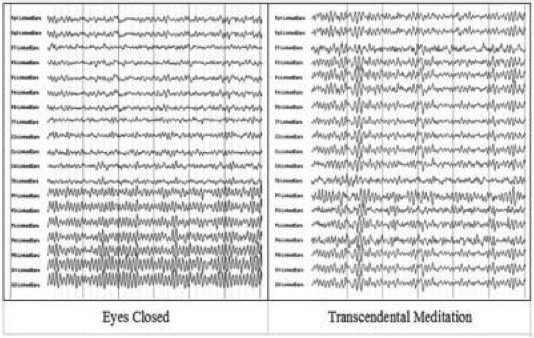
Shear and Travis emphasised that each practice appears to generate its own EEG profile. In the case of Transcendental Meditation, EEG recordings have been described as reflecting a state of restful alertness or “wakeful rest”. This state is associated with a marked increase in Alpha waves and a reduction in Beta frequency in the frontal cortex. The researchers also observed stronger Alpha coherence between the two cerebral hemispheres, which may suggest that, during this form of practice, the brain is functioning in a more integrated way rather than as a set of loosely coordinated regions.
Related offer
OM Meditation
This music is based on the particular frequency of the sacred chant OM. Listening to this program, the term...
View productThe broader classification they proposed links different traditions with different dominant EEG tendencies. Class 1, concentration practices — including forms of Tibetan Buddhism, Zen Buddhism and some Chinese Buddhist practices such as Qi gong — are associated with greater Beta and Gamma activity. Class 2, mindfulness practices — including mindfulness-based Buddhism, Zazen, some Chinese Buddhist practices such as Qi gong, and Vedic practices such as Sahaja Yoga — are associated more with Theta activity. Class 3, self-transcending practices — including some Chinese practices and Vedic meditation, especially Transcendental Meditation — are associated more with Alpha activity.
As Fred Travis put it, “The differences between meditation techniques are explicit and they must be respected.” This remains the key takeaway: although these methods are grouped under the same word, they do not necessarily pursue the same aims or produce the same effects. As Jonathan Shear later argued, much like medicines, meditation methods should not be assumed to be interchangeable. If we want to understand their real clinical effects and underlying mechanisms, they need to be studied independently and with care.
From a research perspective, this has direct consequences. If a clinical trial includes several meditation methods under one label, the results may become difficult to interpret. A benefit observed in one subgroup may not apply to another, simply because the attentional training, subjective demands and neural correlates are not the same. Careful classification therefore improves not only theory, but also the quality of evidence.
- Class 1 – concentration: more Beta and Gamma activity.
- Class 2 – mindfulness: more Theta activity.
- Class 3 – self-transcending: more Alpha activity.
Why Different Meditation Methods Should Not Be Treated as Equivalent
Three broad classes, three distinct patterns
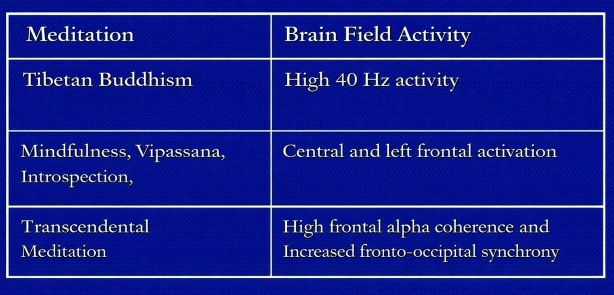
“The differences between meditation techniques are explicit and they should be respected.” This remark from Dr Fred Travis captures the central point of this classification: meditation is not one uniform practice. According to the framework discussed here, Class 1 covers concentration-based methods, in which attention is directed towards a defined object or support. Examples include forms of Tibetan Buddhism, Zen Buddhism and some Chinese Buddhist practices such as Qi gong. In EEG studies, these techniques are associated with stronger Beta and Gamma activity. Class 2 refers to mindfulness-based practices, including Mindfulness meditation, ZaZen, some Chinese Buddhist approaches such as Qi gong, and Vedic practices such as Sahaja Yoga. These methods are characterised by greater Theta activity.
Class 3 brings together practices described as automatic self-transcending, including certain Chinese Buddhist approaches such as Qi gong and Vedic practices such as Transcendental Meditation. In this group, EEG recordings are associated with stronger Alpha activity. The point is not that one class is superior to another, but that each appears to engage attention, regulation and mental state in a different way. Even within a broad family, the practitioner’s experience and the underlying neurophysiological profile may therefore differ in meaningful ways.
It is also useful to remember that these classes are analytical tools rather than rigid boxes. Real-world traditions are often complex, and a single label such as Zen, Qi gong or Vedic meditation may cover practices with different instructions and different experiential emphases. The classification remains valuable because it highlights dominant tendencies, but it should be applied with nuance rather than as a simplistic taxonomy.
- Class 1: concentration — more Beta and Gamma activity
- Class 2: mindfulness — more Theta activity
- Class 3: automatic self-transcending — more Alpha activity
Different aims call for separate study
Even with this three-part classification, meditation practices do not all pursue the same goal. Some are primarily used to stabilise attention, others to observe present-moment experience, and others to move towards a quieter form of awareness often described as self-transcending. That is why these findings suggest that meditation techniques should not be treated as a homogeneous whole. If researchers want to understand their real clinical effects and the mechanisms involved, each method needs to be studied on its own terms rather than grouped together too quickly.
Jonathan Shear, co-author of the study, professor of philosophy at Virginia Commonwealth University in Richmond, and author of several books and articles on meditation, makes this point very clearly: “Like medicines, the effects of meditations differ according to the method chosen. Considering different meditation techniques as ‘similar’ is a mistake.” This comparison is useful because it introduces a necessary nuance. Meditation may support relaxation, attention or emotional regulation, but the effects sought and the effects observed can vary depending on the practice. In other words, choosing a technique is not simply a matter of preference; it may also shape the kind of mental state and outcome most closely associated with that practice.
For practitioners as well as researchers, this means that the question is not only whether meditation “works”, but which meditation is being discussed, for what purpose, and under which conditions. A person seeking improved attentional stability may not choose the same method as someone interested in non-reactive observation of experience. The classification does not answer every practical question, but it helps frame them more intelligently.
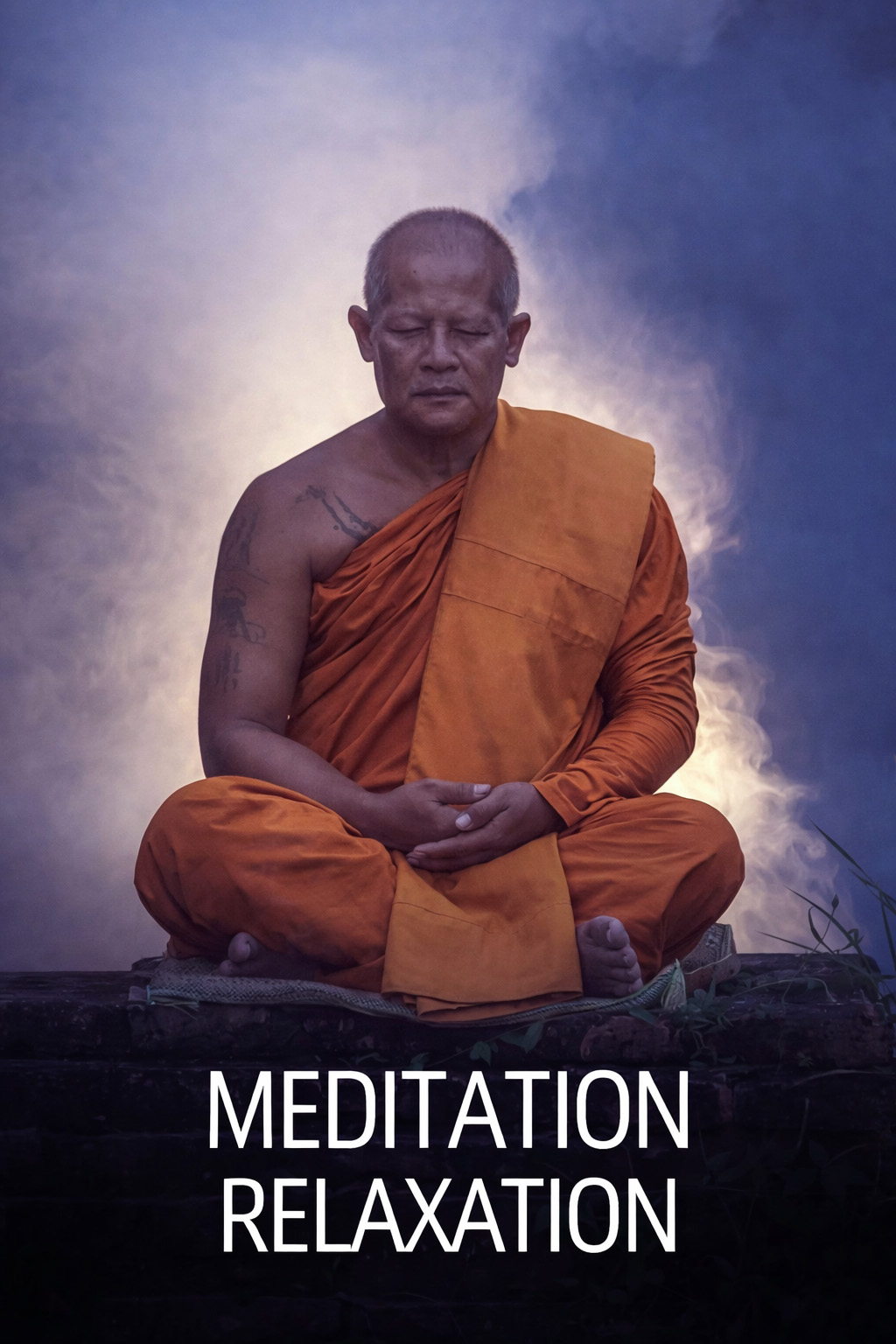
Related offer
Meditation - Relaxation set
All the Mental Waves® know-how in a single pack for quick and easy access to meditation and...
View productThe Mental Waves Meditation Classification Framework
The Mental Waves frame is to choose a meditation technique by the attention it asks of you. Some practices narrow attention, some open it, and others invite a quieter movement beyond deliberate control.
A classification is useful only if it helps practice. Notice your state, choose the technique that fits the moment, and let repetition teach the difference more than theory alone.
If you need a simple entry before comparing techniques, start with the free Mental Reset session and observe which kind of attention feels most natural afterward.
Editorial note from Mental Waves
This article keeps the EEG and technique distinctions useful, but avoids presenting categories as rigid boxes. Practice remains personal, contextual and observable.
Conclusion
What emerges most clearly is that meditation is not one uniform practice wearing different cultural names. Concentration, mindfulness and automatic self-transcending describe distinct modes of attention and distinct mental states, and the EEG findings discussed here suggest that these differences are not merely theoretical. They are associated with different patterns of brain activity, different forms of regulation and, very likely, different practical aims.
That nuance matters. If methods are grouped together too quickly, we risk misunderstanding both the lived experience of practice and the mechanisms researchers are trying to observe. A more careful classification does not reduce meditation to brain waves alone, but it does help place subjective experience alongside measurable signals with greater precision. In that sense, respecting the differences between techniques is not a detail of terminology; it is part of understanding what each practice may genuinely support.
More broadly, this classification invites a more mature view of meditation. Rather than treating it as a single remedy for every difficulty, it encourages a method-specific approach grounded in attention, cognition and observable mental states. That approach is more modest, but also more credible. It leaves room for subjective depth while remaining consistent with careful scientific interpretation.
Scientific sources and references
- Lutz A: “Attention regulation and monitoring in meditation”, Trends Cogn Sci., 2008
- Fred Travis, Jonathan Shear: “Focused attention, open monitoring and automatic self-transcending: Categories to organise meditations from Vedic, Buddhist and Chinese traditions”, Consciousness and Cognition, Volume 19, Issue 4, 2010
- Fred Travis, David A. F. Haaga, John Hagelin, Melissa Tanner, Alaric Arenander, Sanford Nidich, et al: “A self-referential default brain state: patterns of coherence, power, and eLORETA sources during eyes-closed rest and Transcendental Meditation practice”, Cognitive Processing, Volume 11, Issue 1, 21–30, 2010
- Ken Chawkin: “Are all meditation techniques the same? Different practices often produce different results”, 2010
Frequently asked questions about the classification of meditation techniques
What are the main categories used to classify meditation techniques?
Three broad categories are used here: focused attention, mindfulness, and automatic self-transcending. Focused attention involves keeping the mind on a chosen object or support. Mindfulness centres on present-moment experience and sensations. Automatic self-transcending refers to a quieter, less effortful form of practice linked in this framework with Transcendental Meditation.
What is focused attention meditation?
Focused attention meditation means directing attention towards a defined object, sound or support and returning to it when the mind wanders. Examples mentioned include practices from Tibetan Buddhism, Zen Buddhism and some Chinese Buddhist traditions such as Qi gong. In the classification discussed, this group is associated with stronger Beta and Gamma activity on EEG recordings.
How is mindfulness meditation different from concentration meditation?
Mindfulness meditation keeps attention open to what is happening in the present moment rather than fixing it on one chosen object. It involves noticing sensations, perceptions and immediate experience as they arise. By contrast, concentration meditation narrows attention onto a specific support. In this framework, mindfulness practices are linked more closely with Theta activity.
What does automatic self-transcending mean in meditation?
Automatic self-transcending describes a form of meditation presented as less effortful than concentration or open monitoring. It is associated here with Transcendental Meditation and with a quieter mental state sometimes described as restful alertness or wakeful rest. In EEG findings, this class is linked with stronger Alpha activity.
Why did researchers add a third category to the earlier two-part model?
A third category was added because the earlier split between concentration and mindfulness did not fully reflect the differences observed between meditation styles. Jonathan Shear and Fred Travis proposed automatic self-transcending after noting distinct EEG patterns across practices. Their view was that some methods involve a different mode of awareness rather than simply another version of attention training.
What do EEG recordings suggest about different meditation practices?
EEG recordings suggest that different meditation techniques are associated with different patterns of brain activity. Focused attention practices are linked with greater Beta and Gamma activity, mindfulness practices with greater Theta activity, and automatic self-transcending with greater Alpha activity. This supports the idea that meditation methods are not all doing the same thing in the same way.
What brain activity is associated with Transcendental Meditation in this classification?
Transcendental Meditation is associated with a marked rise in Alpha waves and a reduction in Beta frequency in the frontal cortex. The recordings also show greater Alpha coherence between the two hemispheres. This pattern is described as a state of restful alertness, suggesting a brain state that is awake but deeply at rest.
Can the same practice appear in more than one meditation category?
Yes, some traditions are listed across more than one category. Qi gong, for example, appears under concentration, mindfulness and automatic self-transcending in the classification presented. This shows that broad tradition labels do not always map neatly onto a single mental process, and that practices within the same tradition may differ in method and effect.
Why is it important not to treat all meditation techniques as equivalent?
Different meditation techniques appear to involve different aims, different modes of attention and different EEG profiles. Treating them as interchangeable can blur their real mechanisms and make clinical effects harder to interpret. The key point is that meditation is not a single homogeneous practice, so each method needs to be studied on its own terms.