en
enVotre panier est vide.


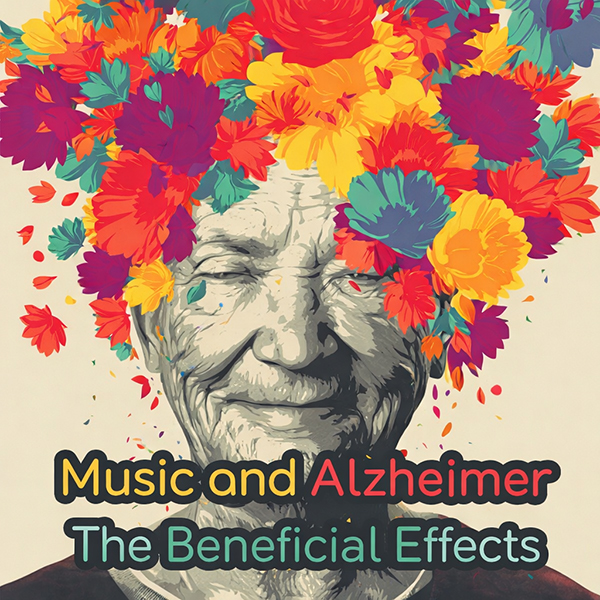
Alzheimer’s disease remains one of the illnesses most feared in France, and with good reason. According to figures cited from France Alzheimer & related organisations, around 850,000 people in France are living with the condition, with 225,000 new cases diagnosed each year. Far from being a normal consequence of ageing, Alzheimer’s is a progressive neurodegenerative disease that gradually affects cognition, attention, judgement and everyday autonomy over many years. Long under-recognised and too often diagnosed late, it is now rightly treated as a major public health issue, with research increasingly focused on how to preserve attention and make the best use of remaining cognitive capacities.
Alongside that scientific effort, another path has drawn attention for its simplicity: music may offer a gentle, low-cost way to reconnect patients with memory, emotion and interaction. This is the approach brought to wider public notice by Dan Cohen’s work and by Michael Rossato-Bennett’s 2014 documentary Alive Inside, filmed over three years and later shown to mark World Alzheimer’s Day. The idea is not to romanticise the disease or to promise more than the evidence allows, but to observe something deeply human and clinically relevant: familiar melodies, rhythm, tone and timbre can sometimes help awaken responses that seemed out of reach, offering a more supportive complement to conventional care.
Why music is emerging as a low-cost support for people with Alzheimer’s
A major public health challenge that is not part of normal ageing
According to the Paquid survey conducted by Inserm Bordeaux, Alzheimer’s disease ranks as the second most feared illness among people in France, behind cancer. Figures from France Alzheimer & Maladies apparentées show why: around 850,000 people in France are living with the condition, and roughly 225,000 new cases are diagnosed each year. For more than a decade, over 40% of those affected have been aged over 75. Yet this should not be confused with ordinary ageing.
In short: how can music support Alzheimer's patients?
Music can support Alzheimer's patients by activating memory, emotion, rhythm and social connection in a gentle way. The effect depends on the person, the music chosen and the caregiving context.
- Familiar songs may awaken personal memories.
- Rhythm can encourage movement and attention.
- Shared listening can create moments of connection.
- Music should be adapted to comfort, fatigue and sensitivity.
For the wider psychology of listening, read Psychological Benefits of Music. For a contemplative sound cue, receive the Sacred Frequency Session.
As Marie-Céline Jacquier, journalist at futura-sciences.com and Doctor of Biology from the University of Lyon 1, explained for World Alzheimer’s Day, the disease involves a slow and insidious decline in psychological and intellectual functioning, with growing impact on daily life and a progressive loss of autonomy. Its course often unfolds over around ten years, with worsening impairment in judgement and logical reasoning. In no case should this evolution be treated as a normal part of getting older: Alzheimer’s is a pathological neurodegenerative process.
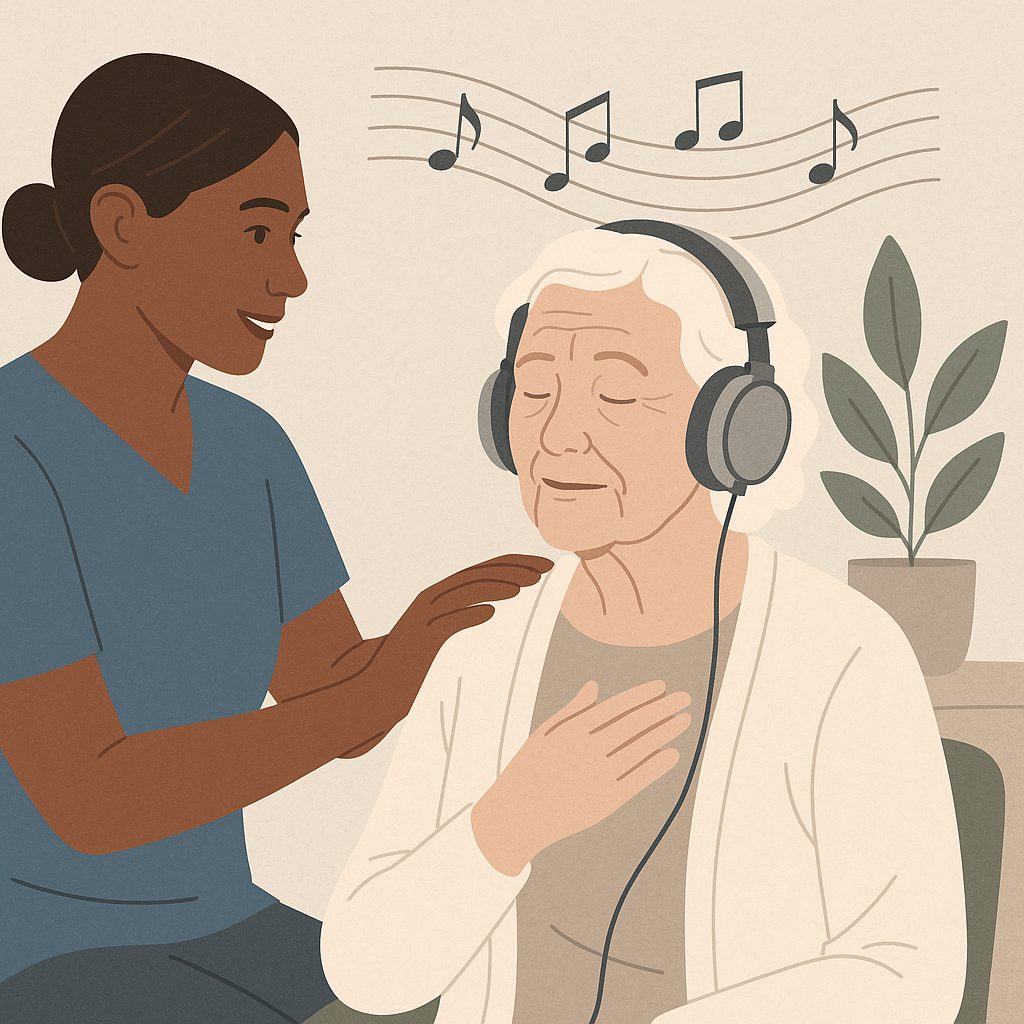
For decades, the disease was both underdiagnosed and underestimated, with fewer than one in two patients identified. Today, research increasingly aims to improve attention and make better use of the cognitive capacities that remain. Alongside laboratory and clinical work, more accessible forms of support have also drawn attention. One of the most striking examples is a simple, low-cost approach developed by social worker Dan Cohen, who uses music to help reactivate memory in people living with Alzheimer’s. Through sound and silence, rhythm and pitch, nuance and timbre, this approach seeks to reconnect patients with parts of their personal history that may still be reachable even when language and orientation have become fragile.
- Alzheimer’s is a neurodegenerative disease, not a normal effect of ageing.
- It remains a major public health issue because of both its prevalence and its long-term impact on autonomy.
- Current research also looks at how to support attention and preserve remaining cognitive function.
Why music has attracted such interest
The wider public discovered this possibility in Alive Inside, the 2014 documentary by Michael Rossato-Bennett, filmed over three years and later shown around the 23rd World Alzheimer’s Day. The film highlighted a form of music-based care built around personal memory rather than abstract stimulation. The idea is simple but powerful: could a playlist of familiar melodies and rhythms, whether jazz, classical, pop or other deeply personal sounds, help soothe a person with Alzheimer’s? In many cases, it appears to. Songs linked to a patient’s past may help bring back emotions and memories that have lain dormant for years, sometimes decades.
Even a single melody may stimulate activity in affected brain networks and create moments of attention, recognition or connection in people who are too often left facing silence.
This is one reason the Music & Memory (M&M) programme has been so widely welcomed. As reported by futura-sciences.com, the documentary showed care home residents with dementia singing, dancing, making small movements and interacting with others while listening to their favourite music, helping to popularise the method in the United States. The interest is not only emotional but clinical. Standard treatment often includes antipsychotic medication, which can carry significant side effects, so researchers and care teams are understandably looking for gentler alternatives. Music therapy does not offer a remedy, and it should not be presented as one. However, it may help regulate behaviour and emotional state, and is associated with reductions in aggression, agitation and anxiety.
In that sense, music is increasingly seen not as a decorative extra, but as a credible and humane support within dementia care.
- It draws on the patient’s own musical history and emotional memory.
- It may support attention, interaction and behavioural regulation.
- It is also attractive because it is simple to implement and relatively inexpensive.
Personal playlists in care homes show promising results
What personalised music can change in daily care
Alive Inside, Michael Rossato-Bennett’s 2014 documentary, helped bring the Music & Memory method to a wider audience in the United States. In the film, care home residents living with dementia are seen singing, dancing, sketching out movements and reconnecting with other people while listening to music that matters to them personally. That visibility mattered, because it highlighted a simple idea with very human consequences: familiar songs may help awaken memories, emotions and forms of attention that seem difficult to reach in ordinary conversation. In practice, this approach is often explored as a gentle complement to standard care, especially because treatment based largely on antipsychotics can also involve significant risks and unwanted side effects.
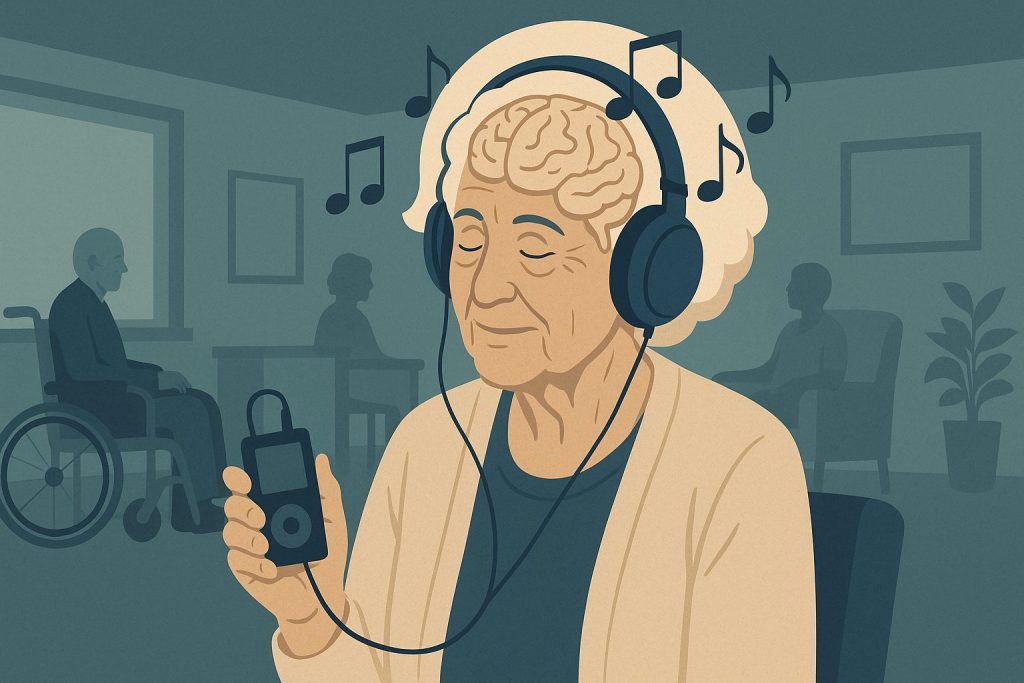
The principle is straightforward. Staff identify each resident’s musical preferences, personal history and favourite songs, then create an individual playlist and load it onto an MP3 player. This is not about playing background music at random, but about using sounds, rhythms, singing and familiar tonal patterns that are closely tied to the person’s own life. In that context, music may help reduce agitation, anxiety, aggression and certain behavioural difficulties, while also supporting interaction and moments of presence. It is not a remedy, and it should not be presented as one, but it may offer a meaningful way to improve quality of life for people who are too often left in silence.
- personal musical preferences
- life history and emotional memories
- a tailored playlist on a simple MP3 player
What the research suggests, and why the approach remains attractive
The results cited by Marie-Céline Jacquier, drawing on research published in the American Journal of Geriatric Psychiatry by investigators at the Brown University School of Public Health, give this approach a more concrete footing. Over six months, researchers followed 12,905 residents in 98 care homes using the Music & Memory programme, all living with Alzheimer’s disease or a related dementia, and compared them with 12,811 residents in 98 other facilities not involved in the programme. The findings were encouraging. In homes using M&M, the proportion of residents who stopped antipsychotic treatment rose from 17.6% to 20.1%, while it remained stable in the comparison homes at around 15 to 16%.
For anxiolytics, a similar pattern appeared: treatment discontinuation increased from 23.5% to 24.4% in the M&M homes, whereas it fell in the control facilities from 24.8% to 20%.
Related offer
Mental Dynamism and Good Mood
The action of our audio recording affects the limbic system, where our emotional keyboard is located. The...
View productThe study also reported fewer behavioural problems among residents taking part in the programme, although no clear effect was observed on mood or depression. That nuance is important. It suggests that personalised music may be especially useful for regulation, distress and day-to-day behaviour, without solving every aspect of dementia-related suffering. One reason the method continues to attract interest is that it is relatively inexpensive to put in place: staff need training to build suitable playlists, and care homes need only purchase the selected tracks and a basic MP3 player.
For many families facing the underestimated burden of Alzheimer’s, that makes music a practical and accessible support while research continues elsewhere, including at the EPFL, where scientists have developed an implantable capsule intended to protect neurons and slow the disease process. It is only one step, but sometimes small steps matter. Once again, music reminds us that even a modest intervention can restore a little movement, connection and dignity.
How Families and Carers Can Use Music Gently
The most useful music is often personal. A song from youth, a family celebration, a religious or cultural memory, or a melody connected to a meaningful place can carry more emotional weight than a generic relaxation track. The listener's history matters.
Start softly, observe the response and stop if the music causes agitation, sadness or fatigue. A helpful session can be very short. The aim is not performance or correction, but presence: a shared moment where memory, rhythm and emotion can meet safely.
A family playlist can be built like a small biography. Ask relatives about songs from adolescence, early adulthood, important places, celebrations, work, faith or family rituals. If the person can still express preferences, let those preferences guide the choice. If not, observe facial expression, breathing, movement, eye contact and signs of comfort.
The same song may not work every day. Fatigue, pain, medication timing, noise level and emotional state can all change the response. This is why music sessions should stay flexible. A caregiver can begin with one familiar track, pause, and notice whether the person seems more settled, connected, restless or withdrawn.
Music can also support relationship. Singing together, tapping a rhythm, holding hands during a familiar melody or simply listening in silence can create connection without requiring complex conversation. In that sense, music is not only stimulation; it can be a shared language when ordinary words become harder.
There are limits. If music brings distress, overstimulation or repeated sadness, the choice should be changed or the session stopped. Respecting the person's state matters more than completing a planned activity.
A Simple Listening Session for Families
A gentle session can begin with preparation rather than sound. Reduce background noise, choose a comfortable position and explain simply what is about to happen. Then play one familiar piece at a moderate volume and stay present. The caregiver does not need to ask many questions; observation is often more respectful than testing memory.
After the song, leave a little silence. The person may speak, hum, move, smile, cry or simply rest. All of these responses can carry meaning. If the moment feels positive, another short track may follow. If the person seems tired or unsettled, the session can end there. Short and respectful is better than long and demanding.
Keeping notes can help over time: which songs seemed comforting, which were too intense, what time of day worked best and whether shared listening helped communication. This makes music part of a thoughtful care environment instead of a random activity.

Related offer
Meditation - Relaxation set
All the Mental Waves® know-how in a single pack for quick and easy access to meditation and...
View productWhen professional carers are involved, share these observations with them. Music choices, fatigue patterns and signs of comfort can help everyone respond with more consistency. The aim is a calmer environment around the person, not a separate technique added on top of care or daily family support over time together.
The Mental Waves Alzheimer's Music Support Framework
The Mental Waves frame is to use music as a respectful bridge. The person is not reduced to symptoms; they are met through sound, memory and relationship.
- Personalize: choose music connected to the person's life.
- Observe: watch mood, movement, attention and comfort.
- Share: listen together rather than making the person perform.
- Adapt: change volume, duration or music when the response shifts.
For another recovery context, continue with Music After Stroke Recovery. For brain-state background, read Brainwave Frequencies and Meditation.
Editorial note from Mental Waves
This article is educational and caregiver-focused. Alzheimer's care should be coordinated with qualified health professionals, and music should be adapted to the person's comfort and medical situation.
Conclusion
What emerges most clearly here is not the idea of music as a miracle, but as a credible, humane and low-cost support within Alzheimer’s care. When listening is shaped around a person’s own history, preferences and emotional memory, it may help re-open channels of attention, recognition and connection that the disease has not entirely erased. That matters not only for behaviour in the moment, but for dignity: the patient is no longer approached solely through symptoms, but through what still resonates.
The research cited remains measured, and that nuance is essential. Personalised music does not resolve depression, does not reverse neurodegeneration and should not be confused with a remedy. Yet if it can contribute to calmer states, fewer behavioural disturbances and, in some settings, a reduced reliance on antipsychotics or anxiolytics, then it deserves serious attention. In a field where families and carers often face exhaustion, uncertainty and limited options, even a modest intervention can change the texture of daily life. Sometimes, care begins by restoring a familiar sound.
Frequently Asked Questions About Music for Alzheimer's Patients
Why can music matter for Alzheimer's patients?
Music can reach emotion, memory and rhythm in ways that may remain meaningful even when verbal communication is harder.
What music should families choose?
Start with familiar, personally meaningful music from the person’s life, culture and preferences.
Can music improve mood?
It may support comfort, connection and emotional expression for some people, depending on the moment and the music.
Can music cause agitation?
Yes. Volume, tempo, memories or fatigue can make music uncomfortable, so observation matters.
How long should a listening session last?
Short sessions are often enough. Comfort and response matter more than duration.
Is live music better than recorded music?
Both can help. Live music adds human presence, while recorded music offers familiar songs easily.
Should the person be encouraged to sing?
Only if it feels natural and welcome. The aim is connection, not performance.
Can music replace professional care?
No. Music is a supportive activity and should fit within a broader care plan.
What is the main takeaway?
Music can offer gentle moments of memory, comfort and connection when it is personal, respectful and carefully adapted.