en
enVotre panier est vide.



Tips and practices
Explanations
Relaxation and Meditation
meditation cd
relaxation cd
meditation music
relaxation music
Daily life rarely leaves the mind untouched. Noise, pressure and mental overload can make inner calm feel distant, which is precisely why relaxation music is so often sought out when learning to meditate. Yet meditation is not something that appears on command: it usually asks for practice, patience and the gradual training of attention. In that context, carefully designed music can offer a simple, accessible support, helping the mind settle and creating conditions more favourable to relaxation.
In short: relaxation music for meditation
Relaxation music can make meditation easier by giving attention a gentle anchor while the body settles into a calmer rhythm.
Use this article as a practical map: keep what helps attention become steadier, question anything that sounds absolute, and connect the idea back to repeatable daily practice.
Used regularly, relaxation and meditation music may help reduce the sense of mental interference that builds up through the day, while encouraging a more stable, restorative state. It is often valued not only for stress relief, but also for the feeling of spaciousness it can bring: a temporary step back from immediate worries, and a quieter relationship with one’s own thoughts. More than an escape, it can become a practical route towards inner balance, especially when the listening experience is shaped to support calm, attention and a deeper sense of presence.
This is one reason sound is often used as an entry point for beginners. When attention is scattered, silence can sometimes feel demanding rather than soothing. A carefully structured auditory environment may therefore serve as a bridge between ordinary mental activity and a more contemplative state, making the first stages of meditation feel less abstract and more embodied.
Using relaxation music to enter meditation more gently
Creating mental distance from everyday pressure
Relaxation music and meditation can offer a practical way to loosen the grip of the mental noise that builds up in daily life. For many people, one of the first aims of meditation is not to achieve something abstract, but simply to step back from stress, inner agitation and the constant stream of thoughts. In that sense, this kind of listening may help create a feeling of distance from ordinary concerns. With regular practice, the mind often becomes more available, more spacious and less caught in immediate pressure.
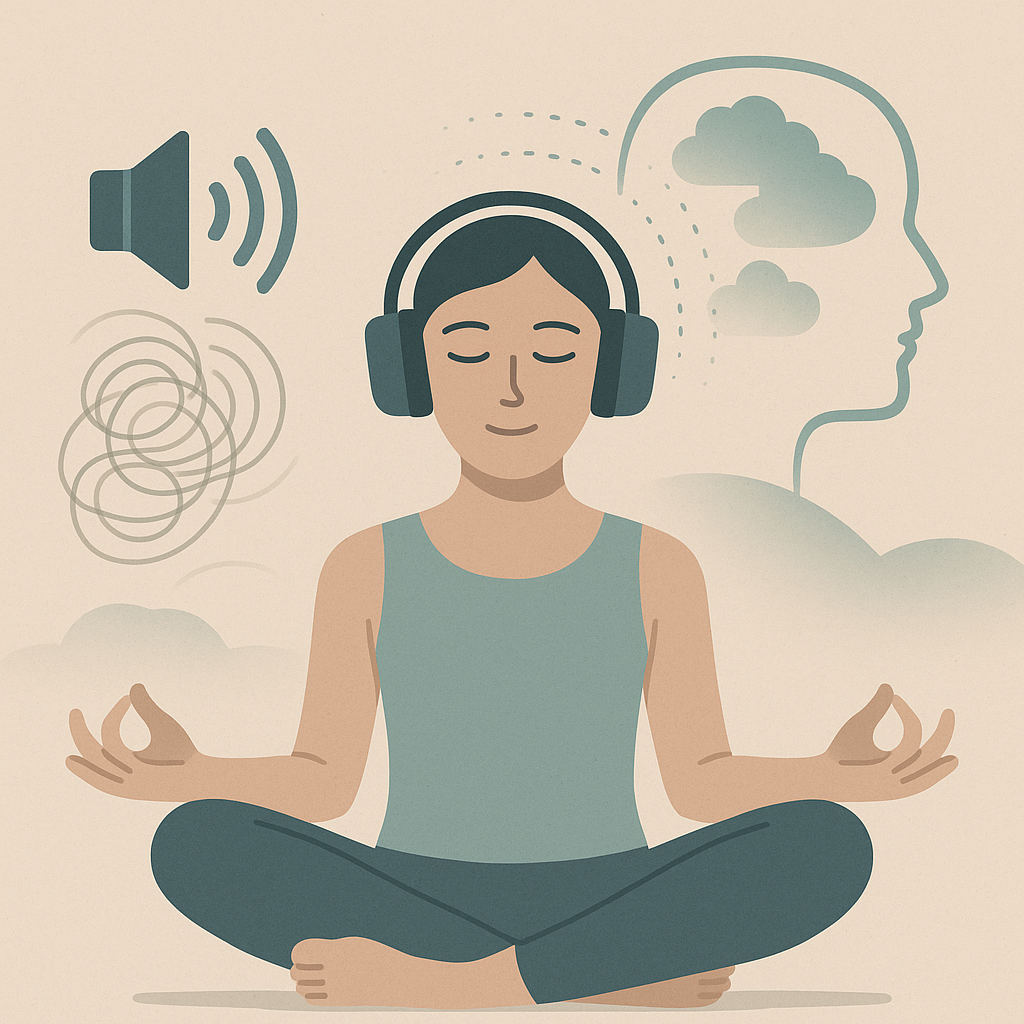
This experience is sometimes described as a form of escape, but not in the sense of denial. Rather, it is a temporary shift in attention: a few minutes in which you leave behind the usual constraints, settle into a calmer state and allow a broader perspective to emerge. That sensation of opening out, of stepping beyond the narrow frame of the everyday, is often sought in relaxation practice. It may help you ease existential anxieties while also acknowledging them more calmly, with a little more clarity and less emotional overload.
From a cognitive point of view, this shift may be understood as a reduction in attentional capture. Instead of being repeatedly pulled towards unfinished tasks, worries or external stimulation, the mind is given a more stable object to rest with. Music does not silence thought by force, but it can reduce the subjective intensity of mental clutter and make self-observation more manageable.
- less mental clutter
- more inner space
- a gentler relationship with anxious thoughts
Moving towards inner peace through a suitable listening environment
A meditation CD, or its digital equivalent, is often used for this reason: it can support a gradual movement towards inner peace and a form of quiet wisdom that may otherwise feel difficult to access. The value of these recordings lies not only in the music itself, but in the atmosphere they are designed to create. When the sound environment is coherent, soothing and intentionally structured, it becomes easier to settle attention, release tension and enter a more contemplative state.
These deeper inner experiences do not necessarily belong to something vague or inaccessible. They may become more approachable when the listening context is carefully shaped to support meditation. Music created specifically for relaxation is intended to immerse you in an appropriate climate, one that encourages calm, receptivity and introspection. Used in this way, it can become a simple but meaningful support for anyone learning to meditate and seeking a more stable sense of balance within themselves.
The listening environment matters more than many beginners expect. Volume, timbre, repetition and the absence of abrupt sonic events can all influence whether the nervous system interprets the experience as safe and settling, or as stimulating and distracting. A well-designed session therefore does more than provide pleasant background sound: it helps organise perception in a way that may support sustained calm.
For some listeners, this supportive atmosphere also makes it easier to remain present with subtle bodily sensations, breathing rhythms and emotional states that would otherwise be overlooked. In that sense, the music may function less as a distraction and more as a gentle frame for awareness.
A simple, natural way to support meditation
An easy practice to use in everyday life
There is no need to make meditation more complicated than it needs to be. A relaxation CD or meditation track can be used very simply at home, or in any place where you feel comfortable and undisturbed. The principle is natural: you listen, allow the musical textures to settle into your attention, and gradually learn to let go. When this kind of listening is combined with basic breathing techniques, it may help the mind move towards a calmer, more receptive state and make that sought-after sense of release easier to access.

This approach is designed to support relaxation without overloading the listener. The sound environments used in meditation CDs and relaxation sessions are generally built to encourage mental disengagement from everyday pressure rather than demand effort or analysis. In practice, the method remains straightforward: create a quiet moment, listen regularly, and allow the body and attention to settle. For many people, that simplicity is precisely what makes the experience easier to integrate into daily life.
Regularity often matters more than duration. A short session practised consistently may be more useful than occasional long sessions approached with strain or unrealistic expectations. Learning to meditate usually depends on repetition, familiarity and the gradual recognition of how your own attention behaves from one day to the next.
It can also help to adopt a modest aim at the beginning. Rather than trying to achieve a dramatic altered state, you might simply notice whether the jaw softens, the breath slows, or the stream of thought becomes slightly less urgent. These small shifts are often the real foundations of a sustainable meditation practice.
- Use it at home or anywhere you feel at ease
- Pair listening with slow, steady breathing
- Let attention soften rather than forcing concentration
How isochronic and binaural sounds are used
Many meditation CDs and relaxation recordings include isochronic tones and binaural beats. These are layered into ambient music that contains no voices and no subliminal messages, so the listening space remains clear and uncluttered. The idea behind these sound structures is that they may interact with patterns of brain activity and perception, helping to orient attention towards a more relaxed mental state. Research has long explored this kind of auditory stimulation as a way of influencing how the brain organises its activity, even if the effects can vary from one person to another.
Binaural beats were identified by Heinrich Wilhelm Dove in 1839. They are perceived by the brain in a particular way, not as a simple external physical stimulus in the usual sense, which is why they continue to attract interest in relaxation and meditation contexts. Their frequencies are used because they are associated with a soothing effect on mental activity. The original text also distinguishes them from monaural sounds: monaural tones, at equal intensity, are often easier to perceive directly, whereas binaural and isochronic sounds, also presented at similar intensity, involve a faster pulsation pattern.
Related offer
OM Meditation
This music is based on the particular frequency of the sacred chant OM. Listening to this program, the term...
View productDuring listening, these auditory cues may act on attention and brain-state regulation, which is why they are used to help the listener enter meditation more effectively.
It is worth keeping the mechanism in perspective. Claims around auditory entrainment are sometimes overstated, whereas the more credible view is that such sounds may support certain mental states under suitable conditions rather than mechanically produce them. In practice, the listener’s expectations, level of fatigue, sensory sensitivity and listening context all influence the outcome.
Even so, the appeal of these techniques is understandable. Repetition, rhythmic stability and subtle frequency design can provide the brain with a predictable sensory pattern, and predictability itself is often associated with reduced vigilance and easier relaxation. This may help explain why some people report a quicker transition into calm, focused or drowsy states when using these recordings with headphones.
In discussions of EEG-related states, these recordings are often linked with slower-frequency patterns associated with rest, relaxed wakefulness or meditative absorption. Such associations should be treated carefully, but they reflect a broader attempt to connect subjective experience with measurable aspects of brain activity rather than relying on vague language alone.
Choosing the Right Meditation Music and Getting Started
A simple first step that can suit different needs
To begin meditating, it can help to choose a format that is easy to use and adapted to your aim. Our site offers several types of relaxation music and meditation tracks, designed for different objectives and different listener profiles. The idea is not to impose long, repetitive sessions from the outset, but to make the first experience accessible. In practice, many people notice an effect from the very first listening session: a shift in attention, a calmer mental rhythm, or a clearer sense of inner distance from everyday pressure. These early effects should be understood with care, but they are often what encourages a regular practice to take root.
If you are curious, the most useful approach is simply to try one session for yourself. Choose a category of meditation music or relaxation music that matches your current need, then listen in a quiet setting with a pair of headphones. Access is straightforward, since the recordings are available as downloadable MP3 files. This simplicity matters: when the method is easy to integrate into daily life, it becomes much easier to return to it and to build a meditation habit without strain.
Choosing the right session often depends on intention. Some listeners are primarily looking for decompression after work, others for support with evening rest, and others for a more focused meditative practice in the morning. Matching the sound environment to the moment can make the experience feel more coherent and may improve adherence over time.
Beginners also benefit from approaching the first sessions with curiosity rather than performance pressure. You do not need to meditate perfectly, empty the mind, or feel transformed immediately. A more realistic aim is to become familiar with the process of settling, noticing distraction, and returning gently to the listening experience.
- Choose a session that matches your intention
- Listen in a calm place where you feel at ease
- Use headphones to support immersion
What regular listening may support over time
Used consistently, relaxation music and meditation music may support more than a brief moment of calm. They are often sought for improving the quality of rest, easing the sense of persistent tension, and helping the mind disengage from patterns that feel invasive or exhausting. The original promise of meditation remains the same here: not to erase every difficulty instantly, but to create conditions in which the brain and attention can gradually regulate themselves more effectively.
Seen in that light, a meditation CD or relaxation programme is not just a background soundscape. It can become a practical gateway to personal development and a more stable inner balance. Better sleep, relief from ongoing discomfort, and support when trying to loosen the grip of stubborn habits are among the benefits many listeners hope for. Results naturally vary from one person to another, but as a gentle and repeatable practice, meditation supported by sound can offer a credible path towards greater calm, self-awareness and personal fulfilment.
Over time, the most meaningful change is often not dramatic relaxation during the session itself, but a subtle improvement in self-regulation outside it. Some people notice that they recover more quickly after stress, react less impulsively to intrusive thoughts, or find it easier to recognise when they are becoming mentally overloaded. These are modest but important shifts in attentional and emotional balance.
It is also useful to remember that meditation music is not a universal solution. If a particular track feels overstimulating, emotionally uncomfortable or simply unhelpful, another sound profile may be more suitable. The aim is not to force a response, but to find a listening environment that genuinely supports calm, clarity and continuity of practice.

Related offer
Meditation - Relaxation set
All the Mental Waves® know-how in a single pack for quick and easy access to meditation and...
View productThe Mental Waves Meditation Music Framework
The Mental Waves frame is to make the beginning of meditation less abrupt. Music can soften the transition from mental activity into listening, breathing and presence.
Choose a track that does not demand attention. Keep volume modest, let breathing remain natural, and treat the sound as a support rather than the whole practice.
If meditation feels difficult to start, try the free Mental Reset session as a short transition into calmer attention.
Editorial note from Mental Waves
This article presents music and meditation as supportive relaxation practices. They are not a treatment, and discomfort or persistent distress should be discussed with a qualified professional.
Conclusion
Learning to meditate rarely begins with forcing the mind into silence. More often, it starts by creating the right conditions for attention to settle. In that sense, relaxation music may be less a shortcut than a support: a way of softening mental noise, easing the body out of habitual tension, and making a more stable inner state feel accessible. When listening is paired with breath and regular practice, it can help meditation become more approachable, more concrete and more sustainable.
What matters, though, is keeping the balance clear. Sound can guide perception, influence atmosphere and support regulation, but it does not replace practice, patience or discernment. Used well, music designed for relaxation or meditation may help some people enter a calmer state more readily, whether they are seeking rest, focus or a gentler relationship with their own thoughts. Sometimes, a quieter mind begins not with effort, but with the right kind of listening.
For anyone learning to meditate, this is perhaps the most useful perspective: sound is not there to do the inner work for you, but to make that work easier to begin and easier to repeat. In a world saturated with stimulation, a carefully chosen listening practice can become a rare and valuable form of mental hygiene, supporting attention, rest and a more deliberate relationship with consciousness itself.
Frequently Asked Questions About Relaxation Music for Learning to Meditate
How can relaxation music help when learning to meditate?
Relaxation music can make meditation feel more approachable by reducing mental noise and creating a calmer inner atmosphere. It helps the mind step back from daily pressure, stress and agitation, which can make it easier to settle attention and begin practising meditation without forcing concentration.
Is relaxation music meant to replace meditation practice?
Relaxation music is best understood as a support rather than a substitute for meditation. It can help create favourable conditions for calm and presence, but meditation still requires practice, patience and a gradual training of attention over time.
What is the simplest way to use relaxation music for meditation at home?
Choose a quiet place where you feel comfortable, start a relaxation or meditation track, and let your attention rest on the sound without trying too hard. Pairing the listening with slow, steady breathing can help you let go more naturally and enter a calmer state.
What are binaural beats and isochronic tones in meditation music?
Binaural beats and isochronic tones are sound structures added to ambient meditation music. They are used because they may interact with attention and patterns of brain activity, helping to orient the listener towards a more relaxed and meditative state.
Why do these meditation recordings avoid voices and subliminal messages?
A voice-free and subliminal-free sound environment keeps the listening experience clearer and less mentally cluttered. That simplicity can make it easier to relax, release tension and stay with the experience without distraction or unnecessary stimulation.
Who first identified binaural beats?
Binaural beats were identified by Heinrich Wilhelm Dove in 1839. They remain of interest in relaxation and meditation because they are perceived by the brain in a particular way and are associated here with a soothing effect on mental activity.
Do you need long sessions to feel the effects of meditation music?
Long sessions are not presented as necessary at the start. A first listening session may already bring a shift in attention, a calmer rhythm or a greater sense of distance from everyday pressure, although the experience can vary from one person to another.
Is it better to listen with headphones?
Headphones are useful because they support immersion and help the listening environment feel more contained. They are especially relevant when using downloadable MP3 meditation sessions designed to guide attention through carefully structured sound.
What might regular listening to relaxation music support over time?
Regular listening may support better rest, less persistent tension and a gentler relationship with anxious or invasive thoughts. It is also presented as a way to encourage inner balance, self-awareness and a more stable sense of calm when practised consistently.