en
enVotre panier est vide.


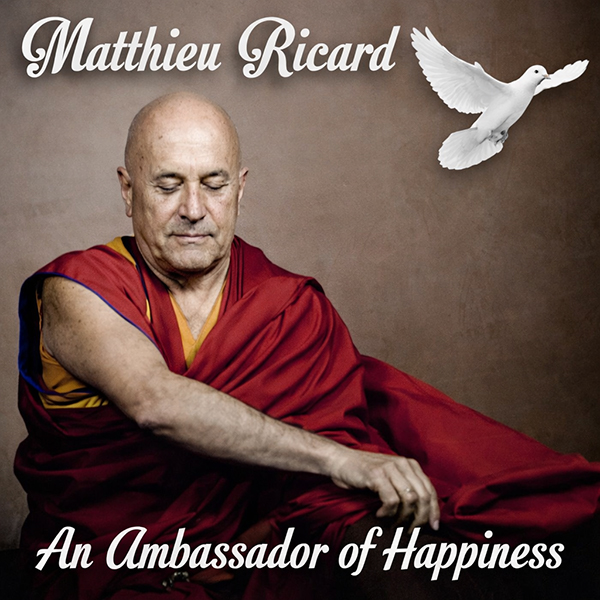
During a recent edition of The Extraordinary Powers of the Human Body on France 2, Matthieu Ricard returned to a conviction that has shaped much of his life: that each of us carries an immense, often underused potential for attention, altruism, inner peace and compassion. Having devoted the equivalent of seven years of his life to meditation, he describes this practice not as an abstract ideal, but as a form of mental training that may help cultivate qualities already present within us.
That formulation matters, because it shifts meditation away from the register of vague self-improvement and places it closer to disciplined cognitive exercise. In Ricard’s view, the mind is not a fixed entity but a dynamic field of habits, tendencies and capacities that can be refined through repeated practice. Such an approach resonates with contemporary research on attention and emotional regulation, which increasingly suggests that mental states are not merely endured but, to some extent, trained.
What makes Ricard’s voice distinctive is that his path sits at the meeting point of contemplation and research. Trained first as a doctor in cellular genetics, he has also offered his own brain to scientific study, contributing to work on meditation and mental states. In that context, meditation is presented not only as a spiritual discipline found across several religious traditions, but also as a practice increasingly explored for its effects on stress regulation, attention and health.
In short: what does Matthieu Ricard teach about happiness?
Matthieu Ricard teaches that happiness is not only a passing emotion, but a capacity that can be cultivated through meditation, altruism and mental training. His message connects contemplative tradition with modern interest in the science of wellbeing.
- Happiness is presented as a stable inner quality, not constant pleasure.
- Meditation trains attention and emotional habits over time.
- Altruism is central to his view of wellbeing.
- The message asks for practice, not passive inspiration.
For research context, read Meditation and the Brain. For a contemplative sound cue, receive the Sacred Frequency Session.
Ricard himself noted that a daily practice of 20 minutes over three months may help support the immune system and reduce the impact of negative stressors — a measured but striking reminder that the life of the mind can also leave traces in the body.
It is worth keeping the language careful here. Meditation is not a instant solution, nor does every study point in the same direction with the same strength. Yet the broader scientific interest is understandable: practices that alter attention, breathing, emotional reactivity and self-observation may plausibly influence how the nervous system responds to pressure. This is precisely where Ricard’s contribution becomes especially valuable, because he embodies a rare dialogue between first-person experience and third-person observation.
Meditation, science and the making of a Buddhist monk
A life of meditation placed under the lens of science
During a recent edition of Les Pouvoirs extraordinaires du corps humain on France 2, presented by Adriana Karembeu and Michel Cymes, Matthieu Ricard reflected on what he sees as our most valuable human capacities: attention, altruism, inner peace, inner reality and compassion. Having spent the equivalent of seven years of his life meditating, he argued that these qualities exist in all of us as a kind of dormant potential, and that training the mind through meditation may help to cultivate them more fully. By allowing researchers to study his own brain, Ricard has also contributed to a body of scientific work that has brought meditation into dialogue with contemporary neuroscience.
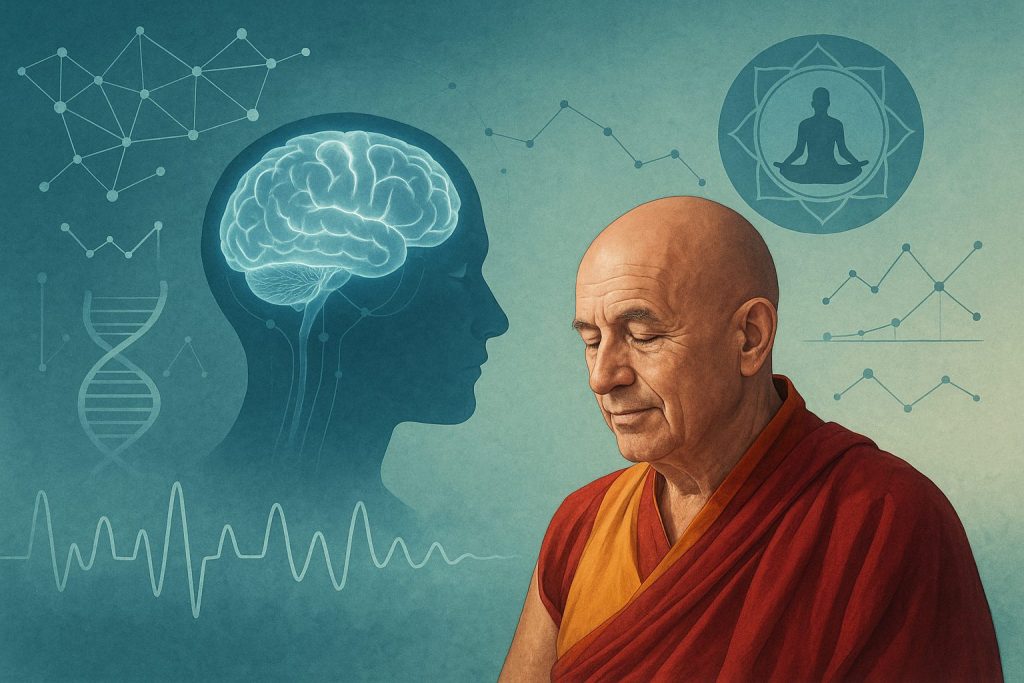
His remarks are compelling partly because they avoid the simplistic opposition between spirituality and science. Rather than claiming that meditation belongs exclusively to one domain, Ricard presents it as a disciplined practice of attention whose effects may be explored from several angles: phenomenological, ethical, physiological and neurological. In practical terms, this means that the subjective experience of calm, clarity or compassion can be examined alongside measurable changes in behaviour, stress markers or patterns of brain activity.
That interest is not limited to one tradition. Meditation sits at the heart of practices found in Buddhism, Hinduism, Jainism, Sikhism, Taoism, yoga, Islam and Christianity, while also being explored in medical and psychological settings. In that same programme, Ricard suggested that three months of meditation, practised for 20 minutes a day, may help support the immune system and may reduce stress and exposure to harmful stress responses. Such claims deserve to be approached with scientific caution, but they help explain why meditation is now often studied in relation to attention, emotional regulation and overall mental balance, rather than being seen only as a spiritual exercise.
From a scientific perspective, one reason meditation attracts interest is that it appears to involve several mechanisms at once. Depending on the form practised, it may train sustained attention, reduce automatic distraction, alter the appraisal of thoughts and sensations, and soften habitual emotional reactivity. Some studies have also examined changes in EEG patterns, functional connectivity and stress-related physiology, although interpretation remains complex and should not be overstated. Even so, the convergence of subjective reports and laboratory findings has been enough to make meditation a serious object of inquiry rather than a marginal curiosity.
- attention and mental training
- stress regulation and inner calm
- compassion and altruistic behaviour
What emerges from this body of work is not a single grand conclusion, but a more nuanced picture: meditation may help some individuals stabilise attention, relate differently to intrusive thoughts and cultivate a less reactive inner climate. Ricard’s public interventions have often helped make that nuance intelligible to a wider audience. He does not merely speak about serenity in abstract terms; he frames it as a trainable disposition, one that may gradually reshape how experience is perceived and responded to.
From cellular genetics to Tibetan Buddhism
So who is Matthieu Ricard, exactly? Born in France in 1946, he is the son of the philosopher Jean-François Revel and the painter Yahne Le Toumelin. He completed a doctorate in cellular genetics in 1972, but a decisive turning point had already come earlier, during a first trip to India in 1967, when he met several great Tibetan spiritual masters. After finishing his studies, he chose to settle in the Himalayan region, where he has lived for more than four decades. Since then, he has become known not only as a Buddhist monk, but also as an author, photographer and the Dalai Lama’s official French interpreter since 1989.
This biographical trajectory helps explain why Ricard occupies such an unusual place in contemporary intellectual life. He did not move towards Buddhism from ignorance of science, nor towards science from indifference to inner life. Instead, his path suggests a continuity between rigorous inquiry and contemplative discipline. The laboratory and the monastery are often imagined as opposing worlds; in his case, they became two ways of asking what the mind is, how suffering arises and whether human beings can transform their habitual modes of perception.
Ricard is also widely recognised for building bridges between contemplative practice and scientific research, particularly in collaboration with universities working in neuroscience. Around the world, he has taken part in studies on the brain linked to meditation, relaxation, emptiness of mind, non-conceptual states and altered states of consciousness. As an active member of the Mind and Life Institute, he has helped advance research into how meditation may affect the brain and deepen our understanding of the mind, with the broader aim of reducing inner suffering.
Alongside this work, he has written books translated into more than twenty languages, including The Monk and the Philosopher, works on happiness, meditation, altruism and compassion, translations of major Tibetan texts and photography books. This literary work helped carry contemplative ideas into public conversation beyond specialist Buddhist circles. At the same time, his passion for photography has led to exhibitions in galleries and museums around the world, as well as striking books including Un voyage immobile : L’Himalaya vu d’un ermitage, Tibet : Regards de compassion, 108 sourires and Bhoutan : Terre de sérénité.
His bibliography and translations reveal another important dimension of his work: transmission. Ricard has not simply pursued a private spiritual path; he has spent decades making complex traditions accessible across languages, cultures and intellectual frameworks. Translation, in this sense, is not a secondary activity. It requires precision, patience and sensitivity to conceptual nuance, especially when dealing with ideas about consciousness, selfhood, compassion or emptiness that do not map neatly onto Western categories.
The same can be said of his photography. Far from being an ornamental side interest, it reflects a sustained attention to presence, landscape and human expression. One might even say that his images extend, in visual form, the contemplative discipline that shapes his writing: a way of looking that is patient, exacting and receptive. In that respect, his artistic work complements his philosophical and humanitarian commitments rather than standing apart from them.
Where neuroscience, compassion and humanitarian action meet
A dialogue between contemplative practice and brain science
Matthieu Ricard’s work does not stop at meditation practice or spiritual teaching. He has also helped build a serious conversation between lived inner experience and contemporary neuroscience. One striking example is Cerveau & méditation. Dialogue entre le bouddhisme et les neurosciences, a book prefaced by Christophe André and co-written with the neurobiologist Wolf Singer, one of the world’s leading brain specialists and emeritus director of the Max Planck Institute for Brain Research. Over eight years, the two men compared their knowledge and explored a shared question: how can contemplative traditions and modern science deepen our understanding of the mind without reducing it to a single framework?

This question is more demanding than it first appears. Neuroscience seeks observable correlates of mental life: neural circuits, oscillatory activity, sensory processing, memory systems and the regulation of emotion. Contemplative traditions, by contrast, often begin with disciplined introspection and the fine-grained observation of experience from within. The challenge is not to force one language into the other, but to ask whether these approaches can illuminate different aspects of the same reality. Ricard’s importance lies precisely in his ability to sustain that conversation without collapsing its differences.

Related offer
Mental Dynamism and Good Mood
The action of our audio recording affects the limbic system, where our emotional keyboard is located. The...
View productThe book examines major questions that remain central today: Can meditation modify neural circuits? How do emotions take shape? What are altered states of consciousness? What do we mean by the “self”? Does free will exist? And what can be said about the nature of consciousness itself? On each theme, Ricard and Singer place two distinct approaches side by side: one rooted in Buddhist philosophy, the other in neuroscience. What makes this exchange so compelling is not that the two perspectives are identical, but that they often arrive at converging insights.
In that sense, Ricard’s contribution is especially valuable: he helps create a bridge between careful observation of mental states and the scientific study of attention, perception and consciousness.
That bridge is especially relevant in the study of meditation. Researchers may observe changes in attentional performance, emotional reactivity or brain dynamics, but such data remain incomplete without a careful account of what practitioners are actually doing inwardly. Not all meditation is the same. Focused attention, open monitoring, compassion practice and non-dual awareness involve different cognitive operations and may therefore be associated with different neural signatures. Ricard’s long experience helps clarify these distinctions, which is essential if scientific work is to remain conceptually sound.
More broadly, his dialogue with neuroscience encourages a more mature public understanding of consciousness. Rather than treating it as either a mystical essence or a mere by-product to be dismissed, Ricard invites a patient inquiry into how experience is structured. Questions about the self, agency and awareness are not only philosophical abstractions; they shape how people interpret suffering, identity and freedom. This is one reason his exchanges with scientists continue to attract attention well beyond explicitly religious circles.
- Buddhist philosophy
- Neuroscience
- Consciousness and altered states
- The effects of meditation on the mind and brain
Seen in this light, Ricard’s role is not that of a guru seeking scientific validation, but of an interlocutor capable of enriching the terms of the debate. He reminds researchers that first-person experience contains structure and nuance, and he reminds contemplative audiences that intellectual honesty requires evidence, distinction and restraint. That double fidelity gives his work a rare credibility.
Altruism put into practice
That same coherence appears in Matthieu Ricard’s way of living. Far from keeping compassion at the level of ideas, he directs the proceeds from the sale of his photographs, all of his author royalties and the profits from his talks to his humanitarian organisation Karuna-Shechen, created to support some of the most disadvantaged populations in the Himalayan region. The project reflects a central thread running through his life and work: inner transformation only has real meaning if it also leads to concrete care for others. Those wishing to learn more can visit the organisation’s website: https://karuna-shechen.org/en/.
This practical dimension is crucial to understanding why Ricard’s reflections on happiness have had such resonance. In his work, happiness is not reduced to pleasure, comfort or personal optimisation. It is more closely associated with a stable form of inner balance, one that may support generosity, clarity and ethical consistency. Such a conception stands apart from the highly individualised pursuit of wellbeing that often dominates contemporary culture. It suggests that mental flourishing cannot be separated from the quality of our relationships and from the effects of our actions on others.
Ricard also speaks clearly in defence of veganism and, more broadly, of respect for all living beings. As he puts it, “True happiness cannot be built by causing suffering to others.” His reflections on happiness and the mind invite us to see altruism not as a moral luxury, but as a practical necessity in a world facing climate change, dwindling drinking water resources and rising temperatures. In that light, his books speak not only to spiritual seekers, but also to politicians, decision-makers, teachers, parents and pupils. They ask a demanding but essential question: what kind of society do we want to build?
The words of Martin Luther King remain a fitting echo here: “It is for each of us to decide whether he shall walk in the light of creative altruism or in the darkness of destructive selfishness.”
There is also a psychological intelligence in this ethical stance. Altruism, as Ricard presents it, is not self-erasure or sentimental idealism. It may be understood as a disciplined orientation of attention away from compulsive self-centredness and towards the reality of other beings. In cognitive terms, such a shift may alter how situations are appraised, how emotions are regulated and how social bonds are formed. Compassion, then, is not merely a noble feeling; it can become a mode of perception and action.
That is perhaps why his message continues to feel timely. At a moment when distraction is constant, public discourse is polarised and many people experience fatigue, anxiety or moral disorientation, Ricard proposes neither withdrawal nor naïve optimism. He proposes training: training attention so that the mind is less scattered, training compassion so that concern extends beyond the self, and training discernment so that inner life is not governed entirely by impulse. Whether one approaches this through Buddhism, psychology or simple human curiosity, the invitation remains a serious one.
Why Happiness Needs Training, Not Just Desire
The strength of Matthieu Ricard's message is that happiness is treated as something practical. Wanting to be happy is not the same as training the mind. Attention, compassion, gratitude and patience are habits, and habits become stronger through repetition.
This does not mean forcing positivity or denying suffering. In the contemplative view, happiness becomes deeper when the mind is less dominated by comparison, resentment and restless craving. That is a demanding idea, but also a useful one.
It also separates happiness from constant stimulation. Pleasure can be valuable, but it rises and falls quickly. The kind of happiness Ricard often points toward is quieter: a capacity to remain connected, lucid and compassionate even when life is imperfect. That makes the subject less glamorous, but more practical for daily inner training over time. It is a discipline, not a slogan.
That is also why altruism is not secondary in his message. If happiness is trained only as a private comfort, it can become narrow. When attention is linked with compassion, practice becomes more relational: how we speak, listen, help and respond to suffering becomes part of inner training.
This is where Ricard's voice remains useful for modern readers. He does not present happiness as escape from the world, but as a way to meet the world with a less contracted mind.
The Mental Waves Happiness Training Framework
The Mental Waves frame is to treat happiness as a direction of practice. The goal is not permanent cheerfulness, but a steadier relationship with the mind and with others.
- Attend: notice where the mind repeatedly goes.
- Soften: reduce hostility toward yourself and others.
- Practice: build small daily moments of attention and gratitude.
- Serve: connect wellbeing with altruism and useful action.
For brainwave context, continue with Brainwave Frequencies and Meditation. For the wider spiritual question, read What Is Spirituality?.
Editorial note from Mental Waves
This article is educational and reflective. Meditation and altruistic practice can support wellbeing, but serious distress or mental-health symptoms require appropriate professional support.
Conclusion
What makes Matthieu Ricard compelling is not simply that he speaks about happiness, but that he places it at the meeting point of inner discipline, scientific curiosity and moral responsibility. In his work, meditation is neither reduced to a fashionable wellness tool nor sealed off in pure spirituality; it appears instead as a sustained training of attention, emotional regulation and compassion, one that may help us understand the mind more clearly while also easing a measure of human suffering.
That balance matters. Ricard’s path suggests that reflection on consciousness has little value if it remains abstract, just as scientific observation loses something if it forgets the lived texture of experience. Between neuroscience, contemplative practice and humanitarian commitment, his thought keeps returning to the same demanding idea: happiness is not a private performance, but a way of relating to others and to the living world with greater lucidity. That is perhaps why his voice still resonates so strongly.
To read him seriously is therefore to encounter more than a reassuring discourse on wellbeing. It is to face a disciplined proposal about what human development might mean: not the endless amplification of desire, but the refinement of attention; not the glorification of the isolated self, but the cultivation of a more lucid and generous consciousness. Whether one agrees with all his premises or not, Matthieu Ricard has helped make one point difficult to ignore: the quality of our inner life may shape far more of our collective future than we usually admit.
Frequently Asked Questions About Matthieu Ricard and Happiness
Who is Matthieu Ricard?
Matthieu Ricard is a Buddhist monk, author and public voice on meditation, altruism and happiness.
What does happiness mean in his view?
Happiness is presented as a stable quality of mind rather than a constant sequence of pleasant moments.
Why does meditation matter for happiness?
Meditation trains attention and emotional habits, which can shape how the mind responds to experience.
Why is altruism important?
Ricard often links happiness with compassion and concern for others rather than isolated self-satisfaction.
Is happiness trainable?
In this view, aspects of happiness can be cultivated through repeated mental and emotional practice.
Does this deny suffering?
No. The point is to relate to suffering with more clarity, compassion and steadiness.
How can someone start?
Begin with short meditation, gratitude, kindness or attention practices that can be repeated daily.
Is this approach only religious?
It comes from Buddhist practice, but many ideas can be reflected on in secular ways too.
What is the main takeaway?
Matthieu Ricard’s message is that happiness deepens through attention, compassion, practice and altruism.