en
enVotre panier est vide.


Sometimes a sound changes the room before it changes anything else: the breath softens, attention gathers and a few quiet minutes begin to feel intentional.
1618 Hz is a sound frequency: an acoustic vibration completing 1,618 cycles per second. It is associated with the golden ratio because the number resembles 1.618, a rounded form of the mathematical constant phi. That resemblance can inspire music and meditation rituals, but it is not evidence of a special biological or therapeutic effect. Some listeners seek relaxation, focus or a reflective atmosphere from 1618 Hz audio; these experiences remain subjective, and this exact frequency has no established clinical benefit.
The distinction does not make the experience less meaningful. At Mental Waves, sound is approached as an organized wave that can become an inner environment: frequency becomes vibration, vibration becomes rhythm, rhythm can support regulation, and regulation can open awareness. Physics, proportion, intention and personal experience each keep their proper place.
A Mental Waves sound protocol does not force transformation. It creates the conditions for inner reorganization.
What is 1618 Hz?
Hertz, abbreviated Hz, is the SI unit of frequency. The International Bureau of Weights and Measures expresses it as s⁻¹, or one cycle per second. A steady 1618 Hz tone therefore repeats 1,618 times each second and is perceived as pitch.
Frequency is not the same as volume. A 1618 Hz tone can be quiet or loud, pure or textured, brief or sustained. In an audio composition, it may sit alone, move through harmonies or form one layer within music and ambience. The full experience depends on the recording’s level, rhythm, timbre, spatial design and duration, as well as the listener, setting and expectations.
This is why “1618 Hz audio” does not name one universal stimulus or guarantee one universal response. It describes audio designed around a frequency reference.
For the wider physical and sensory foundation, read Sound and the Resonance of Life.
Why is 1618 Hz associated with the golden ratio?
The golden ratio, usually written as phi (φ), is the unitless mathematical value described in this Cornell University mathematics reference:
φ = (1 + √5) / 2 ≈ 1.6180339887…
In a golden division, the ratio of the whole to the larger part equals the ratio of the larger part to the smaller. This proportion appears in well-defined areas of geometry and mathematics.
The association with 1618 Hz comes from taking phi’s familiar three-decimal approximation, 1.618, and scaling the digits to 1618. That makes the frequency a creative numerical reference to the ratio. It does not make 1618 Hz phi itself, nor does mathematics designate it as a unique or official “golden ratio frequency.”
That difference matters because a numerical echo can be artistically elegant without becoming a law of acoustics, biology or consciousness.

A frequency in hertz versus a mathematical ratio
The two ideas belong to different categories:
- 1618 Hz is a measured frequency. It has a unit and describes cycles per second.
- Phi is a ratio. It has no unit and describes a proportional relationship.
- Their connection is symbolic and compositional. An audio creator can use 1618 Hz to evoke the idea of phi.
- A listener’s response is experiential. The sound may feel bright, centering, immersive, neutral or uncomfortable.
Multiplying a rounded mathematical value by 1,000 does not demonstrate a biological resonance. It also does not establish that cells, organs, DNA or brain activity naturally “tune” to 1618 Hz. Those claims would require direct, reproducible evidence; the resemblance between two written numbers cannot supply it.
Used with this clarity, “golden ratio frequency” is best understood as a creative label rather than a scientific classification.
Why do people listen to 1618 Hz audio?
Frequency-based audio often gives a quiet practice a clear beginning. Choosing a place, lowering the lights and pressing play can mark a transition away from the pace of the day. The tone becomes an object of attention while the surrounding composition creates emotional and sensory space.
People may listen to 1618 Hz audio to:
- settle into meditation or breath awareness;
- create a calm boundary before sleep or after work;
- give attention a stable sensory anchor;
- support reflection, visualization or journaling;
- explore the golden ratio as a personal symbol of proportion and balance;
- build a repeatable ritual around intentional listening.
These are uses, not promised outcomes. The setting, the complete sound design and the listener’s preferences may matter more than the isolated number in the title.
For a wider account of how listening can engage perception, emotion and the body, see How Sound Affects the Body and Brain.
Related offer
Frequency 1618 Hz : The Golden Number
Découvrez la Fréquence 1618 Hz, une expérience audio qui favorise l'alignement intérieur et la réceptivité à votre essence…
View productReported 1618 Hz frequency benefits
The safest way to discuss 1618 Hz frequency benefits is to describe experiences some listeners may seek or report, without assigning them to a proven frequency-specific mechanism.
Relaxation and a softer pace
A calm audio session may help create the conditions for slowing down. Some listeners notice easier breathing, less mental noise or a gentler transition into rest. The response may come from the music, reduced stimulation, the decision to pause, expectation or all of these together. It cannot be attributed confidently to 1618 Hz alone.
A focus anchor
A recurring tone gives attention somewhere simple to return. This can be useful during quiet work or contemplation if the sound feels pleasant and does not compete with the task. “Focus” here means a listening aid or ritual cue, not a guaranteed improvement in cognitive performance.
Meditation and sensory awareness
Following the changing texture around a tone can become a form of sensory meditation. When thoughts wander, the listener can return to pitch, space or rhythm without trying to force a blank mind. The audio supports the practice; it does not impose a neurological state.
Symbolic balance and ritual
For some listeners, the link with phi gives the session a theme of proportion, order or balance. Symbolism can make a ritual feel coherent and personally significant. Its value is interpretive, not proof that the body is being mathematically harmonized.
A personal emotional atmosphere
Sound may evoke imagery, emotion, memory or bodily sensation. One person may experience 1618 Hz as luminous and precise; another may find it sharp or simply ordinary. A valid wellness practice leaves room for all of those responses and makes comfort more important than expectation.
A 20-minute ritual, when you are ready
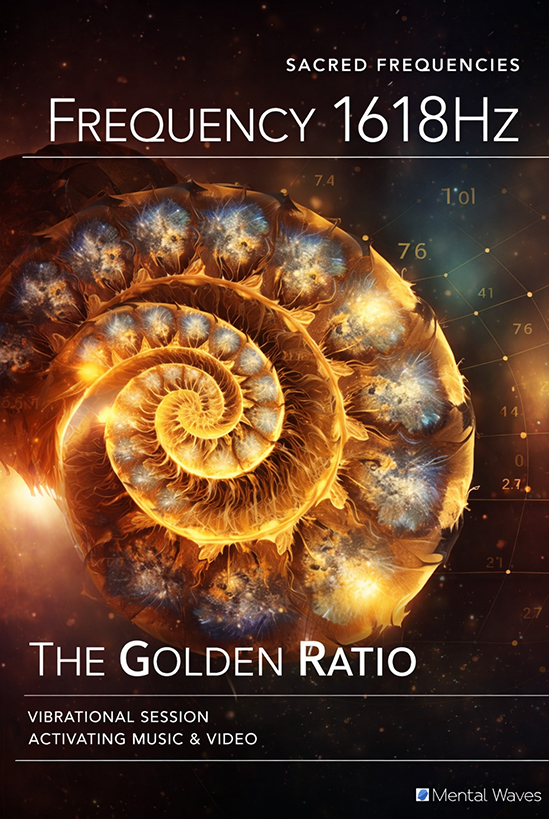
The Mental Waves 1618 Hz Frequency: The Golden Ratio program turns this symbolic association into a focused 20-minute sound protocol. Use it as a transition before meditation, creative work or a quiet reset—without asking the sound to force an outcome.
What science supports about sound and music generally
Research supports a measured statement: listening can interact with attention, emotion and physiological stress processes, but results vary with the music, timing, context and person.
For example, a randomized laboratory study by Thoma and colleagues assigned 60 healthy women to relaxing music, rippling-water sound or rest before a standardized stressor. The groups differed on some biological measures, and the music group showed faster recovery in one autonomic marker than the rest group. However, psychological measures did not differ, and relaxing music did not reduce the cortisol response. The study shows why broad claims need nuance: auditory conditions can matter, yet effects are neither simple nor uniform.
This research concerned a complete piece of relaxing music and comparison conditions—not 1618 Hz. It cannot establish what an isolated frequency will do, and it does not justify transferring a general music finding to a specific tone.
Experience 1618 Hz as a harmony ritual
1618 Hz is a listening experience designed to support inner alignment, vital energy flow, calm focus and creative harmony. Inspired by the golden ratio, the program uses harmonic proportion as a symbolic framework for bringing emotions, intentions and actions into greater coherence.
The experience comes from the complete composition: frequency, texture, repetition, attention and ritual working together to create a more receptive inner state. Rather than reducing the session to a number alone, approach it as a space for returning to your natural rhythm and listening more closely to your own perceptions.
How to listen to 1618 Hz safely
There is no scientifically established listening dose for 1618 Hz. Use comfort, overall sound level and total exposure as your guides.
- Begin at a low volume. Raise it only enough to hear the recording comfortably. Pitch does not need to be intense to be perceptible.
- Try a short first session. Five to ten minutes is a practical way to test comfort, not a therapeutic prescription. Continue only while the experience remains pleasant.
- Choose a safe setting. Sit or lie down somewhere you can relax. Do not use immersive audio while driving, cycling in traffic, operating machinery or doing anything that needs full situational awareness.
- Take listening breaks. Your total audio exposure across the day matters, not only the length of one meditation.
- Use headphones by choice, not necessity. Speakers are suitable for ordinary 1618 Hz audio. Headphones can reveal stereo detail but should remain comfortable and cleanly fitted.
- Stop when your body asks you to stop. Do not push through discomfort in pursuit of an effect.
The World Health Organization’s safe-listening guidance advises keeping personal devices at no more than 60% of maximum and, where monitoring is available, below an average of 80 dB. Its adult reference exposure is up to 40 hours per week at 80 dB, falling to four hours per week at 90 dB. These are upper safe-listening benchmarks, not targets. Quieter is better for a reflective session.
Stop listening if you notice pain, pressure, ringing, muffled hearing, dizziness, nausea, headache, agitation or another troubling response. Persistent tinnitus or a change in hearing warrants advice from a qualified hearing professional or clinician. If you have tinnitus, hyperacusis, sound-triggered migraine, a recent ear condition or personalized medical restrictions, follow professional guidance rather than a general online routine.
This article discusses wellness listening. It is not medical advice, and 1618 Hz audio is not a medical treatment or a substitute for appropriate care.
Is 1618 Hz a binaural beat or a brainwave frequency?
No. A 1618 Hz tone is an acoustic frequency heard as pitch. As described in Gerald Oster’s primary paper on auditory beats in the brain, a binaural beat is a different phenomenon: two nearby tones are delivered separately to the left and right ears, and the listener perceives a slow beat related to the difference between them. A single frequency label does not tell you that a recording contains binaural beats. Headphones are generally used when true left-right separation is part of the design.
EEG brainwave bands refer to patterns in the brain’s recorded electrical activity. Common clinical ranges include delta below 4 Hz, theta around 4–7 Hz, alpha around 8–12 Hz and beta around 13–30 Hz. Definitions can vary, but 1618 Hz is far outside these familiar EEG bands. It is an audio pitch, not a brainwave state. Read Brainwaves Explained for a fuller distinction.
Sharing the unit hertz does not make sound waves and EEG activity the same thing. Hertz simply counts cycles per second in both cases; what is cycling, how it is measured and what it means are different.
Experience 1618 Hz as a Mental Waves sound protocol
If this grounded approach resonates with you, 1618 Hz Frequency: The Golden Ratio offers an intentional listening experience inspired by this numerical association. The protocol uses frequency, harmony and focused repetition as structured sensory input for calm focus, inner alignment and meaningful listening—without promising a predetermined result.
The golden ratio can offer a beautiful frame. The listening itself remains immediate and human: sound, attention, breath and a little unhurried space.
Frequently Asked Questions about 1618 Hz
What is the meaning of 1618 Hz?
Physically, 1618 Hz means an acoustic vibration repeating 1,618 times per second. In frequency-based wellness audio, the number is also used as a creative reference to the golden ratio’s familiar approximation, 1.618. That association is symbolic and compositional, not proof of a biological effect.
Is 1618 Hz the golden ratio frequency?
It is often called a golden ratio frequency because 1618 resembles 1.618 after scaling the digits. The golden ratio is actually the unitless value phi, approximately 1.6180339887, while 1618 Hz is a physical frequency measured in cycles per second. There is no official scientific designation of 1618 Hz as the golden ratio frequency.
What are the claimed benefits of 1618 Hz?
Some listeners seek relaxation, focus, meditation support, sensory awareness or a stronger sense of ritual from 1618 Hz audio. These are possible subjective responses to the complete recording and listening context. They are not guaranteed outcomes or established medical benefits of the frequency itself.
Is 1618 Hz scientifically proven?
No unique clinical benefit or therapeutic effect of 1618 Hz has been scientifically established. Research on music and sound generally cannot be treated as proof for this exact frequency, and its numerical resemblance to 1.618 is not biological or neurological evidence.
How long should you listen to 1618 Hz?
There is no scientifically proven duration. For a first session, try five to ten minutes at a low, comfortable volume. Continue only while the audio feels pleasant, take breaks and stop if you notice pain, ringing, dizziness, headache or distress.
Do you need headphones for 1618 Hz?
No. Speakers can reproduce ordinary 1618 Hz audio, and headphones are optional unless the recording uses a channel-specific technique that requires left-right separation. If you use headphones, keep the fit and volume comfortable.
Is 1618 Hz a brainwave frequency?
No. In this context, 1618 Hz is an acoustic frequency heard as pitch. EEG brainwave bands describe much slower patterns in recorded electrical brain activity, commonly below about 30 Hz for delta, theta, alpha and beta. The shared unit does not make the phenomena equivalent.