en
enVotre panier est vide.


Neuroscience emerged at the crossroads of biology and medicine, shaped in part by the scientistic outlook of the nineteenth century, which tended to treat human behaviour as having no endogenous, self-generated cause. As knowledge and methods evolved, the field was transformed by contributions from chemistry, psychology, computing and physics. Modern philosophy also continued to influence the way the brain was studied, particularly through the rise of cognitive science and cognitive neuroscience. From the outset, then, neuroscience was never only a laboratory discipline; it was also a way of asking what kind of explanation human thought, emotion and behaviour might require.
In short: history of neuroscience and the brain
The history of neuroscience and the brain shows how human beings gradually moved from symbolic explanations to observation, anatomy and modern brain science.
Use this article as a practical map: keep what helps attention become steadier, question anything that sounds absolute, and connect the idea back to repeatable daily practice.
One of the clearest examples of this long dialogue between philosophy and brain science is the seventeenth-century search for a location of the soul within the brain. René Descartes famously argued that the pineal gland was its seat, reasoning that, unlike many brain structures, it did not appear to have a symmetrical counterpart in the other hemisphere. The terms of that debate now belong to another intellectual world, yet the underlying question has not entirely disappeared. The history of neuroscience is also a history of the ideas used to interpret the brain — and of the shifting scientific paradigms that continue to shape how consciousness, perception and mental life are understood.
How the Brain Gradually Became the Centre of Mind
From the heart to the brain
Today, it feels almost self-evident that damage to the brain can affect speech, movement, sensation or behaviour elsewhere in the body. Yet this idea took a very long time to emerge. For many centuries, mental life was commonly thought to reside not in the head but in the centre of the body, in the heart. Aristotle defended this view, whereas Hippocrates had already argued that thoughts, feelings and emotions were governed by the brain. Aristotle’s position, which we now know to be mistaken, remained influential for a remarkably long time. That persistence may partly reflect lived experience itself: intense emotion is often accompanied by a racing heart, while the brain, by contrast, seems strangely insensible.
Traces of this older worldview still survive in everyday expressions such as “You break my heart”, “a heart of stone”, or “learn by heart”.
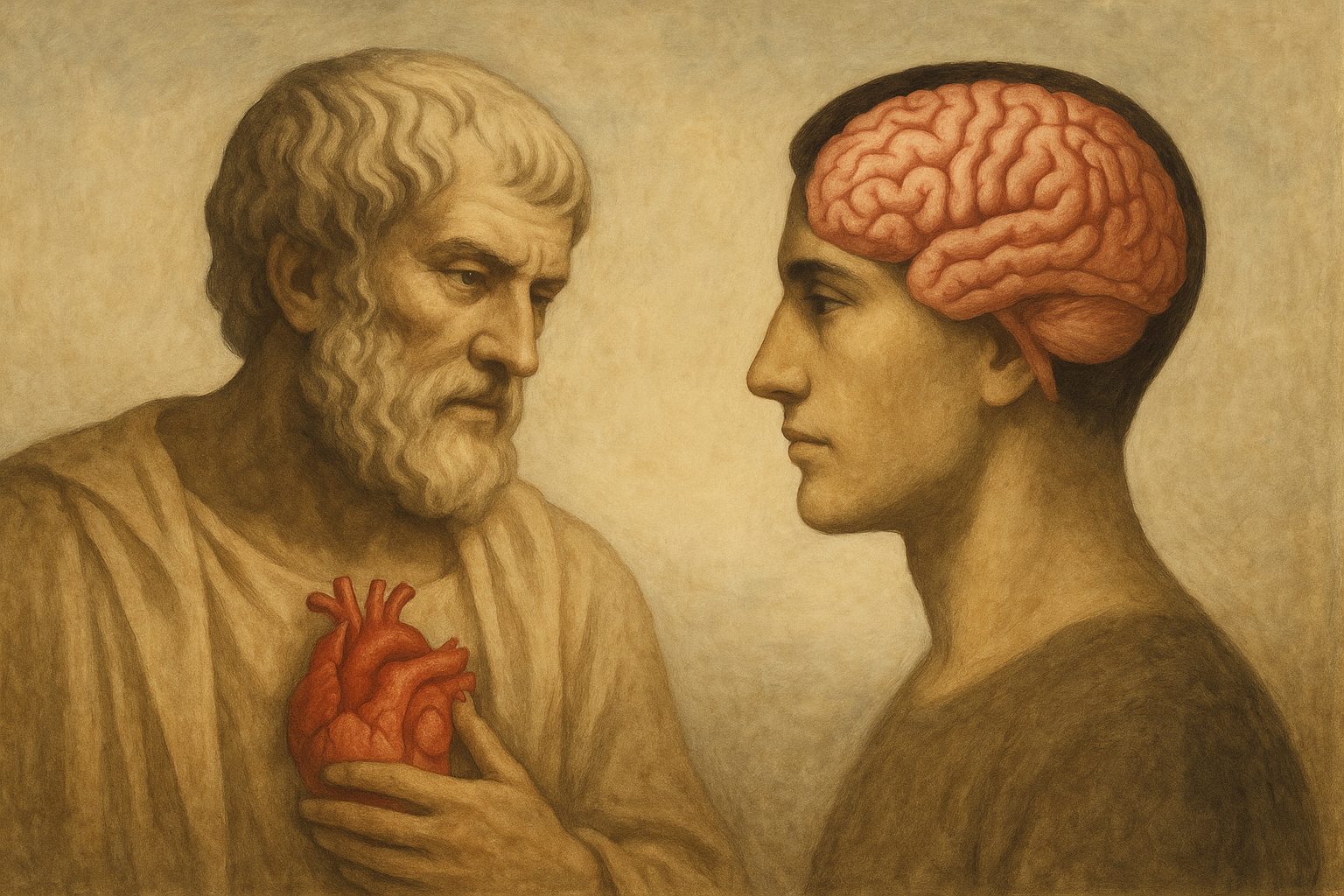
After the experimental work of Galen, however, it became increasingly difficult to deny that the seat of the “governing soul” lay in the brain. Even so, the centuries that followed brought fewer decisive advances than one might expect, despite lively debates about the uniqueness of the human mind and a revival of anatomical study from the sixteenth century onwards. In the seventeenth century, René Descartes argued that the soul belonged to a thinking substance, the res cogitans, fundamentally distinct from material substance, the res extensa. He famously used an anatomical argument to make the pineal gland the seat of the soul, noting that many brain structures appear in symmetrical pairs, whereas the pineal gland does not.
La Mettrie took the opposite path: he rejected the need for any bridge between mind and matter and treated the body as a machine in which the brain is the organ through which what we call the soul is expressed.
- Aristotle placed mental activity in the heart.
- Hippocrates argued that the brain governed thought and emotion.
- Galen’s experiments helped establish the brain as the commanding centre.
From speculation to modern neuroscience
A further turning point came at the start of the nineteenth century with the rise of phrenology. Although now discredited, it reinforced the idea that the brain was the active centre of knowledge and emotion. Debates over cerebral localisation set its supporters, including Gall and Broussais, against defenders of a more unitary view of brain activity such as Flourens. Phrenology was undoubtedly marred by fanciful claims, including the notorious idea of a “bump for mathematics”. Even so, it helped open the way to the first attempts to localise specific functions in the cortex, most notably Broca’s work on the brain areas involved in language, a key step towards what would later become cognitive neuroscience.
By the end of the nineteenth century, nearly every major development of the scientific revolution had begun to shape the study of the central nervous system. Advances in electromagnetism, organic chemistry and microscopy provided new tools and moved research beyond descriptive anatomy alone. A decisive breakthrough came with Golgi and Cajal’s identification of the cells of the nervous system, later called neurons, using a new staining technique that also made it possible to study their form, properties, functions and connections. From there, the field expanded rapidly: Sherrington described the operation of reflex systems, Sperry showed that the right and left hemispheres contribute differently to brain function, and Penfield mapped somatic sensation in the cerebral cortex.
During the twentieth century, neuroscience progressively naturalised subjects once treated mainly by philosophy of mind, including perception, language, emotion and intelligence. Neurophysiology produced major findings on dreaming through the work of Jouvet, while the emerging cognitive sciences drew on mathematical and cybernetic models and increasingly recognised the importance of emotion with Damasio, and of the environment with Changeux’s neuronal selection theories and Edelman’s neural Darwinism.
Strengthened by ever more powerful techniques such as microelectrodes, electroencephalography, X-ray imaging, positron cameras and MRI, and enriched by neighbouring disciplines including neurobiology, neuropsychology, cognitive neuroscience, physico-chemistry, genetics and embryology, neuroscience now seeks to describe even the most complex dimensions of mental life, including self-awareness and the relationship between the conscious and the unconscious.
Ancient Ideas About the Brain and the Birth of Anatomical Thinking
Why the brain was not an obvious candidate
In Antiquity, the brain was not immediately recognised as the seat of thought. Aristotle, for instance, saw it as a kind of radiator rather than the organ of the mind. His mistake becomes easier to understand when we consider the body as it appears to direct observation: the brain is indeed one of the most richly vascularised organs in the human body, and when exposed it seems far less sensitive to mechanical stimulation than the heart. In that context, linking emotion, vitality and inner life to the heart may have seemed more intuitive than placing them in a silent, apparently passive mass inside the skull.
It therefore took a genuine philosophical and scientific shift for the brain to be regarded as the centre of thought. On the philosophical side, Plato divided the soul into three parts, one of them immortal and located in the head. On the scientific side, Hippocrates, Herophilus and Erasistratus helped to deepen knowledge of human anatomy. Physicians gradually began to accept that damage to the brain could produce effects elsewhere in the body. Even so, this knowledge remained limited. Hippocrates, for example, wrote: “The brain is similar to a gland...
white and friable like it.” And Herophilus, despite his major contribution to the anatomy of the brain, still believed that all disorders of the human body ultimately arose from imbalances of the humours.
- Aristotle treated the brain as a cooling organ.
- Plato helped relocate part of the soul to the head.
- Hippocrates, Herophilus and Erasistratus advanced anatomical observation.
From the heart to the ventricles
Later thinkers no longer placed the mind in the heart, yet they still did not understand the brain in anything like modern terms. Augustine of Hippo (354–430), for example, accepted the central importance of the brain but located the mind within the empty spaces revealed by anatomy: the ventricles. These structures had already been described by Galen in the 2nd century. In the 5th century, Nemesius assigned a specific function to each of them: imagination and sensation to the front part, reflection to the middle part, and memory to the rear part.
This ventricular theory shows an important transition: the brain had become central, but its internal workings were still interpreted through speculative models rather than through a true physiology of neural function.
The real nature of the brain, and of its relationship with the rest of the body, therefore remained only partially understood. Still, it is important not to dismiss Antiquity too quickly. Anatomical knowledge of the brain progressed considerably during this period, even if explanation lagged behind observation. In Europe, it would not be until the 17th century that this level of understanding was decisively surpassed, thanks to the renewed practice of dissection after long restrictions linked to morality and the Church. In that sense, ancient thought did not solve the mystery of the brain, but it laid part of the groundwork on which later neuroscience would slowly be built.

Related offer
10 States of Consciousness - Infinity Elementary Pack
Elementary Infinity - The 10 States of Consciousness A unique sound box designed to explore the 5 states of...
View productFrom phrenology to the first functional maps of the brain
Early localisation theories, between intuition and error
In the eighteenth century, the neurologist Franz Joseph Gall proposed a theory of cerebral localisation that is now obsolete: phrenology. However flawed it was, it marked an important step in the history of ideas, because it treated the brain as the place where distinct mental functions might be organised. In the first half of the nineteenth century, François Broussais taught and extended this view after developing his own theory of the relations between “life” and “stimulus”, as well as the interdependence, or “sympathies”, between the body’s organs. These lines of thought also influenced Auguste Comte, who published a cerebral chart in his Système de politique positive in 1851.

Even so, these early attempts remained deeply imperfect. Phrenology encouraged the idea that mental capacities could be tied to specific brain regions, but it did so through claims that often drifted into fantasy. What matters historically is that it helped shift discussion away from vague speculation and towards the question of where functions might be situated in the brain. That question would remain central as research moved beyond broad philosophical systems and towards more careful observation of language, sensation and behaviour.
- Gall: early theory of localisation
- Broussais: stimulus, life and organ “sympathies”
- Comte: cerebral chart in 1851
Sherrington, Cajal and Penfield: the brain becomes a working system
By the beginning of the twentieth century, it had become clear that much remained to be understood about the way the brain governs language, a faculty so closely associated with human cognition. From 1906 onwards, Charles Sherrington described the body-brain relationship as a complex mechanism regulated by feedback loops. As he wrote, feedback allows the brain to assess a range of stimuli and produce an appropriate response. At the same time, Santiago Ramón y Cajal was studying the cellular structure of the brain. His work showed that nerve cells, later named neurons by Waldeyer, are the basic functional units of the nervous system and transmit nerve impulses without ever physically touching one another.
This led Cajal to formulate the neuron doctrine in 1891; later research would show that signals pass from one neuron to another across the synapse by means of neurotransmitters.
Between 1930 and 1950, the Canadian neurosurgeon Wilder Penfield pushed this movement further by refining knowledge of cerebral localisation through direct cortical stimulation during surgery. He carefully recorded patients’ responses to each stimulus, creating one of the first detailed functional maps of the cortex. These findings were famously summarised in the form of the motor and sensory homunculus. Taken together, the work of Sherrington, Cajal and Penfield helped transform the brain from a largely theoretical object into a system that could be studied through its circuits, cells and observable functions.
How Brain Science Moved from Abstract Models to Powerful Images
From cybernetic abstraction to an ‘iconophobia’ of the brain
This shift in representation echoes the ideas presented by Professor Dr Michael Hagner in Göttingen on 14 October 2005, in his lecture Ikonophilie und Ikonophobie in der Hirnforschung. Looking at the illustrations used in scientific books about the brain, he identifies a striking change across the second half of the twentieth century: researchers moved, broadly speaking, from a form of iconophobia to a form of iconophilia.
In the decades after the Second World War, cybernetics became a dominant framework for studying the brain. The brain was increasingly treated as a kind of calculating machine, at a time when computing itself was just emerging and basic logical operations seemed capable of explaining highly complex processes. By analogy, many researchers assumed that the brain must perform similar operations. As a result, brain research often focused on diagrams of logical circuits thought to underlie mental activity, while anatomical representations were reduced or left aside altogether. John von Neumann’s famous book The Computer and the Brain is a telling example: its frontispiece gives pride of place to the computer, with von Neumann himself off to one side.
In the same spirit, diagrams of connected neurons often looked less like histological plates than like schematics from electronics or formal logic. More broadly, biology has long oscillated between two ways of representing living systems: physiognomic images, which show what a structure is, and functional ones, which show what it does. Cybernetics in the 1940s and 1950s deliberately favoured the second. Much like behaviourism, it was less concerned with the nature of the system than with the operations it could perform.
- the brain as a calculating machine
- logical circuits rather than anatomy
- function privileged over form
The return of images and the caution they still require
This abstract style of representation also reflected a wider intellectual climate. In several fields, there was a marked suspicion of particularist or physiognomic approaches. In ethnology, for example, structuralism, associated above all with Claude Lévi-Strauss, became highly influential. Physiognomic representation had too often been used by sciences shaped by nationalism to rank peoples and living beings according to supposed superiority. Systematic abstraction, by contrast, aimed to resist such hierarchies, not only between human cultures but also, more broadly, between living beings and even between all structures capable of logical information processing.
Since the 1990s, however, brain research has seen a renewed authority of the image as scientific evidence. Modern brain imaging depends on highly technical procedures and complex computer processing, so the resulting scans are not direct windows onto mental life. Yet their apparent simplicity, their vivid colours and sometimes even their animated form give them a powerful persuasive force. In that context, the old computer–brain comparison has lost some of its influence within neuroscience, giving way to ideas such as self-organisation, plasticity and learning.
Related offer
Alpha states of consciousness
Easily reach the state of Alpha Brain Rhythm to reduce anxiety and stress, soothe pain, enter...
View productThere is an irony here: while neuroscientists have become less attached to the metaphor of the computer, computer science has increasingly tried to imitate the brain, through neural networks, artificial intelligence, learning machines and even the language of more ‘user-friendly’ systems. Even so, specialists remain cautious about this new iconophilia. Images can illuminate brain activity, attention and cognition, but they can also seduce too easily if they are treated as transparent proof. Neuroscience remains a fast-moving field, and the story of how we represent the brain is still unfolding.
The Mental Waves Brain History Framework
The Mental Waves frame is to see neuroscience as a long movement from speculation toward better observation. Each era added a tool, a language or a question that made the brain less mysterious without making it simple.
A useful reading of this history keeps curiosity and humility together: science advances, but the relation between brain, consciousness and lived experience remains a field of active inquiry.
If brain states and sound-based exploration interest you, receive the free 128 Hz sacred frequency session and use it as a calm listening experiment.
Editorial note from Mental Waves
This article is historical and educational. It does not reduce consciousness to a single mechanism or use neuroscience as a medical diagnosis.
Conclusion
The history of neuroscience is not a simple march from error to truth. It is a slower, more revealing shift in how human beings have tried to understand thought, emotion and consciousness: first through philosophy, then through anatomy, then through increasingly refined methods of observation. What emerges is a discipline shaped as much by its tools as by its questions, moving from the heart, the ventricles and the “seat of the soul” towards neurons, networks, localisation, plasticity and brain imaging. Each step clarified something real, even when the wider theory was incomplete or mistaken.
That is perhaps the most useful perspective to keep: neuroscience has advanced by correcting its own images of the brain, not by escaping interpretation altogether. From phrenology’s partial intuitions to the authority now granted to colourful scans, the field reminds us that evidence always needs framing, caution and thought. The brain may now be studied with extraordinary precision, but it still resists reduction to any single model — machine, map or picture. And that tension is not a weakness of the field; it is part of what keeps it alive.
Frequently Asked Questions About the History of Neuroscience and the Brain
Why was the heart once seen as the centre of thought and emotion rather than the brain?
For many centuries, the heart seemed the more obvious candidate because strong emotions are often felt physically in the chest, while the brain appears strangely insensitive. Aristotle defended this view, and it remained influential for a long time. That older belief still survives in everyday expressions about heartbreak, memory and feeling.
What role did Hippocrates and Galen play in changing ideas about the brain?
Hippocrates argued early on that thoughts, feelings and emotions were governed by the brain rather than the heart. Galen’s experimental work later made it much harder to deny that the brain was the commanding centre of the body. Together, they helped shift thinking away from the heart and towards the head.
Why did Descartes link the soul to the pineal gland?
Descartes chose the pineal gland because he believed it was unlike many other brain structures that appear in symmetrical pairs. He treated it as a possible meeting point between the thinking soul, or res cogitans, and the material body, or res extensa. This reflected his wider attempt to keep mind and matter distinct.
How did La Mettrie differ from Descartes in his view of the brain and the soul?
La Mettrie rejected the need for a separate bridge between mind and matter. Instead of treating the soul as something distinct that had to connect to the body, he saw the body as a machine and the brain as the organ through which what people call the soul is expressed. His view was far more materialist.
Was phrenology completely useless to the history of neuroscience?
No, although phrenology is now discredited and included fanciful claims such as a supposed 'bump for mathematics', it still helped establish the idea that different functions might be linked to different parts of the brain. That question of localisation later fed into more serious work, including Broca’s research on language areas.
What made the late nineteenth century such an important period for brain science?
New tools transformed the field beyond descriptive anatomy alone. Advances in electromagnetism, organic chemistry and microscopy gave researchers better ways to study the central nervous system. A major breakthrough came when Golgi and Cajal used staining techniques to reveal nerve cells, opening the way to detailed study of neurons and their connections.
Why are Cajal, Sherrington and Penfield so important in the history of neuroscience?
Cajal helped establish that neurons are the basic functional units of the nervous system, while Sherrington described reflex systems and feedback mechanisms linking body and brain. Penfield then mapped functions in the cortex through direct stimulation during surgery, summarising his findings in the motor and sensory homunculus.
What was the ventricular theory of the mind in late Antiquity?
The ventricular theory placed mental functions not in the brain tissue itself but in its internal cavities, the ventricles. Augustine of Hippo accepted the brain’s central role in this sense, and Nemesius later assigned different functions to different ventricles: sensation and imagination to the front, reflection to the middle, and memory to the rear.
How did cybernetics change the way scientists represented the brain after the Second World War?
Cybernetics encouraged researchers to treat the brain as a calculating machine and to focus on logical operations rather than anatomy. Diagrams often resembled electronics or formal logic more than biological structures. This approach favoured functional representations of what the system does, while giving much less attention to what the brain physically is.