en
enVotre panier est vide.


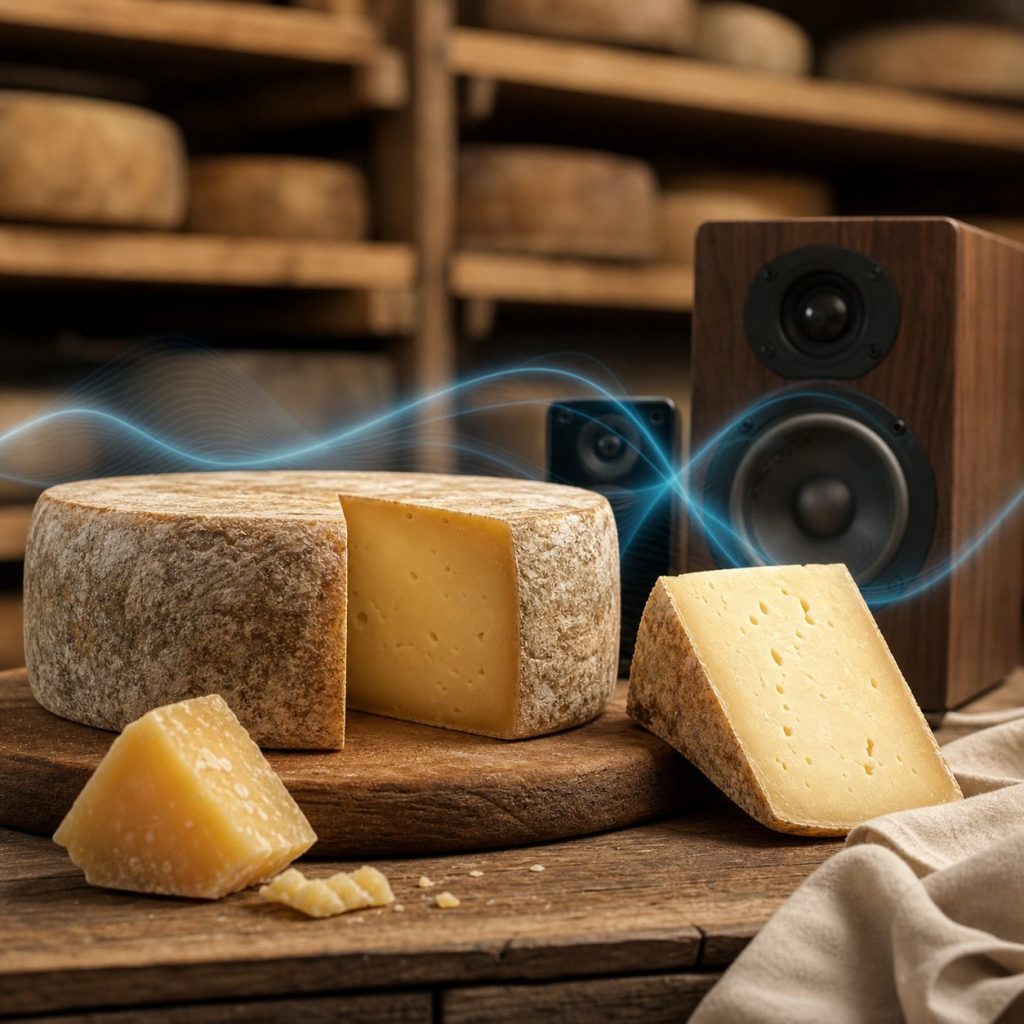
Good cheese is usually shaped by familiar variables: temperature, time, humidity and the slow work of bacteria during maturation. Yet one Swiss experiment has drawn attention for a far less expected factor: sound. More specifically, it explored whether music might influence the ageing process of cheese itself, and in turn alter its flavour, aroma and texture.
In short: music improve cheese ripening
The idea that music could influence cheese ripening is surprising, but it opens a useful conversation about vibration, environment and careful interpretation.
Use this article as a practical map: keep what helps attention become steadier, question anything that sounds absolute, and connect the idea back to repeatable daily practice.
The idea may sound eccentric at first, but the question behind it is more concrete than it seems. In western Switzerland, cheesemaker and affineur Beat Wampfler worked with the Bern University of the Arts to test whether different sound vibrations could affect wheels of Emmental as they matured over several months. Rather than treating music as a novelty, the project placed it within a more serious line of enquiry about resonance, fermentation and the behaviour of living cultures—raising a simple but intriguing possibility: if bacteria respond to their environment, might sound be one influence among others?
That question matters because cheese is not an inert product while it ages. It is a dynamic microbial environment in which texture, aroma and flavour emerge gradually through biochemical change. In that sense, the experiment sits at the meeting point of craft practice and material science: it asks whether an acoustic environment, like temperature or humidity, may subtly shape the conditions in which maturation unfolds.
How Beat Wampfler Turned Cheese Ageing into an Acoustic Experiment
A Swiss cheesemaker’s unusual hypothesis
We often say that music can soothe people, but it is far less intuitive to imagine that it might also influence the taste of a cheese. That unlikely idea is precisely what led Beat Wampfler, a cheesemaker and affineur based in western Switzerland, to explore a possible link between sound and maturation. Convinced that acoustics might play a role in the ageing process, he partnered with the Bern University of the Arts to test the theory in a more structured way.

The project, titled “Sonifying Cheese: Between Acoustics and Gastronomy”, began in August 2018. It focused on 40 cm wheels of Emmental, each placed in a wooden crate and exposed continuously to sound for nearly eight months. One wheel was left without any sound exposure to serve as a reference point. The musical selection was deliberately varied, ranging from Mozart to techno and rock, alongside simple sound waves, so that the team could compare how different acoustic environments might affect the same cheese.
- Location: western Switzerland
- Partner: Bern University of the Arts
- Cheese used: 40 cm wheels of Emmental
- Ageing period: nearly eight months
What makes the design interesting is its attempt to isolate one unusual variable without abandoning the practical realities of affineur work. The cheeses were not treated as abstract laboratory samples alone; they remained part of a recognisable maturation process, with sound introduced as an additional environmental condition. That gives the project a hybrid character: not a full industrial trial, but more than a simple publicity gesture.
It also helps explain why the experiment attracted attention beyond specialist food circles. Food producers have long adjusted airflow, cellar conditions and handling methods to refine a product’s final profile. Introducing music into that list may seem surprising, yet the underlying logic is familiar: if maturation depends on a sensitive balance of physical conditions, then vibration may be worth testing rather than dismissing outright.
What sonochemistry may reveal about maturation
The approach used in the experiment is referred to as sonochemistry, the study of how sound vibrations act on matter. In this case, the underlying idea was not that music would magically transform the cheese, but that the bacteria involved in fermentation may respond to vibrations. If that is the case, then the resonance patterns produced by different kinds of music could influence the way the cheese develops during ageing.
That hypothesis remains striking, but it is not entirely detached from a scientific way of thinking. Cheese maturation depends on a delicate balance of time, temperature and microbial activity. Wampfler’s conclusion was that sound may be one more variable within that environment, acting on the fermentation process through vibration rather than through any symbolic or emotional effect of music itself. In other words, the quality of the ageing may depend, at least in part, on how these bacteria react to different sonic frequencies and resonances.
To put it more carefully, the relevant factor is not “music” in the cultural sense, but the physical structure of sound: frequency, amplitude, rhythm and resonance. Bacteria do not listen in the way humans do, and there is no reason to assume anything like aesthetic appreciation. What may matter instead is whether repeated vibrations alter the micro-environment around the cheese, influence molecular movement, or affect the activity of microbial communities involved in fermentation.
This distinction is important because it keeps the discussion grounded. The experiment does not suggest that a cheese somehow prefers hip-hop or Mozart in a psychological sense. Rather, it raises the possibility that different acoustic signatures may create slightly different physical conditions during ageing. In food science, small shifts in microbial behaviour can sometimes lead to noticeable sensory differences later on, especially over long maturation periods.
At the same time, caution remains essential. A project of this kind can point towards a plausible mechanism without fully proving it in all its details. To establish a robust causal account, researchers would need repeated trials, tighter controls and microbiological measurements capable of showing exactly how sound exposure changes fermentation over time. Even so, as an exploratory study, it offers a credible starting point for further work.
What the tasting revealed about music and flavour
Why the hip-hop cheese stood out
After eight months of ageing, the Emmental wheels exposed to different sound environments were assessed by an expert tasting panel. Their verdict was striking: the cheeses showed clear sensory differences, to the point that the jurors could almost have doubted they had all started from the same base. This was the most compelling part of Beat Wampfler’s experiment, because it suggested that sound may do more than create an unusual ageing ritual; it may also influence how a cheese develops in terms of aroma, texture and overall flavour profile.

Related offer
Mental Dynamism and Good Mood
The action of our audio recording affects the limbic system, where our emotional keyboard is located. The...
View productAmong all the samples, the cheese matured with hip-hop stood out most clearly. According to the conclusions reported by the Bern University of the Arts, it proved “particularly fruity, both in smell and in taste”. One possible explanation put forward in the project is that the lower frequencies typical of hip-hop may have encouraged softer, more floral notes to emerge during maturation. By contrast, the wheel exposed to Mozart was described as more balanced. These observations do not mean that one genre is universally “better” than another, but they do suggest that different acoustic environments may be associated with distinct sensory outcomes.
- Hip-hop was judged the most fruity in both aroma and taste.
- Its lower frequencies were linked to softer, more floral notes.
- Mozart appeared to produce a more balanced flavour.
From a sensory perspective, this is where the story becomes especially compelling. Taste is never just one thing: it is an integration of aroma, mouthfeel, texture, persistence and retronasal perception. When tasters describe a cheese as fruitier or more balanced, they are often reporting a complex overall impression rather than a single isolated property. If sound exposure altered microbial activity even slightly, that could plausibly affect several dimensions of the final tasting experience at once.
The prominence of hip-hop in the results has often been repeated because it is memorable, but the more meaningful point is methodological. Different sound profiles appeared to correlate with different outcomes, which suggests that the acoustic environment may matter in a differentiated way rather than as a simple on/off effect. In other words, the question is not merely whether sound changes cheese, but whether specific frequency ranges and patterns of vibration may shape maturation differently.
That said, sensory evaluation always requires nuance. Expert juries are valuable because trained tasters can detect subtle distinctions that casual consumers may miss, yet tasting still involves perception and judgement. For that reason, the findings are best read as strong indications rather than absolute proof. They become more persuasive when combined with the broader logic of fermentation science, but they still invite replication.
What this could mean for gastronomy beyond cheese
The experiment also points to a broader idea: music and gastronomy may interact in more creative ways than we usually assume. In that sense, Wampfler’s work is not just a curiosity. It opens up new possibilities for cheesemakers, affineurs and food producers interested in refining flavour through controlled environmental factors, including sound. The Bern University of the Arts even suggested that such an approach might help shorten the ageing period, which could in turn reduce production costs. That remains a promising avenue rather than a settled industrial rule, but it shows why the project attracted attention beyond the world of artisan cheese.
More broadly, sonochemistry is not being explored only in dairies. In the United States, the heavy metal band Metallica has also used this principle in the production of Bourbon whisky. That comparison helps place the cheese experiment in a wider context: sound is increasingly being treated not simply as something we hear, but as a physical stimulus that may interact with matter in subtle ways. Even so, caution is important. The results are intriguing and concrete, yet they are best understood as an invitation to further investigation rather than as final proof that music alone can transform every food product.
For gastronomy, the implications are both practical and conceptual. Practically, producers are always looking for ways to guide maturation with greater precision while preserving quality and distinctiveness. Conceptually, the experiment reminds us that flavour is shaped by processes that begin long before tasting. What reaches the palate is the end result of a chain of interactions involving microbes, chemistry, time and environment. Sound may become part of that chain in some contexts, even if its role remains modest and highly specific.
There is also a cultural dimension worth noting. Contemporary gastronomy increasingly values multisensory thinking, often focusing on how sound influences the diner’s perception during a meal. This experiment shifts the emphasis upstream, towards production rather than consumption. Instead of asking how music changes what people think they taste, it asks whether vibration may change the product before anyone tastes it at all. That is a more demanding and more scientifically interesting question.
If future studies support these early observations, sound-based ageing could become a niche but meaningful tool in artisan and experimental food production. It is unlikely to replace established expertise in maturation, and it should not be treated as a miracle shortcut. Yet as a supplementary variable—carefully controlled, measured and adapted to specific products—it may offer producers another way to shape sensory character with intention.
The Mental Waves Sound Environment Framework
The Mental Waves frame is to take sound seriously without turning every result into a universal rule. Sound creates vibration, context and rhythm, but each environment responds in its own way.

Related offer
Meditation - Relaxation set
All the Mental Waves® know-how in a single pack for quick and easy access to meditation and...
View productFor humans, the lesson is not that music controls matter, but that acoustic environments deserve attention. Listening conditions can shape mood, focus and ritual, even when the mechanism remains complex.
If this kind of sound experiment makes you curious, receive the free 128 Hz sacred frequency session and explore frequency listening from a grounded perspective.
Editorial note from Mental Waves
This article discusses a sound-and-food experiment for curiosity and education. It does not claim that music reliably changes food safety, nutrition or human health outcomes.
Conclusion
What makes this experiment so compelling is not simply its novelty, but the more careful idea beneath it: cheese ageing is a living process, shaped by time, environment and microbial activity, and sound may be one more variable within that delicate balance. The results do not justify sweeping claims, yet they do suggest that vibration and frequency can influence maturation in ways that are perceptible in taste, texture and aroma.
The hip-hop result, with its fruitier and softer profile, gives the story its memorable edge, but the deeper point is broader than any single genre. This is less about turning music into a miracle ingredient than about recognising how sensory environments can interact with biological processes. In that sense, the study opens an intriguing space between craft, acoustics and food science, where curiosity remains just as important as certainty. Sometimes, innovation begins with listening more closely.
Seen in that light, the experiment is valuable even if its conclusions remain provisional. It encourages a more attentive view of material processes: the idea that what seems peripheral in one context may prove influential in another. For researchers, that means designing better studies. For producers, it means remaining open to unconventional variables without abandoning rigour. And for the wider public, it offers a rare example of how an apparently whimsical idea can still lead to a serious scientific question.
FAQ: Can music really change the way cheese matures?
Who carried out the cheese and music experiment?
Beat Wampfler, a cheesemaker and affineur based in western Switzerland, led the experiment with the Bern University of the Arts. He wanted to test whether sound and music could influence the maturation of cheese in a measurable way.
What exactly was tested during the experiment?
The test used 40 cm wheels of Emmental placed in wooden crates and exposed continuously to different sounds for nearly eight months. One wheel was left without sound as a reference, allowing the team to compare the effects of different acoustic conditions.
What kinds of music were used to mature the cheese?
The sound selection was deliberately varied and included Mozart, techno, rock, hip-hop and even simple sound waves. This made it possible to observe whether different frequencies and musical styles were linked to different results in the cheese.
How could music affect cheese in the first place?
The proposed mechanism involves vibration rather than any emotional effect of music. The idea is that the bacteria responsible for fermentation may react to sound waves, and that these reactions could influence how the cheese develops during ageing.
What is sonochemistry in this context?
Sonochemistry here refers to the study of how sound vibrations act on matter. In cheese maturation, it was used to explore whether acoustic resonance could affect fermentation and, in turn, alter flavour, aroma or texture over time.
Did the cheeses actually taste different after being exposed to music?
Yes, the expert tasting panel found clear differences between the cheeses after eight months. The variations were pronounced enough that the jurors felt the samples no longer seemed like identical cheeses that had simply started from the same base.
Which type of music produced the most noticeable result?
Hip-hop stood out most clearly in the tasting. The cheese exposed to it was described as particularly fruity in both smell and taste, with lower frequencies thought to be linked to softer, more floral notes.
How did the cheese exposed to Mozart compare?
Mozart was associated with a more balanced flavour profile. That does not mean it was definitively better than the other samples, but it suggests that different musical environments may shape maturation in distinct ways.
Could this approach have practical uses beyond an unusual experiment?
It may have practical potential, although the idea remains exploratory. The Bern University of the Arts suggested that sound-based maturation could possibly shorten ageing time and reduce production costs, while also opening new creative possibilities in gastronomy.